
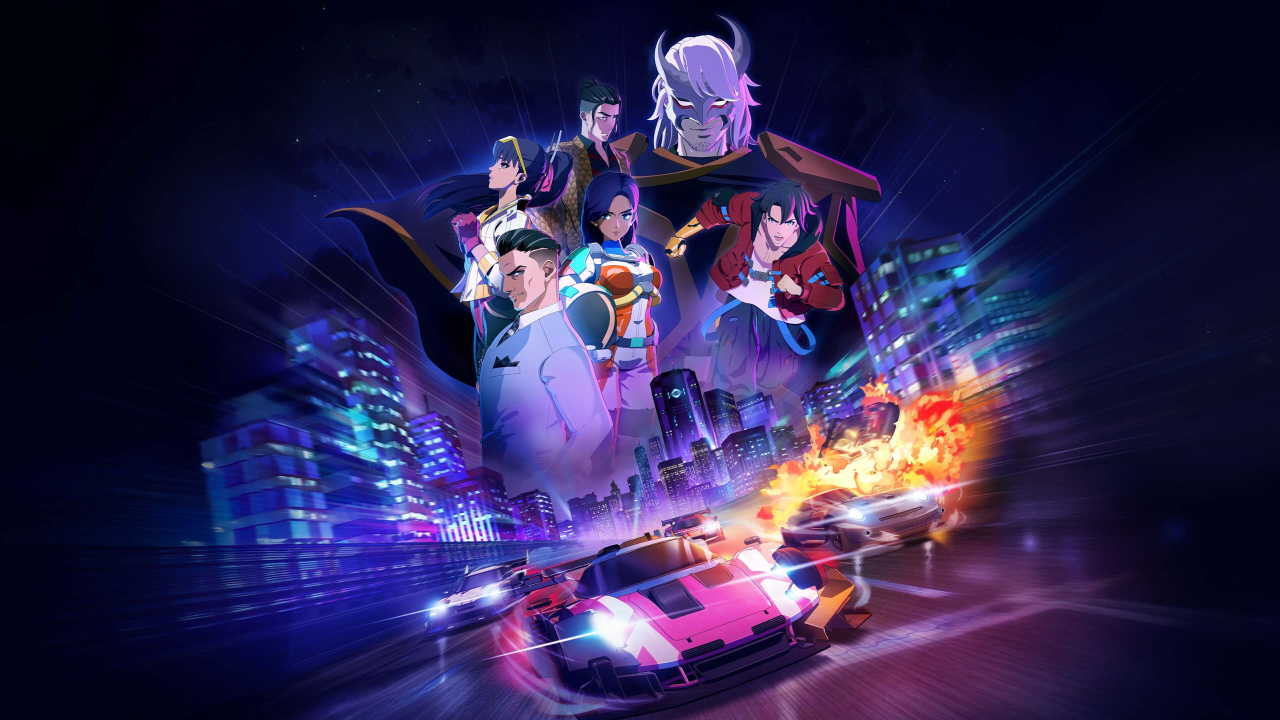
REVIEW – Screamer has no interest in living off nostalgia, and it definitely does not pretend we are still stuck in the mid-1990s. Milestone takes the old name, throws it into a neon-soaked cyberpunk pileup built around anime theatrics and demolition racing, then floors the accelerator. The result is a racing game that sometimes talks too much and sometimes reaches too far, but when it finally shuts up and lets the cars do the work, it can hit surprisingly hard.
This version of Screamer is not the one older players will remember from decades ago. Milestone did not want to dust the brand off and coast on recognition, but to give it a completely different identity with futuristic tracks, anime-style drivers, a story-heavy structure, and races where the point is not taking the cleanest line but figuring out when to shove somebody out of yours. In that sense, it does bring back memories of the way Bugbear tore apart and rebuilt the Ridge Racer formula for Unbounded, except this time the result feels more confident and far easier to like. The real question is whether players are willing to accept that this Screamer is not trying to impersonate the old one, but to become something else entirely.

In Neo Rey, the Corners Are Not the Most Dangerous Part
The whole thing unfolds in Neo Rey, which is not exactly the most imaginative name in the world, but the city itself has more variety than the title suggests. You are not only blasting through neon-lit urban circuits, but also tearing across deserts, wooded stretches, and environments with enough visual contrast to keep the cyberpunk look from turning into one long glowing blur. The presentation is genuinely strong, not just because it is pretty, but because it has movement, color, and actual energy in motion. Neo Rey does not feel like wallpaper. It feels like a playground built for bad decisions at full throttle.
Since this is a dystopia, the place is obviously rotten to the core, and the game does not waste much time pretending otherwise. That becomes clear the moment you realize you and the rest of the drivers have entered a tournament where billions of dollars are up for grabs and the fastest route to victory involves smashing the competition apart with your own vehicle. A shadowy Mr. A is pulling the strings behind it all, gathering the racers known as Screamers and setting the whole spectacle in motion. Because the story runs on money and revenge, sportsmanship here is worth about as much as a paper cup in a flamethrower fight. Cash matters more than anyone’s health, and revenge only poisons the mix further, especially after Quinn Connolly’s death sends the Green Reaper crew clean over the edge.

Whenever the Cast Finally Shuts Up, the Game Gets Better
The characters are not exactly gifted with the instinct to stop talking. Cutscenes are packed with constant chatter, posturing, arguing, and melodrama, and while some of it does serve the story, the endless conversations start chewing through your patience after a while. Even when something important is happening, all that back-and-forth has a bad habit of kneecapping the momentum. Screamer is at its best when it stops trying to explain why it should matter and simply lets the racing and the chaos make the point for it.
One genuinely smart touch is the multilingual cast, with French, Japanese, and other languages popping up throughout the story. From a logic standpoint, it sometimes stretches credibility to the point of comedy, because it is not always clear how these people are supposed to understand one another without a translator in the room, but it does add flavor. It helps Screamer stand apart from the endless line of polished, interchangeable racing games that all feel assembled from the same parts bin. That also sums up the broader package: anime hotheads, revenge drama, cyberpunk shine, and racing built around destruction rather than restraint. Screamer is not subtle. It wants to leave a mark by yelling, and more often than not, it gets the job done.

The Campaign Runs Long, and Patience Only Holds So Much Fuel
The backbone of the game is Tournament Mode, where races and story scenes keep trading places. Early on, you are eased into the basics through simple objectives that teach you how to drift, how Overdrive works, and when to use the more aggressive tools at your disposal. Later events become more involved, and moving the story forward usually means finishing in at least the top three. The difficulty options are flexible enough that most players should not hit an absolute wall. The tradeoff is that the campaign is pretty lengthy, so you need to settle into its rhythm if you want to get the most out of it.
Screamer does a decent job bouncing between story beats and racing, but the cutscenes often run too long and throw off the pacing. When you are in the mood to race, sitting through another round of pointless bickering is not exactly ideal. Yes, you can skip them, but that does not really fix the underlying problem that the storytelling is too talkative for its own good. With less yapping and more scenes that actually punch, it would be much easier to get fully invested.

Drifting Is the Bread, Overdrive Is the Molotov Cocktail
Once you are actually on the track, though, Screamer grabs its authority right back. Everything glows, everything moves, everything looks like it was designed specifically to trick you into saying “one more race” at two in the morning. There is not much time to admire any of it, however, because the pack is usually swarming ahead of you and your first job is to bulldoze a path toward the front. Thankfully, the game does not hand you polite little nudges to do that. It gives you an arsenal.
Before the truly wild stuff opens up, though, you need to get comfortable with drifting. Here it is mapped to the right stick, and when you nail it, each corner can spit you back out with such a satisfying burst of speed that sliding starts to feel automatic. That said, several tracks are tight enough that a stylish drift can instantly turn into a ridiculous wall kiss if you are careless. Downtown Run looks fantastic, but its twisting streets and outer barriers leave very little room to work with, especially once the rest of the Screamers start breathing down your neck.
High-speed arcade racing would not amount to much without some kind of boost system, and Screamer tries to add a little more flavor than usual here as well. One shoulder button brings up a small triangular mechanic where the outer edge gives you a regular flame-fueled burst, while the inner triangle rewards precise timing with a hotter, electrically charged kick. That runs on a sync meter filled through drafting, drifting, and clean momentum-building. Even that is fun, but Overdrive is where things really get unhinged, landing with the force of Zeus throwing a lightning bolt at the circuit. It does not just launch you forward, it can scythe straight through rivals, too, though it has to be used with care because a badly timed activation can leave your own car blown to pieces first. On top of that, there is Strike, which burns two chunks of the entropy gauge. It is not as dramatic as Overdrive, but it works nicely as a middle ground between ordinary boosting and full-blown vehicular mayhem.
No Shortage of Content, and Even Less Fear of Looking Silly
Outside Tournament Mode, Screamer piles on a surprisingly generous set of solo and multiplayer options. There are score challenges, time trials, Overdrive events, and an Arcade Mode where you can race alone or go into team-based chaos. In raw content terms, it easily outmuscles quite a few other racing games. On that front, it is hard to complain much at all.
Of course, there will be people who hate how radically Screamer has broken from the classics of the mid-1990s. The track design is more involved, the driving is built less around clean lines and more around destruction, and the whole presentation has been pushed so far that apart from the name, it barely resembles what came before. Honestly, though, there is no point sulking about that. This is not change as an excuse. It is change as a working design choice, and by its own rules the game absolutely gets where it wants to go.
The soundtrack deserves special credit, because the mix of electric punk, emo flavor, and rock pulse clicks together far better than expected with the anime attitude and the meteor-strike pace of the racing. Musically, Screamer knows exactly what kind of beast it wants to be. The voice work and script are not as sharp, even if the cast is clearly trying hard to be memorable. Taken as a whole, though, the game feels like a message from an older era, back when racing games were still willing to experiment with loud, oversized, slightly ridiculous ideas. That is rare on PS5, which is exactly why what Milestone has built here feels refreshing. Tournament Mode is too long, the cutscenes drag their heels, and the whole thing is not quite as immediately welcoming as the games it borrows energy from, but Screamer works hard to stay in your head. Thanks to its range of modes, its strong presentation, and its love of destruction-first arcade chaos, it mostly succeeds.
-Gergely Herpai “BadSector”-
Pros:
+ Flashy, aggressive racing with excellent drifting, a strong boost system, and a brutally satisfying Overdrive mechanic
+ A sharp audiovisual identity, with anime energy, neon-soaked tracks, and a soundtrack that lands far better than expected
+ A genuinely generous amount of modes and content across both single-player and multiplayer play
Cons:
– Tournament Mode runs too long, and the cutscenes frequently beat the pacing to death
– The story and its endless dialogue often want to seem more interesting than they really are
– Players attached to the old Screamer formula may find this anime-cyberpunk demolition derby a bridge too far
Publisher: Milestone S.r.l.
Developer: Milestone S.r.l.
Genre: arcade action racing game
Release: March 26, 2026
Screamer
Gameplay - 7.8
Graphics - 8
Story - 6
Music/audio - 7.4
Ambience - 6.8
7.2
GOOD
Screamer is not a careful revival. It is a full rewiring job, and for the most part it works. The campaign goes on too long and the talking gets old fast, but once the neon-soaked demolition racing kicks into gear, the game is very much alive. It is messy, loud, and occasionally dumb in exactly the right way, which already makes it more interesting than most of its competition.













![Dexter Returns in the First Look at Dexter: Resurrection Season 2 [VIDEO]](https://thegeek.games/wp-content/uploads/2026/07/theGeek-Dexter-Season-2-300x365.jpg)

Leave a Reply