
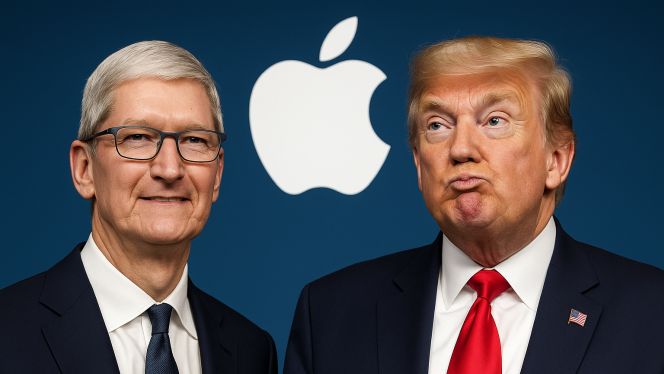
TECH NEWS – A deal may have been made that undercut TSMC’s price by 25%, bringing the two American companies together.
Whatever one may think of Trump, it is clear that he is a master at shaping narratives. And it seems the president played a significant role in convincing Apple to agree to an Intel deal, one that could bring major short- and long-term benefits to the Cupertino tech giant. According to the Wall Street Journal, Apple has reached a preliminary agreement with Intel regarding chip manufacturing. Although the details of the agreement are not yet known, it will probably resemble Apple’s arrangement with TSMC, under which Apple designs custom chips based on ARM intellectual property, while TSMC manufactures them on its advanced production lines.
It is still unclear exactly which Apple products will receive chips from Intel. In any case, Apple will likely use Intel’s 18A-P technology for its lowest-end M-series chips, which are expected to reach the market in 2027, as well as for non-Pro iPhone chips in 2028, according to information from GF Securities and DigiTimes a few months ago. Apple has reportedly obtained PDK samples from Intel to evaluate its 18A-P manufacturing process. GF Securities also believes that Apple’s upcoming ASIC, codenamed Baltra and expected in 2027 or 2028, will use Intel’s EMIB packaging technology.
Given that Apple is currently facing shrinking margins after asking TSMC to restart production of A18 chips for the current-generation MacBook Neo, it makes complete sense for Apple to power the next-generation MacBook Neo with Intel Core Series 3 chips, codenamed Wildcat Lake. Of course, in the absence of official confirmation, these possible moves remain firmly in the realm of speculation.
According to the Wall Street Journal, Trump played an important role in selling the possible deal to Apple CEO Tim Cook after stating during a meeting that he liked Intel and that the government had made tens of billions of dollars from its stake in the chipmaker. Even from a purely economic standpoint, this deal makes almost too much sense for Apple. Intel’s 18A silicon wafers are reportedly priced 25% lower than what TSMC charges for its 2 nm wafers. This could give Apple considerable breathing room amid current memory chip inflation. The deal partly neutralizes Apple’s supply chain and tariff risks while weakening TSMC’s ability to set monopolistic prices.
Of course, everything depends on the stability of Intel’s 18A process.













Leave a Reply