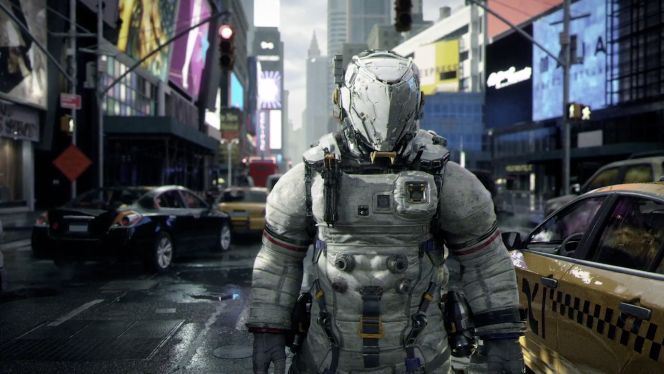
It is not a criticism of Capcom’s developers that their game is being compared to countless titles released two console generations earlier.
If you have played Pragmata, there is a small chance you noticed how much it resembles an action game you might have seen on PlayStation 3 or Xbox 360. While developers would have considered this an insult ten years ago, these days, it is not. In fact, the similarity appears to be a key factor in Pragmata’s commercial success. The developers were thrilled that players drew this parallel.
In an interview with GamesRadar, Pragmata director Cho Yonghee and producer Naoto Oyama were asked about players comparing their sci-fi adventure to the golden age of third-person shooters. They seemed to smile with delight even before the Japanese interpreter finished translating the question. However, neither developer confirmed that the era of cover-based shooters and chainsaw bayonets served as direct inspiration. According to Oyama, the comparison arises because the PS3/X360 era represented a period of innovation.
“The dev team has heard similar comments from reviewers and players alike. Honestly, it is a huge compliment. I enjoyed games during the PS3 and Xbox 360 era as well as before that, so to hear that it has a similar feel is basically an honor and a huge compliment. I appreciate the sentiment,” said Cho. “Maybe people feel that way because during the PS3 and Xbox 360 era, many developers and publishers were experimenting with new types of games. Maybe that is what causes people to feel that way. The Pragmata dev team put a lot of passion into creating something new as well,” Oyama added.
We believe this has more to do with the fact that Oyama and Cho created a linear, single-player action game that does not engage players for too long. They did so at a time when such games had all but disappeared, though a few similar titles were released this year, such as 007 First Light and Capcom’s Resident Evil Requiem. Both games sold extremely well, further reinforcing the idea that players long for the days when AAA games were bold, brash, and relatively short.
Of course, this does not mean that Pragmata lacks new ideas.
Source: PCGamer, GamesRadar