
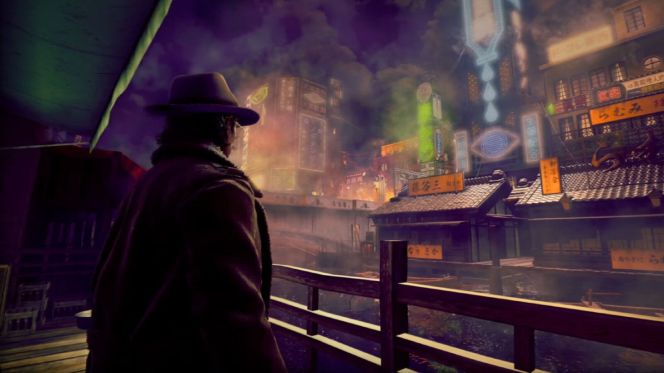
Ryu Ga Gotoku Studio’s game focuses on the controller’s shoulder buttons. Stamina-based counterattacks have replaced Heat moves.
The Stranger Than Heaven demo, which was presented at Summer Game Fest, focused exclusively on combat across three different eras of Japanese history. There were no side missions or detours, just a man, a hammer, and a plan. An interesting narrative twist is that the characters age as the story progresses. Ryu Ga Gotoku Studio has clearly spent a lot of time creating realistic cities, each of which feels as though it belongs to its own distinct era. What the studio hasn’t mentioned yet is the connection between Stranger Than Heaven and the fate of Kazuma Kiryu in Kamurocho. Hints have been dropped in previous trailers and gameplay demos. It wouldn’t be too far-fetched to look at the names of the main playable character, Makoto Daito, and the second lead, Yu Shinjo, and highlight the last syllable of their names, “Tojo,” suggesting they might be connected to the Tojo clan.
Stranger Than Heaven is all about stepping to a different beat, and the revamped combat system illustrates this best. It’s Ryu Ga Gotoku Studio’s first title to focus on a combat system built around the shoulder buttons. To make Makoto throw a punch, for example, you must press the corresponding shoulder button on the controller. The L1 and L2 buttons are used for left-handed punches and left-foot kicks, while the R1 and R2 buttons are used for the dominant hand and right foot. These buttons can also be used to set up attacks. This frees up the player’s thumbs, allowing them to use the buttons to dodge and block. In group combat, however, this can be distracting because the soft lock-on system regularly locks onto a different enemy. During the demo, there was no effective way to lock the camera or focus on a single target.
The essence of alleyway brawls lies in balancing capitalizing on your advantage with taking moments to catch your breath. Both Makoto and his opponents have stamina, which affects their reaction to attacks and the likelihood that Makoto will be knocked down. Exhausting their stamina leaves opponents vulnerable to a powerful counterattack, replacing the traditional “Heat” moves from previous Yakuza games.
While the first two fights in the Yakuza games were the usual 10-on-1 brawls popping up everywhere on the streets of Kamurocho, the third fight was the most memorable. It was a street duel with a master swordsman who was determined to defeat Makoto. Well-timed dodges are therefore crucial. This opponent didn’t actually have high health and was just as prone to being knocked down as Makoto. His fighting style was slightly disrupted by the drop in his health: at first, he would kneel down; then, on a 50-50 gamble, he would either take a sip from the bottle hanging from his hip or leap forward with a wide swing to attack straight at the knee. This move was fairly easy to react to, and it was always satisfying to smash the crowbar into his face in response. With lower HP, he became bolder, launching an unblockable grapple attack that was too fast to react to if you didn’t know it was coming. If we tried to block or counter his move instead of dodging it, we’d end up on the ground time and time again, losing a good two-thirds of our health. Thus, the fights are more dynamic than those in typical Like a Dragon titles.
Stranger Than Heaven launches on January 15 for PlayStation 5, Xbox Series, and PC. It will also be available on Xbox Game Pass.
Source: WCCFTech








Leave a Reply