
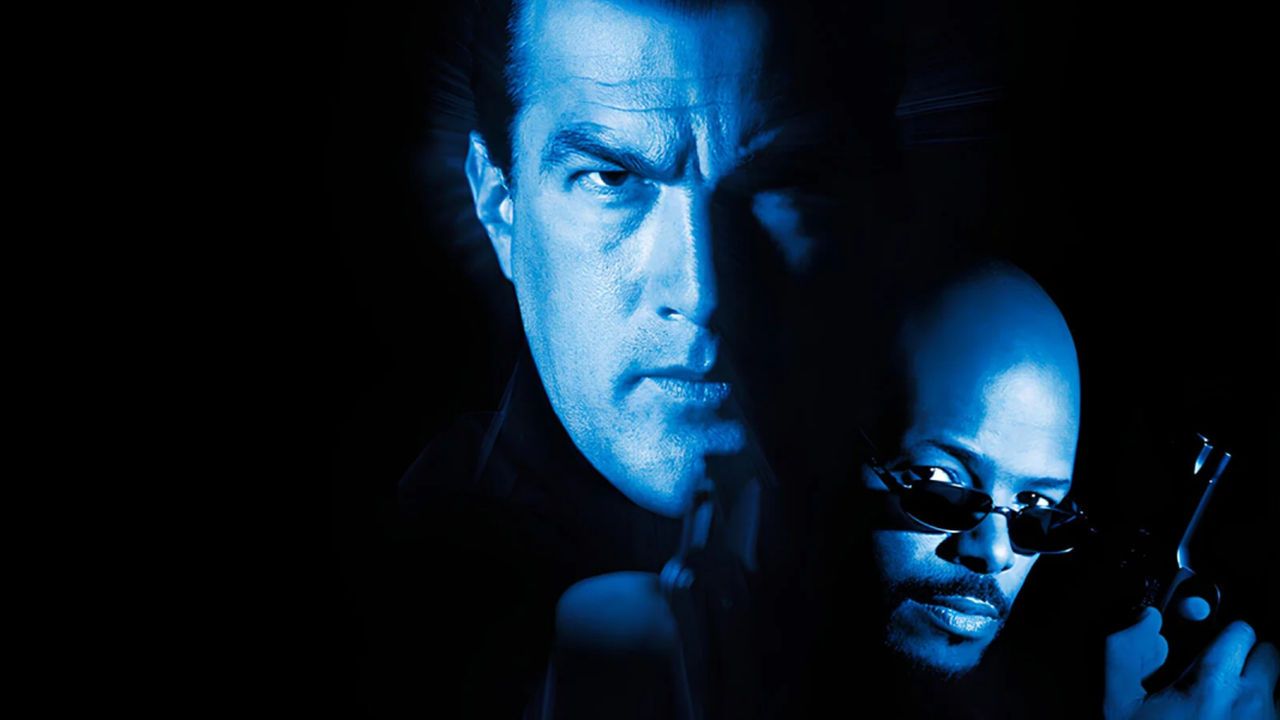
RETRO MOVIE REVIEW – Exactly thirty years ago, one of Steven Seagal’s strangest action thrillers from the final stretch of his major-studio era arrived in cinemas. The Glimmer Man has gained an amusingly topical echo in Hungary because its local title, Tisztítótűz, now resembles TISZA’s political initiative of the same name, built around asset recovery and institutional accountability. John Gray’s movie, fortunately, does not rely on constitutional amendments. Its preferred tools remain aikido, deadpan one-liners and highly suspicious herbal powders.
1996 was a strong year for dark thrillers and serial killers. Se7en was still hanging over Hollywood, and studios understandably wanted to sell the formula again and again: a disturbed murderer, a few symbolic killings, two detectives who preferably dislike each other, and a city where every street looks as though it has just been cleaned after a crime scene. The Glimmer Man tries to tailor that mixture to Seagal. The result is far from flawless. At times, the film deserves credit merely for deciding whether it wants to be a serious religious psychological thriller, a loud buddy-cop comedy or a conspiracy-driven action movie within the same scene. Yet beneath the confused structure lies something rare and oddly appealing: Seagal was still working in a real theatrical movie, with actual money, recognizable co-stars and a partner who could push back against him. Every now and then, it really works.
Three decades later, the Hungarian title receives an extra layer of comedy. TISZA’s official Tisztítótűz operation, focused on exposing state abuses, recovering public assets and strengthening institutions, obviously does not involve someone silently gliding into a meeting room and disabling a procurement-network figure with two wrist locks. Jack Cole, however, absolutely would. He is the former government operative whose legend says that first you see a flash, then the bones start cracking. Seagal plays that mystical aura with such an unchanging expression that, after a while, it becomes difficult to tell whether the larger achievement is Cole’s Zen calm or the actor’s extraordinary economy of facial movement.

The Family Man who did not care for families
Los Angeles is being terrorized by a serial killer calling himself the Family Man. He murders Catholic families and arranges the bodies into frightening crucifixion-like tableaux. The opening is genuinely dark, unsettling and surprisingly serious. Then Detective Jim Campbell enters the story, and the tone immediately shifts. Campbell is the traditional hard-edged, impatient local cop who would rather not listen to a former secret agent explain herbs, energy and enlightenment at a fresh murder scene.
Keenen Ivory Wayans is the movie’s greatest weapon. Not because he receives the most jokes, but because he reacts to Seagal exactly as any normal person would. He sees that Cole is some kind of strange, spiritual CIA leftover, but he has no time to solve that puzzle because a brutal killing spree is unfolding. Wayans has timing, energy and an effortless ability to carry the movie’s cynical humor. Beside him, Seagal’s rigid delivery occasionally starts to feel like a deliberate gag. It may not always be one, but The Glimmer Man benefits from its willingness to live with its own absurdity.
The bickering between the two men never reaches the level of Riggs and Murtaugh, but it does not try to copy them completely either. Campbell despises Cole’s methods while gradually accepting them, whereas Cole delivers his wildest wisdom as though it were printed on page one of a police-academy textbook. In one of the movie’s most famous scenes, powdered deer penis appears, and the film presents it with the solemnity of a crucial investigative exhibit. Anyone able to laugh with the movie at that point will probably make it through the entire ninety minutes.

It begins as Se7en, then takes the wrong exit into a conspiracy
The first third of The Glimmer Man builds its serial-killer mystery fairly well. The Family Man’s religious obsession is sick enough to work, the crime scenes are unpleasant, and Cole and Campbell’s attempt to uncover the pattern could have developed into a sharp, dark detective thriller. John Gray’s direction is effective here, and Rick Bota’s cinematography helps considerably. Los Angeles is not a sunlit postcard city, but a cold, wet concrete labyrinth where every alley, church, home and office seems to conceal a secret or a corpse.
Then the film refuses to settle for a serial killer. The CIA arrives, followed by the Russian mafia, an influential businessman, old intelligence operations, chemical weapons and so many side plots that viewers may eventually feel grateful whenever someone simply pulls out a gun. Every element could have belonged in another, longer and better-considered screenplay. Here, however, they collide with each other. Kevin Brodbin seems to be writing a cheaper Seagal-compatible Se7en, a Lethal Weapon-style cop movie and a political thriller built from Cold War leftovers all at once.
Stephen Tobolowsky’s brief but memorable appearance demonstrates that instability perfectly. Tobolowsky is the kind of character actor who can make an entire situation uncomfortable with two lines, but his scene appears as though it were transferred from a different movie. It works, but the plot has already wandered elsewhere. Bob Gunton also brings a strong presence, although his character deserves better material than a story that keeps placing new secrets in front of him before rushing away again.
When the editing room moves faster than Steven Seagal
One thing Seagal’s early movies could almost always do was show what happened in their fight scenes. His aikido throws, quick movements and apparently weightless disarms gave him a distinctive style even when the story merely existed to justify twisting another wrist. The Glimmer Man lets too little of that quality breathe. Donn Cambern’s editing chops many action scenes into fragments, the camera switches angles before a movement is finished, and the movie sometimes seems not to trust that Seagal can sell a clearly filmed fight on his own.
There are still good action beats. The bar fight briefly reveals something of the old Seagal movement, the chases have momentum, and the sudden bursts of violence occasionally hit harder than expected from a movie that jokes this much. The larger problem is that The Glimmer Man attaches a self-inflicted distraction to every strength. Just as tension begins to form, a joke arrives. Just as the joke lands, another conspiracy thread explodes into the story. Just as the killer becomes interesting, Cole offers another piece of mystical police wisdom.
Trevor Rabin’s score adds a surprising amount to this strange mix. The former Yes guitarist blends world-music details, pulsing keyboard sounds and nineties thriller textures that sometimes sell the film’s darkness more effectively than the screenplay. Then the Seagal universe becomes complete around the credits: two songs written by him appear in the movie, performed by Taj Mahal and the Jeff Healey Band. It is difficult to find a more accurate summary of this film. It is a bloody serial-killer thriller in which the hero is a spiritual ex-CIA detective, his partner constantly loses patience with him, and part of the soundtrack comes from Steven Seagal’s songwriting ambitions.
The Glimmer Man is not a lost masterpiece, nor is it secretly one of the best action movies of the 1990s. Its story is overcrowded, its editing is often frustrating, and Seagal is no longer the agile, irresistible movie star he had been only a few years earlier. But Keenen Ivory Wayans is excellent, the atmosphere frequently works, the humor occasionally hits with genuinely dry weirdness, and the film preserves something from an era when a mid-range Hollywood action thriller could afford to be this peculiar. Thirty years later, The Glimmer Man may not cleanse anything, but it can absolutely make a Saturday afternoon spectacularly messy.
The Glimmer Man
Direction - 6
Actors - 6.8
Story - 5.8
Visuals/Music/Sounds/Action - 6.4
Ambience - 7.5
6.5
GOOD
The Glimmer Man is a messy but unexpectedly entertaining Seagal film that tries to force the darkness of Se7en, buddy-cop humor and the star's peculiar spiritual-action-hero image into one story. It does not always succeed, but when Keenen Ivory Wayans and Seagal find a rhythm together, the chaos becomes strangely lovable.





![The X-Files may finally continue with Mulder and Scully back in action [VIDEO]](https://thegeek.games/wp-content/uploads/2026/08/theGeek-X-Files-season-12-302x180.jpg)
![Pierce Brosnan’s box-office flop becomes a surprise Netflix hit [VIDEO]](https://thegeek.games/wp-content/uploads/2026/08/theGeek-Fast-Charlie-Pierce-Brosnan-302x180.jpg)






Leave a Reply