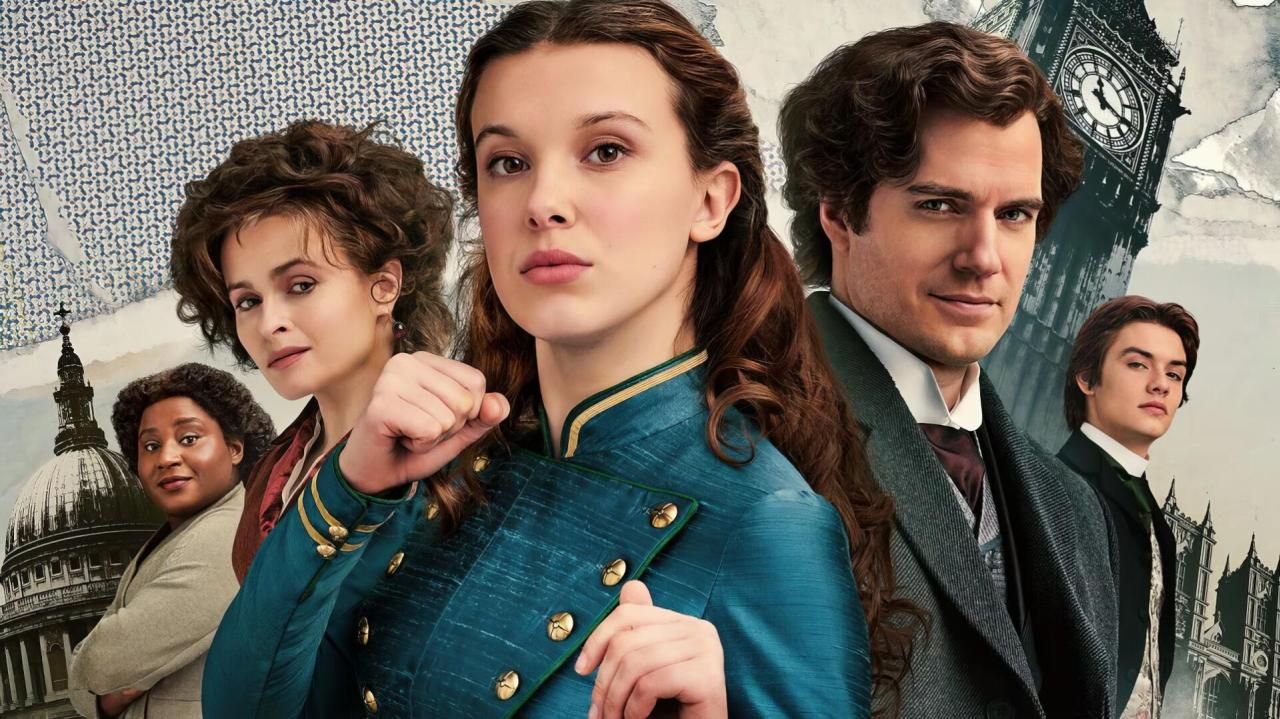
MOVIE REVIEW – Enola Holmes 3 begins with the kind of premise that should practically write a strong sequel by itself: Enola is preparing to marry Lord Tewkesbury in Malta when Sherlock Holmes vanishes, turning a wedding into a kidnapping case, a family crisis, and an international mystery. Millie Bobby Brown still moves through the role with ease, Malta gives the franchise far more visual life than another trip through the same foggy London streets could have managed, and the returning cast remains enjoyable company. The trouble is that the mystery itself is too thin, the larger themes are mostly decorative, and the film repeatedly tries to convince us that Enola has made a brilliant deduction when the answer has simply been placed in front of her by a camera zoom.
The first Enola Holmes worked because it understood how easily this idea could have gone wrong. A younger Holmes sibling who talks to the camera, outsmarts Sherlock, runs through Victorian England in bright clothes, and becomes involved in conspiracies could easily have turned into a mildly irritating Netflix product. Instead, the film had confidence, pace, a clear case to follow, and a lead performance that made Enola look genuinely clever rather than merely written as clever. Millie Bobby Brown made it feel as if Enola was always one step ahead of the room, while still unsure where the next clue might lead.
The second film already had a harder time holding that balance. It became bigger, busier, and more eager to add social issues, supporting players, and dramatic weight. Yet it still retained enough lightness to make its excesses forgivable. The third entry does not resolve that uncertainty. It increases it. The franchise seems unsure how Enola is supposed to grow up, so it makes the material darker, adds larger historical stakes, and gives everyone more serious things to say. The result is a film that often feels heavier without becoming deeper.
The opening is promising. Enola is late to her own wedding, gets tangled up with apparent highway robbers, begins questioning marriage itself, and then learns that Sherlock has been kidnapped. That is more than enough for a fast, personal Holmes adventure. Instead, Jack Thorne’s script adds family secrets, old grudges, stolen valuables, historical crimes, Maltese rebels, hostages, and a larger conspiracy whose supposed importance is never matched by the audience’s actual interest in it.

Malta Looks Better Than the Investigation
The new setting is a genuine improvement. The first two films had already squeezed plenty of atmosphere out of Victorian London, so moving Enola to Malta gives this chapter an immediate lift. The rocky coastline, bright stone streets, sea views, harbours, and warmer colours make the film look more adventurous. There are a few handsome compositions, several well-shot escapes, and enough movement to show that the creative team wanted to make something broader than another enclosed London mystery.
But a strong location is not the same thing as a strong case. Enola moves from clue to clue, except the clues rarely behave like actual clues. The film does not build details, let Enola connect them, and then reward the audience for following the same path. It points at an object, pushes the camera toward it, mentions an important name, and then moves to the next scene as if everyone has naturally understood what this means.
That is especially frustrating in a franchise built around Enola seeing what the men around her miss. Sherlock deduces, Watson observes, Mycroft judges, and Enola notices the obvious thing nobody else has bothered to look at. Here, however, she often does not discover anything so much as receive the answer through the staging. The detecting is being handled by the camera, not the detective.
Philip Barantini is not an incapable director. There are darker scenes here, more immediate peril, and a visible effort to give the story a more adult texture. Malta is used well, the action is occasionally clean and energetic, and the film does not look cheap. But the earlier entries had a lively, mischievous rhythm that does not survive comfortably beside this newer seriousness. Enola Holmes 3 wants to feel more mature, but it does not become more intelligent in the process.

Millie Bobby Brown Still Knows Exactly Who Enola Is
Millie Bobby Brown remains the best reason to keep following this series. Enola works when Brown lets her curiosity, quick reactions, restless humour, and stubborn confidence carry a scene. She does not need to announce that Enola is clever, independent, or different from everyone around her. The character already communicates all of that through the way Brown moves, looks, and reacts.
The direct-to-camera moments still work better because of Brown than because of the script. When Enola turns away from the other characters and includes the viewer in her thinking, there is still a spark of the first film’s charm. The third installment simply does not know what to do with that spark often enough. It seems worried that too much playfulness will make the film feel insufficiently serious, even though that lightness was one of the reasons Enola Holmes worked in the first place.
Enola’s own conflict is not a bad idea. She is about to marry Tewkesbury, yet she does not want marriage to absorb her identity, her work, or the name she has built for herself. She loves him, but she does not want her life to become a version of his. That could have been the emotional centre of the film. Instead, the screenplay repeatedly interrupts it with another chase, a new threat, or one more piece of historical exposition.
Louis Partridge remains a good match for Brown, and there is enough warmth between Enola and Tewkesbury for the uncertainty around their wedding to matter. The film, however, almost never stays with them long enough for that emotional thread to develop. Henry Cavill’s Sherlock is once again more of a prestigious guest appearance than an active character, while Himesh Patel’s Watson gets a few useful moments but spends much of the film waiting for the plot to remember he exists.

The Bigger Themes Have Too Little Story Behind Them
The Enola Holmes films have never avoided social themes. The first film touched on women’s autonomy and political representation, while the second dealt with exploitation in factory work. This third entry goes further into imperial history, stolen wealth, war crimes, and historical responsibility. Those are not bad directions for the franchise. Enola Holmes does not need to remain weightless forever.
The problem is that the film mostly uses these issues instead of exploring them. They are introduced, underlined by serious music, reflected in a few solemn expressions, and then abandoned as the movie races toward another chase, fire, kidnapping, or reveal. The larger ideas never have enough time to settle. They are treated as proof that the story has become important, not as material the film is willing to examine properly.
The screenplay appears to fear that one straightforward case will not be enough for a third film, so it adds a little of everything. By the final stretch, there is family drama, romantic uncertainty, historical injustice, a returning enemy, a hidden past, and a mystery that has to explain itself in increasing detail. Yet the investigation holding all of this together remains surprisingly simple.
The ending does not solve that problem. The film tries to tie together the personal, family, and historical strands while also delivering a growing amount of explanation at speed. There are a few emotional beats that could have carried more weight in a stronger version of the story. By then, however, the mystery has lost too much of its pull. The conclusion does not feel like everything clicks into place. It feels like the film has decided it has provided enough information and should probably stop.
Enola Is Still Good Company, but This Case Is Too Small for Her
Enola Holmes 3 is not a disaster. It has charm, attractive locations, a few capable adventure beats, and a lead character who has not lost her appeal. This is not the kind of sequel that makes you wonder why anyone bothered. It is simply the kind that makes you realise the old formula is no longer enough on its own.
Enola is no longer the girl leaving home for the first time and discovering how the larger world works. She has experience, a name, a partner, a past, and a sense of what she wants from her life. The next film needs a case that truly tests her. It does not need to send her running through more beautiful locations while a camera points out the answers on her behalf.
The franchise does not need more supporting characters, larger historical secrets, or additional fourth-wall moments. It needs a mystery with clues that matter, a solution that feels earned, and a detective who reaches the answer because she is smarter than everyone else in the room. This one is a little too elementary, dear Watson.
-Gergely Herpai „BadSector”-
Enola Holmes 3
Direction - 6.1
Actors - 7.2
Story - 5.3
Visuals/Music/Sounds/ - 6.6
Ambience - 5.8
6.2
FAIR
Enola Holmes 3 remains watchable because Millie Bobby Brown still understands exactly why Enola Holmes works, and Malta gives the franchise a welcome visual refresh. But the third film tries to present a very simple mystery as a major historical case, while repeatedly letting the camera solve problems that Enola should have solved herself. Enola has not lost her charm. This investigation just is not clever enough for her.