
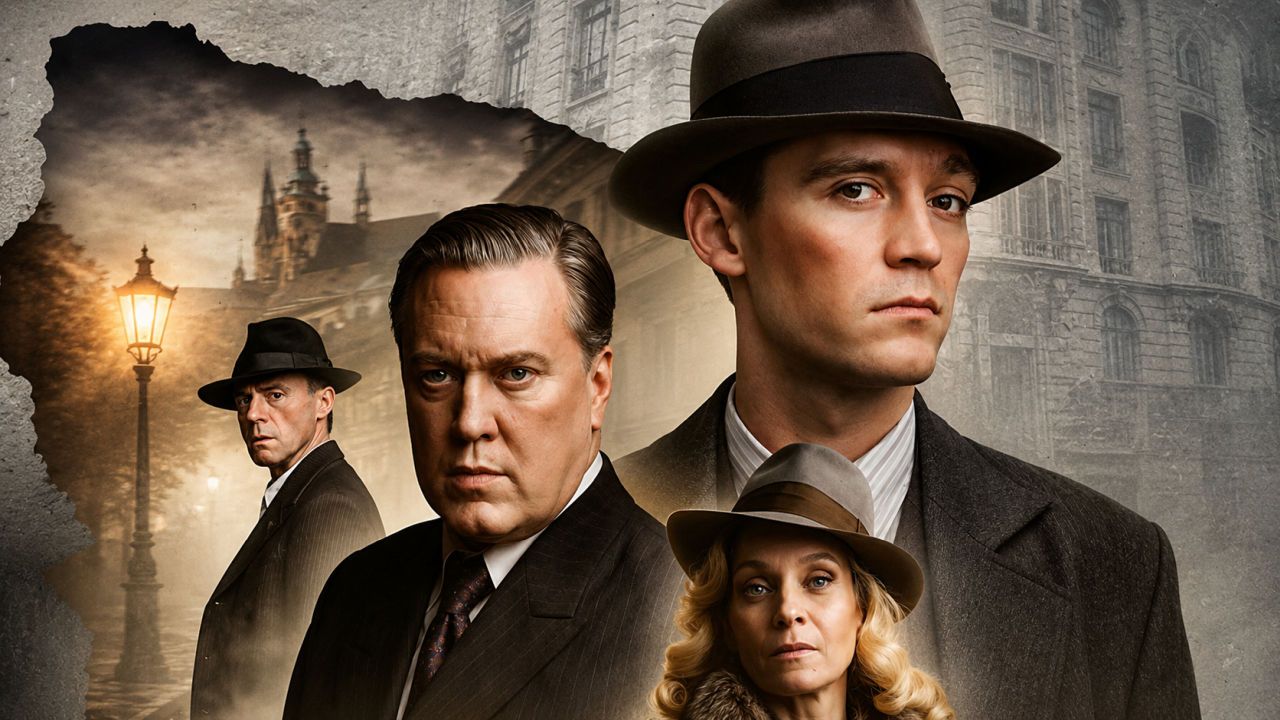
SERIES REVIEW – The Widow Killer takes place in occupied Prague during the spring of 1945, when the approaching collapse of the Third Reich, the growing Czech resistance, and the daily threat of the Gestapo have turned the city into a place ruled by suspicion. A serial killer begins targeting widows, murdering them and removing their hearts, while young Czech detective Jan Morava is assigned to the case under the supervision of the older, enigmatic Gestapo officer Erwin Buback. Across four episodes, the historical crime drama builds a dark noir atmosphere around a patient investigation, grounded performances, and the final weeks of a city still trapped under Nazi control. The murder case drives the plot from beginning to end, while every new lead reveals another layer of fear, compromise, and concealed guilt.
Prague in March 1945 already senses that the war is reaching its final stage. Liberation is moving closer, yet the occupying authorities still control the streets, the police, and the lives of everyone caught beneath them. German patrols remain visible, Czech officers work under constant scrutiny, and resistance members take greater risks with each passing day. The coming end of the regime offers hope somewhere beyond the horizon, though the immediate reality remains brutal and uncertain.
The first victim is the widow of a German officer. Her body is discovered with the heart removed, and the details of the crime point toward a killer with a precise ritual and a deeply personal purpose. Soon, the investigation develops into the hunt for a serial murderer who targets women and disappears into a city already overwhelmed by violence. The disturbing method creates an immediate sense of danger, while the direction places greater emphasis on the aftermath. Empty rooms, frightened witnesses, and unfinished conversations carry the horror far beyond the crime scene.
Jan Morava becomes an engaging protagonist almost immediately. Jonas Nay gives the young Czech detective intelligence, warmth, and a quiet moral stubbornness that fits the period perfectly. Morava notices details, listens carefully, and still reacts to cruelty as something unacceptable rather than routine. His work takes place under political control, which gives every question and every conclusion an added risk. A witness can vanish, evidence can become inconvenient, and a correct answer can attract the wrong kind of attention.
Erwin Buback brings a very different presence to the story. Nicholas Ofczarek plays the Gestapo officer as a tired, heavy, watchful man whose thoughts remain difficult to read. Buback speaks carefully and rarely wastes words, allowing a glance or a pause to carry much of his character. His relationship with Morava develops through suspicion, professional curiosity, and an unavoidable imbalance of power. They work on the same case, yet each conversation reminds us that they occupy radically different positions inside the machinery of occupation.

A serial killer investigation inside a city approaching collapse
One of the series’ strongest decisions is the way it ties the murder investigation to the political condition of Prague. Every new lead brings Morava into contact with people who have adapted to occupation in different ways. Some serve the regime willingly, some obey out of fear, and others focus entirely on surviving the next few days. The suspects and witnesses therefore carry more than information about the killer. Their choices reveal the cost of living under a system where loyalty, guilt, and self-preservation overlap.
The investigation moves at a deliberate pace and relies on observation rather than theatrical displays of genius. Morava builds the case from conversations, contradictions, old records, and small changes in behaviour. The series gives its characters room to breathe and trusts the audience to follow the details. The killer’s motives gradually begin to take shape, although the full pattern remains hidden for much of the story. That steady accumulation of clues creates tension without forcing a shock at the end of every episode.
Several subplots redirect attention and expand the world around the case. The Czech resistance, internal conflicts within the German security apparatus, and Morava’s personal relationships all influence the investigation. These elements occasionally slow the procedural momentum, though they also give the series a broader dramatic scale. The murders become part of a citywide crisis, and the hunt for the killer remains connected to the political forces shaping every character’s life.
The four-part structure allows the plot to grow increasingly tight as it approaches the conclusion. Most revelations emerge naturally from earlier scenes, and several characters become more complicated as new information surfaces. During the final stretch, the investigation draws closer to the political collapse surrounding Prague. The ending lands with less force than the careful build-up promises, and a few questions remain open, yet the road toward that resolution stays gripping throughout.

Historical noir in the shadows of Prague
The visual identity establishes the mood from the opening minutes. Narrow corridors, smoky offices, dim apartments, damp streets, and grey courtyards create a city built from pressure and uncertainty. The influence of film noir is easy to recognise, though it grows naturally from the historical setting. Shadows reflect the emotional condition of the characters and the atmosphere of occupation. As a result, the darkness feels connected to the story rather than added for visual prestige.
Christopher Schier directs with patience and discipline. Scenes are allowed to develop at their own pace, the camera often remains on a face after the dialogue has ended, and small gestures receive genuine dramatic weight. The consequences of violence carry more power than graphic display. A missing answer, an interrupted confession, or a brief look across a police corridor can create more tension than a conventional action sequence. This restraint gives the series a mature confidence.
The sound design contributes just as much to the oppressive atmosphere. Distant gunfire, shouted orders, footsteps in stairwells, and conversations heard through closed doors constantly remind the viewer that the city is close to breaking apart. The score rarely dominates a scene. It works underneath the drama, tightening the pressure almost imperceptibly. By the end of each episode, the tension often continues after the screen has gone dark, making the next chapter difficult to postpone.
The period detail also feels convincing. Uniforms, police offices, apartments, vehicles, and street scenes belong to the same worn and threatening world. The production avoids excessive historical grandeur and presents Prague as exhausted, controlled, and increasingly unstable. War appears in the texture of everyday life rather than through continuous spectacle. That approach helps the series remain credible as both a historical drama and a crime thriller.

Morava and Buback carry the drama together
Jonas Nay and Nicholas Ofczarek form the strongest element of the series. Morava is younger, quicker, and emotionally more open, while Buback brings experience, caution, and a far more guarded way of reading people. The balance between them shifts from scene to scene. At times, Buback controls the room with a single question. Elsewhere, Morava notices a detail that escaped everyone around him. Neither man feels safe in the other’s company, yet the investigation gradually makes their knowledge increasingly valuable to one another.
Buback is especially compelling because the story refuses to simplify him. His past appears in carefully measured fragments, and every new detail raises further questions about his present loyalties. Ofczarek fills the character with exhaustion, intelligence, cynicism, and traces of deeply buried shame. Some of Buback’s decisions are unexpectedly humane, while his uniform and authority keep the danger surrounding him fully visible. The series allows complexity without asking the audience to forget what institution he serves.
Morava changes in quieter ways. At the beginning, he still believes careful police work can produce a meaningful form of justice. As the case develops, he repeatedly encounters a world where evidence becomes political and truth depends on who has the power to use it. Jonas Nay communicates that disillusionment through subtle changes in posture, expression, and tone. Morava grows more cautious and more guarded, while his concern for the victims remains one of the few stable elements in the story.
The supporting cast adds further texture. Jeanette Hain, Karel Dobrý, Devid Striesow, and the rest of the ensemble create characters with individual fears, secrets, and survival strategies. Several of them occupy morally uncomfortable positions, carrying the marks of both victimhood and complicity. Those contradictions produce some of the series’ strongest scenes. Every decision has a personal history behind it, and every compromise leaves a visible cost.
The murders reveal the deeper crimes of an entire era
By its final episodes, The Widow Killer has expanded far beyond the pursuit of one murderer. The case of a serial killer who removes women’s hearts becomes connected to wartime crimes, buried memories, and people who have lived for years with the consequences of their choices. Each stage of the investigation reveals another way in which prolonged violence distorts relationships and changes the meaning of responsibility.
The historical setting draws much of its power from ordinary details. A police report can disappear, a witness can suddenly refuse to speak, and a trusted colleague may also serve the interests of the occupying regime. Moral decisions are rarely simple in this world, yet their consequences remain painfully clear. That gives the investigation genuine weight, because discovering the truth becomes only one part of the problem. The characters must also decide what they are willing to do once they possess it.
The finale closes some threads more quickly than the earlier episodes suggest. A few relationships could have used additional development, and the final confrontation lacks some of the impact promised by the atmosphere surrounding it. These limitations stand out mainly because the preceding episodes create such high expectations. The performances, historical setting, and noir mood remain strong enough to preserve the overall effect.
The Widow Killer is a dense, bleak, carefully constructed European miniseries. Its serial killer mystery, wartime drama, and film noir elements fit together with unusual ease, and the four episodes maintain a steady sense of danger. Jan Morava and Erwin Buback form a memorable investigative pair, Prague feels convincingly lived in, and the murder case remains compelling beside the larger historical themes. Few recent crime dramas have built such a distinctive identity from atmosphere, character, and moral pressure.
-Gergely Herpai “BadSector”-
The Widow Killer
Direction
Actors
Story
Visuals/Music/Sounds/
Ambience
EXCELLENT
The Widow Killer is a dark and twisting historical crime drama in which Nazi-occupied Prague and the hunt for a serial killer who removes women’s hearts create sustained tension. Jonas Nay and Nicholas Ofczarek carry the story through grounded, layered performances, while the noir atmosphere shapes every episode. The finale could have delivered a stronger impact, yet this four-part production remains one of the year’s most memorable European crime miniseries.






Leave a Reply