Christopher Nolan is bringing a story nearly 2,700 years old to the largest screens available, yet one of his most important cinematic reference points was not a historical epic. The director has revealed that Ridley Scott’s 1982 Blade Runner helped him find the language of The Odyssey.
The Odyssey already stands apart within Nolan’s filmography. He assembled an enormous cast, shot across real locations and made the first feature filmed entirely with IMAX cameras. Scale is built into the project, but the director was not interested in size alone. He wanted an environment that could close around the audience through sound as powerfully as it does through images.
The obvious reference shelf might contain Spartacus, Gladiator or 300. During an appearance on the Happy Sad Confused podcast, Nolan instead pointed to a film from another genre and another century. He revisited Blade Runner with members of his crew because Ridley Scott’s future Los Angeles behaves less like a backdrop than a living presence.
Blade Runner’s Sound Pointed the Way
Nolan was not looking to transplant neon, replicants or cyberpunk imagery into the ancient Mediterranean. His interest lay in the way music, ambient noise and effects accumulate until the setting feels physical. Blade Runner makes viewers believe in its world before they have fully understood it, and that quality offered a useful model for a voyage built around strange shores and uncertain dangers.
“The score helps define the materiality of the world.”
The filmmaker also watched Blade Runner with composer Ludwig Göransson. Their conversation focused on how music can merge with sound design instead of sitting politely behind it. Nolan wanted Göransson to embrace the idea that a score can give texture, weight and even temperature to a place—an approach the composer carried into The Odyssey.
That choice hints at a film whose storytelling will not depend on dialogue alone. The movement of the sea, the strain of a ship, the impact of weapons and the silence of an unfamiliar island can all carry narrative information. IMAX photography may establish the distance of Odysseus’ journey; sound can make the audience feel that distance in their bodies.
Not a Cyberpunk Copy, but a World You Can Feel
On the surface, the two movies could hardly be further apart. One moves through a rain-soaked future city, while the other returns to an ancient myth of gods, monsters and long years at sea. Their shared problem is purely cinematic: how do you turn a place nobody has visited into somewhere that seems inhabited, dangerous and older than the story being told?
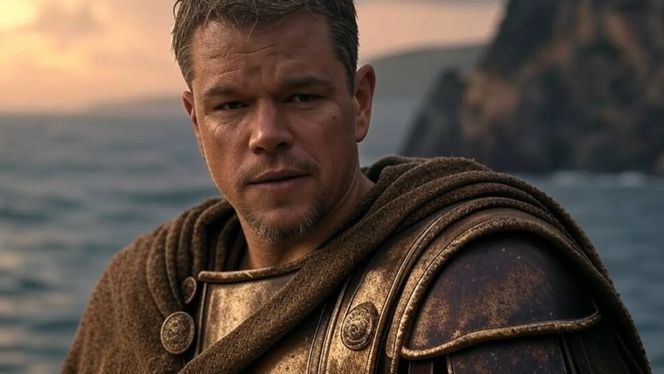
Matt Damon plays Odysseus, trying to reach Ithaca after the Trojan War. At home, Penelope and their son Telemachus, played by Tom Holland, face a crowd of suitors seeking to take the absent king’s place. In that story, world-building cannot be decoration. Every coast, hall and obstacle must carry its own history, because the hero’s return only matters if home feels different from everything he has survived.
The Odyssey opens in theaters on July 17. The influence of Blade Runner may never announce itself in a single shot, but Nolan’s comments offer a useful listening guide: notice the sea, the spaces between sounds, and the moments when Göransson’s music stops accompanying the mythical world and seems to become part of its substance.
Source: MovieWeb