
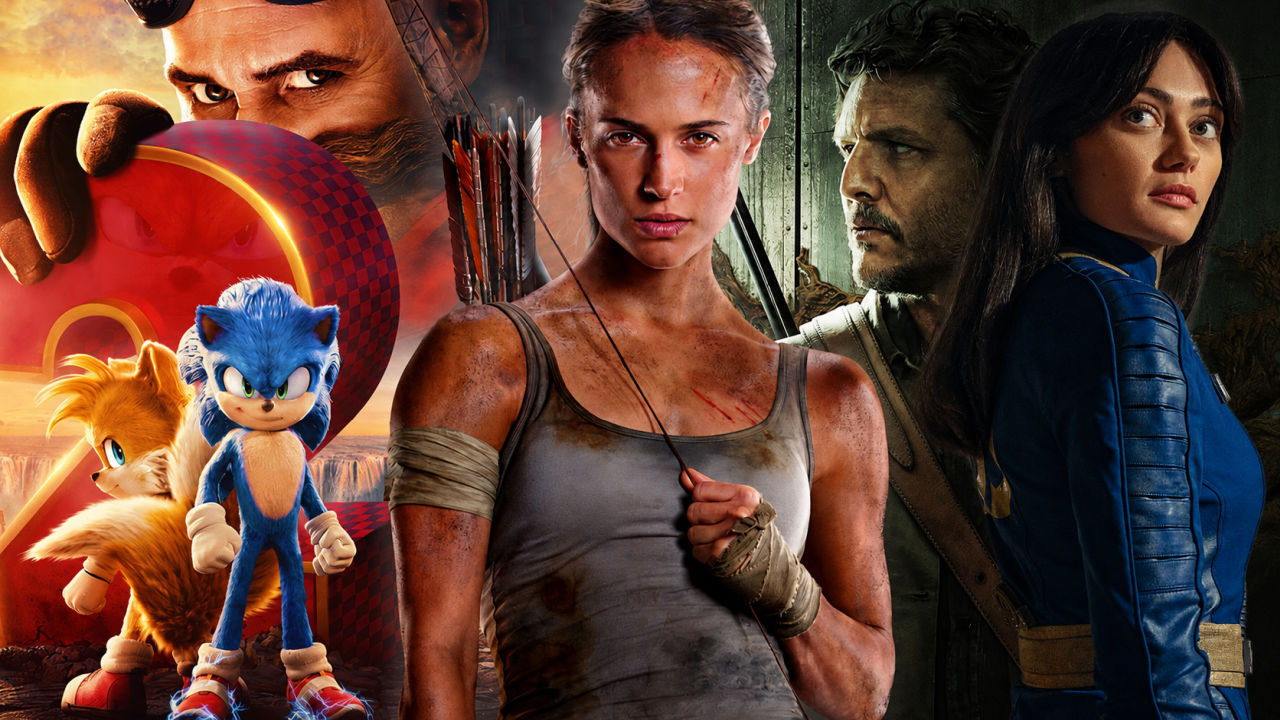
OPINION – There was a time when the words “video game adaptation” sounded almost like a warning label in Hollywood: the studio bought the name, then tried to keep as little as possible of what people actually loved about the game. Today, almost the opposite is happening. After the success of The Super Mario Galaxy Movie, A Minecraft Movie, The Last of Us, Fallout and the Sonic films, Hollywood is rummaging through game libraries much the way it raided comic-book shelves a decade and a half ago. Video games may be the next Marvel, but Marvel’s own history has already shown us what happens when a good idea becomes an industrial production plan.
During the 1990s and for quite a while afterward, it was sensible to keep expectations low whenever a movie was based on a video game. Following 1993’s Super Mario Bros., House of the Dead and other early attempts, the infamous “video game movie curse” became part of the conversation, and not without reason. Hollywood often bought these properties as though the logo and recognizable character names were all that mattered, while the story, world and even the atmosphere of the original game were secondary concerns. Fans did not get what they loved, while ordinary moviegoers were often handed films that did not work on their own either.
By 2026, the situation has been turned almost completely upside down. Variety’s CinemaCon assessment this year effectively described a studio strategy in which, as the former dominance of comic-book movies fades, Hollywood is looking to video games for its next enormous reservoir of IP. This is not a theory about some distant future. The Super Mario Galaxy Movie became the first 2026 release to cross $1 billion worldwide in June, while A Minecraft Movie surpassed $950 million globally in 2025. When Hollywood sees that much money in one place, it rarely needs a formal invitation.

Video Games Have Become the New Comic Books
Producer Roy Lee essentially predicted the current rush back in 2023. Speaking to the Los Angeles Times, he said: “I think video games are gonna be the new comic book movies of the next generation.” Lee saw exactly what studio executives now see as well: game publishers were watching the success of Mario and Five Nights at Freddy’s and realizing that they should not simply license their brands, but actively participate in bringing them to the screen. Two or three years later, the question is no longer whether major video game adaptations are coming, but whether there is any sizable franchise left whose screen rights nobody has tried to secure.
The attraction makes perfect business sense. According to research cited by TheWrap, 66 percent of American children between six and seventeen frequently talk about video games, compared with 59 percent who talk about movies, while a separate Entertainment Software Association survey found that 63 percent of Gen Z respondents would rather play a game than watch a movie. These are not merely potential ticket buyers, but audiences that have already spent years, sometimes decades, inside these worlds. Marvel once had to build a mass audience from comic-book readers and newly recruited viewers. Minecraft, Call of Duty or Zelda already comes with a cultural supply line numbering in the hundreds of millions.
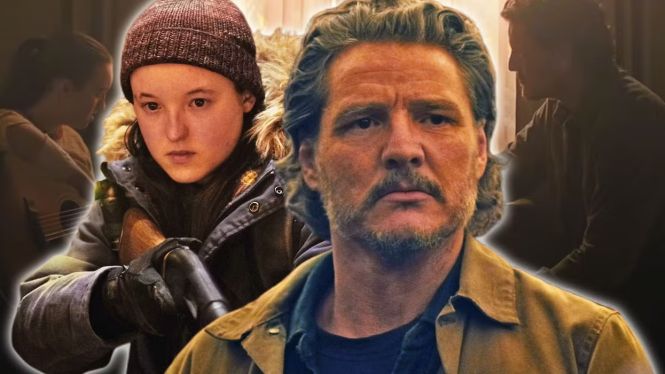
The success is also no longer confined to one cinematic formula. Mario works as an animated family blockbuster, A Minecraft Movie exploded as a live-action comedy, The Last of Us became a prestige HBO drama, and Fallout preserved the grotesque character of its games while telling a new story. That may be the most important distinction between the current gaming wave and the fatigue surrounding some superhero movies: so far, there is no mandatory template. Mario, Joel and Lucy MacLean would probably only share a scene at an exceptionally strange corporate Christmas party.
And the adaptations feed value back into the games themselves. The Fallout series drove renewed activity across older Fallout titles, The Last of Us brought fresh audiences back toward the PlayStation franchise, and Minecraft used its theatrical success to reach multiple generations at once. From a studio perspective, this is almost the perfect business model: the adaptation does not merely sell tickets, it can increase the value of the entire IP ecosystem. That is exactly what makes the model so tempting, and exactly why the industry should already be careful with it.
Hollywood No Longer Hides the Game, It Fears the Bad Adaptation
One of the most important reasons for the turnaround has little to do with technology and everything to do with attitude. Journalist Jason Schreier told TheWrap that the biggest change in recent years has been “respect of the source material.” That sounds painfully obvious, yet Hollywood spent decades struggling to arrive at this conclusion. The old assumption was often that a game’s story was merely raw material for filmmakers to “fix.” Today, creators are increasingly trying to understand why millions of people became fans in the first place.
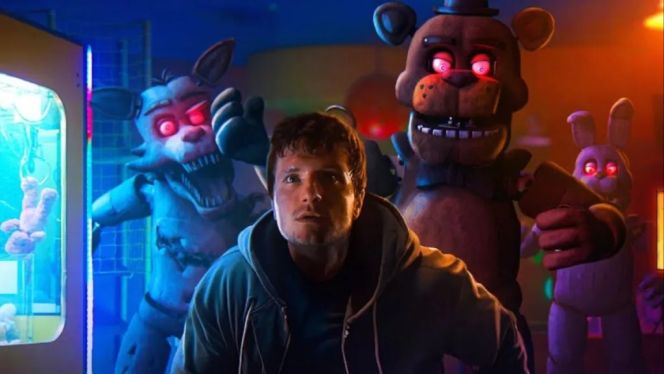
Nintendo’s Shigeru Miyamoto has served as a producer on the Mario films, Five Nights at Freddy’s creator Scott Cawthon worked as a co-writer and producer on its adaptation, and Mojang collaborated closely with the makers of A Minecraft Movie. None of that automatically guarantees a great film, but it fundamentally changes the conversation. The game creator is no longer the inconvenient person in the corner whose rights have been purchased before being politely asked not to interfere.
Zach Cregger’s 2026 Resident Evil could be a particularly interesting example of how an adaptation can remain respectful without becoming a photocopy. Cregger is not retelling Leon’s story, but instead building another story around a different protagonist inside the same world. He has described his approach as one that honors the games’ lore while telling “a new story.” That is a much healthier definition of fidelity than assuming every familiar scene simply has to be recreated with live actors.
A good adaptation is not good because it reproduces a game with 100 percent accuracy. One of Fallout’s smartest decisions was precisely that it did not put one of the games’ protagonists back on screen, but understood the rules, humor, brutality and moral absurdity of the setting. The Last of Us, by contrast, could follow its source much more closely because the game itself was intensely character- and narrative-driven. Two completely different methods, yet the same principle: first understand what you are adapting, then decide how to turn it into a film or television series.
Hollywood Is Already Mapping Every Game Library
The problem is that once Hollywood finds several successes in the same place, the spreadsheet soon follows. Sony, for example, speaks openly about its “IP360” strategy. In its corporate reporting, the company highlighted the success of Gran Turismo and The Last of Us while treating film and television extensions of PlayStation properties as part of a broader system for increasing the value of its brands. God of War, Ghost of Tsushima, Helldivers and other PlayStation properties are no longer simply games. They are potential films, series, animation projects and entire media packages.
The calendar for the next few years is beginning to reflect that thinking. Zach Cregger’s Resident Evil arrives in September 2026, Street Fighter follows in October, the live-action The Legend of Zelda is planned for 2027, and Sony is also developing an R-rated animated Bloodborne movie. Alex Garland is making an Elden Ring adaptation for A24, a Helldivers movie is moving forward, and God of War is preparing for another life on television. This is no longer the beginning of a trend. It is a production strategy.
Paramount has already dated its Call of Duty film for June 2028, with Peter Berg directing and Taylor Sheridan involved in the screenplay. According to Variety, the film will take place in the Modern Warfare universe, while Paramount’s agreement with Activision already leaves room to expand the property across film and television. The first movie has not even been made, yet the possibility of a larger universe is already sitting at the conference table. Somewhere at Marvel, someone is probably nodding approvingly.
Jason Schreier has also pointed out that Hollywood is built around franchises and is constantly looking for ways to reduce risk. A recognizable game can look like a wonderful security blanket in that environment: it already has an audience, visual identity, characters, social-media presence and often decades of history. But the exact logic that reduces risk today can increase it tomorrow. Once “cinematic universe potential” starts appearing at the bottom of every executive presentation, we are not far from repeating the comic-book cycle.

Fatigue Is No Longer Just a Theory
This does not mean video game adaptations are already collapsing. Quite the opposite: they currently represent one of Hollywood’s strongest sources of established IP. But it is already clear that the name of a game is not a magic spell. Borderlands failed spectacularly in 2024, Until Dawn earned only around $35 million worldwide in 2025 against a $15 million production budget, and Return to Silent Hill opened to just $3.2 million in North America in January 2026. These are productions of very different sizes and circumstances, but they demonstrate one thing rather effectively: gamers are not automatic cash dispensers.
Mortal Kombat II was not a disaster either, but roughly $129 million worldwide against an approximately $80 million production budget is not the sort of result that makes studio executives spray champagne across the ceiling. That is particularly interesting because the movie was built around a recognizable franchise with decades of history, iconic characters and an intensely committed fan base. A famous name helps a movie leave the starting line, but it will not carry the film to the finish by itself.
TriStar president Nicole Brown offered a broader Hollywood truth during the Los Angeles Times discussion about the rise of game adaptations: “Audiences are driven by original.” That may sound strange in an article primarily concerned with adaptations, but that is exactly the point. Originality does not necessarily mean that every character has to have been invented yesterday. It means a film or series needs its own reason to exist rather than functioning as the next compulsory exploitation of a recognizable brand.
And this is where the situation begins to resemble Marvel’s problem. Superhero movies did not partly wear out their welcome because audiences woke up one morning and suddenly stopped liking superpowers. The trouble began when too many productions arrived with similar rhythms, similar visual language, interconnected stories and an ever-growing pile of required homework. Eventually, a new installment stopped feeling like an event and started feeling like another item on a list. If Hollywood now wants a film, series, spinoff and universe from every successful game, it can repeat that lesson in record time.

If Everything Becomes a Universe, We End Up Where Marvel Did
The greatest advantage video games currently possess is their diversity. Mario is not The Last of Us, Elden Ring is not Minecraft, Fallout is not Street Fighter, and no sensible film industry should attempt to process them through the same dramatic and visual template. If Hollywood understands that, the adaptation boom could last far longer than an ordinary fad. If it sees only “recognizable IP + existing fandom = reduced risk,” it has already written the first act of its next problem.
Steven Spielberg put the warning more simply at this year’s CinemaCon. According to Variety, he said: “If all we make is known, branded IP, we’re going to run out of gas.” Spielberg was not attacking video games, of course. He was attacking an industrial reflex that tries to reproduce every fresh success until it is neither fresh nor successful. Hollywood history is full of geese that laid golden eggs and were eventually cut open because somebody wanted to know whether twenty eggs were hidden inside at once.
The real lesson of Marvel’s history is not that audiences became tired of comic books. During the MCU’s strongest years, every movie belonged to a larger construction, yet Iron Man, Captain America, Guardians of the Galaxy and Black Panther still possessed their own characters and genre identities. When maintaining the universe began to feel more important than the individual stories, audiences became more selective. That is exactly what game adaptations should avoid: make a good Resident Evil movie first, and only then start planning which streaming show will feature somebody appearing after the credits.
The success of Mario, Minecraft, Fallout and The Last of Us therefore does not prove that “video game movies work.” It proves something far more useful: adaptations work when they understand why their source matters to its audience while still functioning as worthwhile films or television series in their own right. That is a considerably harder recipe than simply buying rights, although unfortunately it does not fit as neatly on a single PowerPoint slide.
Hollywood may genuinely have found its next Marvel in video games. That is both an enormous opportunity and a fairly serious warning. If Zelda, Resident Evil, Elden Ring, God of War and Call of Duty reach screens because somebody has an actual idea for how to make them live in another medium, there may still be years of excellent adaptations ahead. But if the only lesson Hollywood learned from Mario’s billion dollars is that every game has a film franchise buried somewhere inside it, the next form of “superhero fatigue” is already in development. This time, it will simply arrive holding a controller.
-Gergely Herpai „BadSector”-









Leave a Reply