
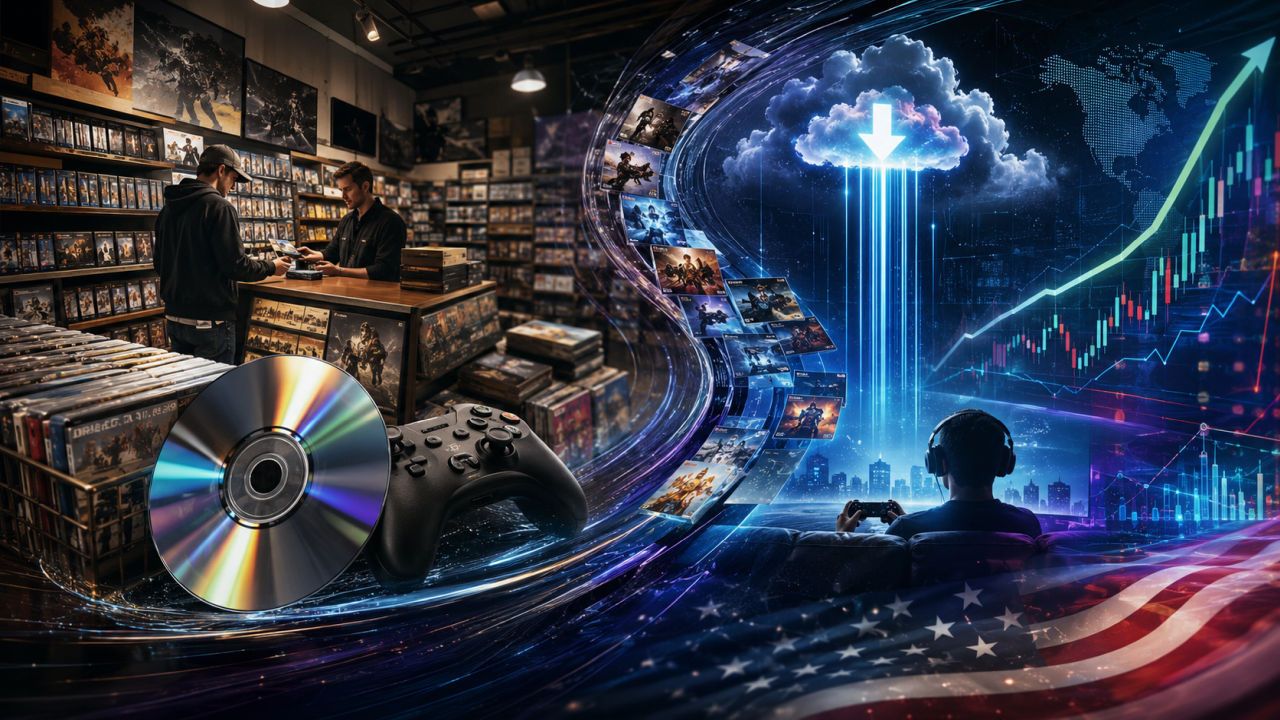
OPINION – Sony will stop manufacturing physical discs for all new PlayStation games in January 2028, presenting the move as a response to consumer preference. In the United States, however, the decision is less the beginning of an all-digital market than the moment when the industry’s largest platform holder finally removes the last meaningful alternative to its own storefront.
Sony’s announcement is simple: older releases can remain on disc, but every new PlayStation title arriving from January 2028 onward will be sold digitally through the PlayStation Store or retail codes. The company calls this a “natural direction,” and the numbers explain why it believes the risk is manageable. Digital downloads represented roughly 80 percent of Sony’s full-game software sales in fiscal 2025, according to Reuters. A dominant habit is not the same as genuine choice. Sony is setting an expiration date for the format and ensuring that future PlayStation customers cannot choose otherwise.

America has already gone digital, but that does not make the transition neutral
The United States is the market in which Sony’s argument looks strongest. Circana analyst Mat Piscatella reported that only seven PlayStation games had sold more than 100,000 physical copies in the country during the first half of 2026, while total American spending on boxed games has fallen dramatically from its late-2000s peak. Former Valve writer Chet Faliszek argued that consumers had already made their choice. He has a point: preloading, instant delivery, subscriptions and digital discounts trained millions of Americans to treat a game as an account entitlement rather than an object.
But consumer behaviour did not develop in a vacuum. Platform holders made digital purchasing effortless, promoted subscription libraries, released cheaper consoles without drives and restricted third-party digital key sales on closed console ecosystems. Meanwhile, stores received fewer special editions and more boxes containing codes instead of playable media. The shift is real, but it has also been engineered. Once discs disappear, Sony gains a much cleaner commercial environment: no used copy competes with a new one, no retailer clears inventory at an inconvenient price, and no customer can recover part of a purchase by reselling it.

GameStop can survive the disc, because it is no longer really about games
The most revealing American response came from GameStop chief executive Ryan Cohen. Asked how Sony’s decision would affect the company, he replied, “It doesn’t matter. It doesn’t matter at all.” In an interview filed with the US Securities and Exchange Commission, Cohen described a business built around roughly 1,600 US stores that has become far less dependent on hardware and software and far more focused on collectibles, trading cards and refurbished technology. Its fiscal 2025 results showed software at about one-fifth of annual sales while collectibles expanded sharply.
Cohen’s confidence is understandable, but it does not make the transition harmless. GameStop can replace a shrinking shelf of PlayStation games with Pokémon cards, graded collectibles, Funko products, used phones, retro systems and high-margin accessories. The customer who relied on trade-ins cannot replace the economic function of a used game with a display case full of collectibles. The company may survive as a pop-culture and resale chain while the market that made its name disappears.
For Walmart, Target, Best Buy and Amazon, the shock will be easier to absorb. These companies place consoles inside a much larger retail ecosystem. They can continue offering PlayStation hardware, SSDs, controllers, headsets, gift cards, subscription codes and financing, and they can use major launches to drive traffic without stocking a disc. What disappears is one of gaming retail’s best repeat-purchase products. A console is bought once every several years; a new game brought the customer back every month, every holiday season and every major release window.
Distributors lose volume, retailers lose circulation
Physical distribution is where the operational damage becomes concrete. Companies such as U&I Entertainment, PLAION’s North American operation and publisher-owned distribution teams coordinate manufacturing, retail placement, warehousing, launch timing, returns and inventory across a vast territory. U&I describes its role as a supply-chain network connecting publishers, manufacturers and retailers through a single distribution point. When PlayStation software becomes digital-only, much of that work vanishes or moves inside Sony’s platform.
The surviving business will concentrate on hardware, Nintendo cartridges and Game-Key Cards, collector’s editions without standard discs, licensed merchandise, boutique physical releases for other platforms and direct-to-consumer fulfilment. Large distributors can diversify, but smaller publishers that used a boxed edition to gain visibility at Walmart, Best Buy or GameStop will lose a discovery channel. Zhenghua Yang, founder of Serenity Forge, argued in a recent industry interview that physical games reach audiences digital distribution often misses, including retail shoppers, collectors and customers with limited connectivity. A store shelf is also advertising space that a small publisher does not have to purchase from a platform algorithm.

The used-game economy is the real casualty
A disc performs several economic jobs at once. It lets a customer buy at launch, lend the game to a friend, sell it on eBay, trade it to GameStop or purchase it months later at a price determined by supply and demand rather than by Sony’s promotional calendar. Digital licensing removes all of those options. The buyer gains convenience but loses liquidity, especially when resale value helps finance the next release.
The American used-game market will become a finite pool. PlayStation 4 and PlayStation 5 discs will continue circulating, rare editions may appreciate, and retro stores will have years of inventory to process. Every digital-only release creates no future used copy. By the early 2030s, a traditional store’s PlayStation section could resemble a record shop’s classic catalogue: culturally attractive, increasingly collectible and disconnected from the current release schedule. That may support specialists, but not the old national trade-in economy.

AAA games will make consumers accept what they say they oppose
The transition will be powered less by corporate persuasion than by irresistible software. Grand Theft Auto VI has already demonstrated the model with a retail box containing a download code rather than a disc. The package preserves visibility, giftability and shelf presence while eliminating resale and production of playable media. Other major releases arriving before January 2028 can still create one final surge of physical demand, and the last true PlayStation discs may become instant collector’s items. Retailers will market them as the end of an era, turning Sony’s deadline into scarcity.
The decisive moment will come with PlayStation 6. Sony has not announced its final launch date or price, but the 2028 cutoff strongly suggests that the company wants the next generation to operate without standard physical software. A drive-free system is cheaper to build and more valuable because every transaction remains inside the controlled ecosystem. Even customers furious about ownership will face the familiar calculation: if the next Naughty Dog, Santa Monica Studio or Insomniac blockbuster is available only inside that ecosystem, how long will principle survive against the desire to play?
Microsoft’s next Xbox, Project Helix, is the most interesting competitive variable. Microsoft says it will send alpha hardware to developers in 2027 and is designing the machine to play both Xbox console and PC games. If the company combines that approach with multiple storefronts, broader key competition, backward compatibility and a credible method of preserving disc libraries, it could turn Sony’s restriction into a rare hardware-selling argument. If Project Helix is merely a drive-free Windows console, Microsoft will only offer another version of the same future.
Nintendo Switch 2 offers the clearest retail counterweight. Nintendo reported 19.86 million units sold worldwide by March 31, 2026, and its ecosystem still treats stores, gift purchases, family audiences and collectible releases as central parts of the business. Game-Key Cards blur physical ownership, but cartridges, special editions, Amiibo, Mario, Pokémon and Zelda still generate shelf traffic. For American retailers, Nintendo could become the last major platform that consistently supplies a physical new-release cycle after PlayStation exits it.

The winners will control access; the losers will own less
Sony is the clearest short-term winner. It reduces manufacturing, packaging, freight, inventory and return costs while strengthening the PlayStation Store’s control over pricing and customer data. Storage manufacturers, broadband providers, subscription services and large retailers focused on accessories can also benefit. The losers are independent game stores, physical distributors, preservation groups, rural or bandwidth-constrained households, collectors who want playable media and ordinary consumers who used resale value as part of their gaming budget.
GameStop may prove that a retailer can outlive the product category that created it, but that is not the same as preserving the market. The chain can sell cards and collectibles; Walmart can sell consoles beside televisions; Amazon can deliver a code in seconds. None of those outcomes replaces a competitive market for the same game across new, used, discounted and imported copies. The all-digital console future is often described as inevitable because it is convenient, but inevitability is a useful word for a company that benefits from making alternatives disappear.
Sony’s 2028 decision is therefore commercially rational and strategically ruthless. American consumers have unquestionably accelerated the decline of discs, but Sony is using that decline to convert preference into permanent dependency. PlayStation 6 and its AAA catalogue will probably be successful because blockbuster demand is stronger than format loyalty. The victory will still carry a cost: players will receive faster access and cleaner shelves, while surrendering the right to lend, resell, preserve and shop around for the games they believed they had bought.
Sources: PlayStation Blog; GameStop interview filed with the SEC; VGC / Circana; Xbox Wire; Nintendo IR.










Leave a Reply