
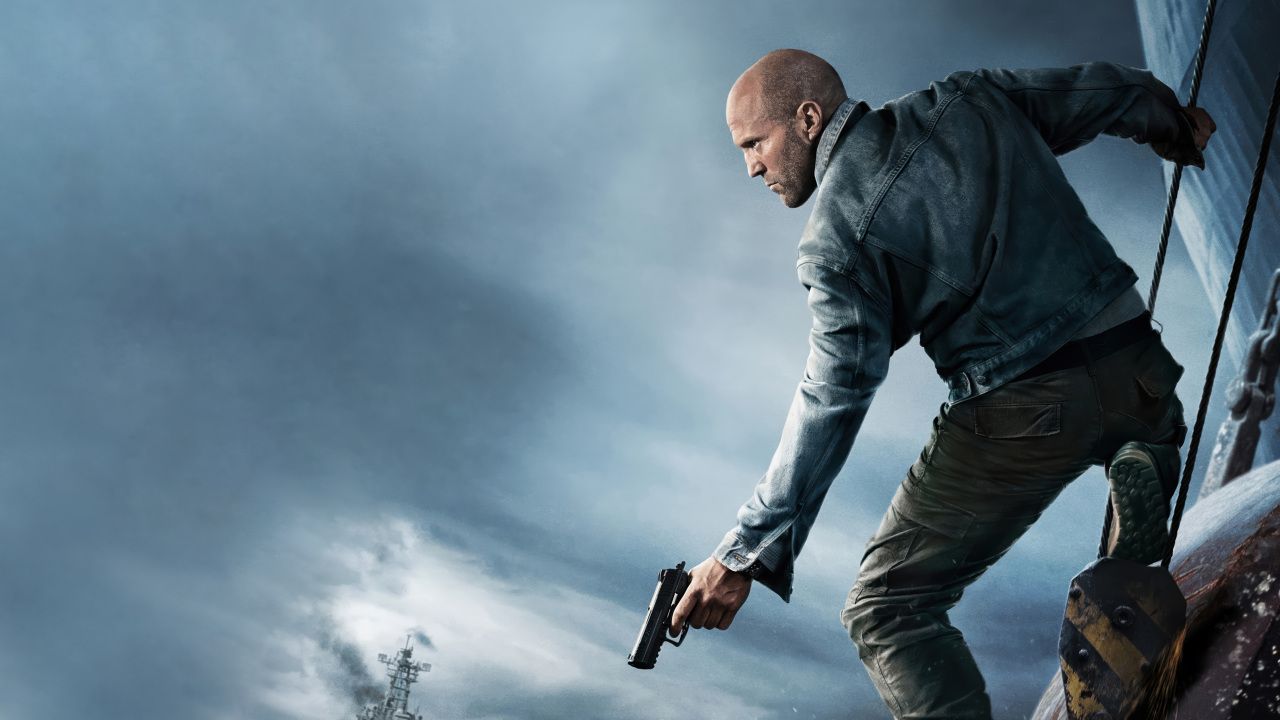
MOVIE REVIEW – Jason Statham has gradually become a film genre of his own: put the bald head, the glare and a nearby firearm on the poster, and we already know that several bad men are about to develop orthopedic problems in statistically improbable directions. Mutiny adds one major innovation to this formula: it happens on a cargo ship, where Statham’s Cole Reed is framed for murder, uncovers a conspiracy, hunts human traffickers and encounters so few surprises that viewers could probably fill out the scene order before the opening credits finish. Jean-François Richet’s movie does not even fully honor the simple contract a Statham action vehicle makes with its audience: if the plot was accidentally left behind sometime in 1997, at least break bones frequently. Instead, we get a lot of corridors, grim expressions and Jason Statham visibly waiting for permission to finally become Jason Statham.
Original storytelling has never been the first item on my checklist when watching a Jason Statham movie. Anyone entering one of these films expecting delicate character development, philosophical depth and a third act that rewrites the language of cinema has probably taken a wrong turn somewhere near the ticket counter. There is an admirable simplicity to the Statham formula: somebody annoys him, lies to him, kidnaps somebody, or preferably manages all three at once, and the British action star starts dismantling the criminal organization with the efficiency of a government audit performed by human fists.
Sometimes that formula works extremely well. The Beekeeper took its complete insanity seriously enough that watching Statham dismantle another institution every ten minutes became part of the fun. A Working Man also understood that its audience had not bought tickets to study Levon Cade’s inner emotional architecture. Mutiny, oddly, takes a story far too seriously that feels as though somebody picked five VHS tapes from a 1990s action-thriller shelf at random and decided the only missing ingredient was a boat.
Cole Reed is a former special-forces operator and police officer now handling security for a billionaire shipping magnate. His employer is not even the standard cartoon rich bastard, but an unusually warm and generous man, which in an action thriller is basically the cinematic equivalent of handing in your notice. He is promptly murdered, Cole is framed, and our hero goes on the run. So far, so serviceable. It is familiar material, but there is at least a mystery, a personal motive and the possibility that Statham may briefly have to discover something before breaking someone’s wrist.

The Mystery Is Thrown Overboard After Twenty Minutes
The first major problem is that the movie becomes bored with its own reasonably promising setup almost immediately. Cole’s investigation gives way to an awkward maneuver that gets him aboard a container ship, as though Richet had already rented the location and somebody urgently needed to explain why the star was standing there. The transition is so abrupt that the opening occasionally feels like leftover footage from a different screenplay.
The murder mystery is then replaced by an international human-trafficking conspiracy. The subject itself is obviously serious; the screenplay mainly uses it as an instant morality marker so nobody has to waste time wondering who deserves to be punched. Human traffickers. Fine. Cole can now drive everyone into the ship’s architecture with a completely clear conscience.
What is surprising is how little action follows. Statham spends much of the running time carrying a weapon through corridors, checking corners, waiting behind doors and trying to become invisible in various engine rooms. None of this would be a problem if Richet generated real suspense from the situation. Die Hard and even Under Siege demonstrated decades ago how entertaining one hard man trapped inside hostile territory can be. Mutiny sometimes seems more interested in demonstrating just how long a cargo ship corridor becomes when nothing is happening in it.
Statham naturally still looks like the sort of person who, when locked in an engine room, makes you worry about the engine room. That is also the problem. Cole Reed appears virtually indestructible. He is outnumbered, wanted for murder and trapped at sea, yet the movie rarely creates the sense that he is genuinely in danger. When Statham enters a room with twenty armed criminals, we do not calculate his odds. We calculate the number of available stretchers.

Annabelle Wallis Boarded the Ship, but Her Character Missed It
Annabelle Wallis’ Angie joins the ship as third mate, and initially she seems capable of becoming an interesting partner for Cole. She is competent, understands the vessel, has her own priorities and desperately wants to get home to her daughter. The screenplay quickly decides to use as little of that potential as possible.
Angie can be resourceful in one scene and somebody Statham needs to rescue in the next. Wallis does what she can to give the role a personality, but character building becomes difficult when your dialogue is functionally reduced to “the engine room is this way,” “watch out” and “I have a daughter.” The film barely attempts romantic chemistry between her and Cole, which at least saves us from mandatory flirting, but their partnership often feels like two people who happened to receive tickets for the same delayed flight.
Adrian Lester fares little better. As the commander of a nearby U.S. Navy vessel, he spends most of his screen time staring at monitors, receiving information and reacting with the expression of an actor wondering when somebody will transfer him into a more interesting movie. Lester’s presence gives those scenes more authority than the material deserves, but the role itself largely functions as an exposition desk.
Roland Møller’s Marko Madsen is the welcome exception. He actually looks and behaves like somebody who might survive more than five minutes in Statham’s immediate vicinity. Huge, tattooed and convincingly unpleasant, the corrupt captain does not need an elaborate psychological explanation for being awful. He is simply efficiently awful. In Mutiny, this practically qualifies as characterization.

Die Hard on a Ship, Minus Most of the Die Hard
The worst thing about Mutiny is not that it is formulaic. Formula is not inherently the enemy. A good hamburger is formulaic too, and nobody complains because they found meat between two buns again. The problem starts when the meat is flavorless, somebody forgot the sauce and the chef spends forty minutes assuring you that the hamburger will arrive shortly.
Richet’s direction is functional, but he extracts surprisingly little energy from the ship. Containers, engine passages, staircases, narrow corridors, cranes and enormous industrial spaces provide a complete playground for a creative action director. Instead, many sequences consist of Cole carefully moving from one location to another while his enemies operate according to a tactical doctrine apparently based on waiting until he walks in front of them.
When violence finally arrives, Statham still knows exactly why he is being paid. His physical style remains compact, hard and refreshingly free of decorative nonsense, while several kills get close enough to the damage to produce involuntary sympathy pains. A couple of impacts may make you rotate your own shoulder just to confirm that it is still pointing in the correct direction.
In 2026, however, that is no longer enough. The John Wick films, Mad Max: Fury Road and a generation of modern Asian action movies have shown just how inventive choreography and staging can become. Mutiny arrives as though somebody sealed it inside a shipping container fifteen years ago and only discovered it at the port last Tuesday.

When the Fight Finally Arrives, It Is Almost Too Late
The movie naturally saves its best action for the end, when Cole and Madsen are finally allowed to beat each other properly. Suddenly, most of what has been missing starts working. The environment matters, the impacts hurt, both men feel physically dangerous and Statham is finally fighting somebody who cannot be administratively removed from the story in three movements.
Møller is imposing enough to keep the outcome from feeling like a routine appointment. The fight is blunt, physical and sustained, and Richet finally trusts the confrontation long enough for the audience to feel its weight. If the rest of the movie carried half this energy, Mutiny could have been a perfectly respectable old-school B-action picture.
By then, unfortunately, we have spent an awful lot of time following Cole through hallways. A 95-minute Jason Statham movie should not possess enough spare time to become boring. That is the action-movie equivalent of managing to be twenty minutes late for a ten-minute journey. Technically impressive, just not in the way anybody wanted.

Statham Versus Déjà Vu
My recurring problem throughout Mutiny was that nearly every scene reminded me of another movie that had done the same thing better. Wrongly accused former operative? Seen it. One-man army? Seen it. Human traffickers? At this point Statham encounters them more frequently than London cab drivers. Armed criminals on a ship? Steven Seagal dealt with that thirty-four years ago and still found time to discover Erika Eleniak inside a cake.
Statham himself is not the problem. In fact, he is probably the main reason the movie remains watchable. There is something reassuring about a man who has spent nearly three decades using essentially the same facial expression to inform criminals that orthopedic treatment will soon be required. He does not appear tired of it. The audience occasionally might be.
A Statham vehicle does not need to be intelligent, but it needs a personality. Crank was lunatic, The Transporter was sleek, The Beekeeper bordered on glorious self-parody, and Guy Ritchie gave Wrath of Man a grim, controlled framework. Mutiny‘s defining characteristic is that it happens on a ship. That is a location, not a personality.
The absence of humor hurts too. Statham does not need to perform stand-up before every broken jaw, but his better movies understand the comedy inherent in his dry, immovable screen presence. Here everybody behaves as though they have not only uncovered a global criminal conspiracy but also received official confirmation that weekends have been permanently canceled.
More Drifting Than Mutiny
Jean-François Richet previously demonstrated with Plane that he can take straightforward masculine action material and turn it into a tight genre picture. Gerard Butler’s plane crashed, the movie understood the situation, and nobody spent an hour debating what kind of film they were in. Mutiny should have been equally simple: Jason Statham on a hostile cargo ship. Nobody needed a doctorate to make that work.
The screenplay nevertheless piles on conspiracy, murder framing, trafficking and secondary characters in an attempt to make itself look thicker than it is. Cole’s revenge has little emotional force because the murdered employer barely gets enough screen time to become a person. Angie’s longing to reach her daughter feels similarly prefabricated, less like a relationship than a screenplay note reading “important motivation.”
By the finale, all the important people eventually locate whoever they need to punch or shoot, and the plot pieces more or less crawl back together. That does not transform the previous ninety minutes into a strong movie. The final fight is genuinely good, Møller works as an opponent and several violent moments are satisfyingly nasty, but these are not bonuses in a Jason Statham film. They are supposed to be standard equipment.
Mutiny is ultimately bad not because Jason Statham is Jason Statham again. It is bad because the movie spends far too long refusing to let him properly be Jason Statham. If we are going to receive the same action movie for the twentieth time, the least it can do is start before we begin wishing it would hurry up.
-Gergely Herpai „BadSector”-
Mutiny
Direction - 3.5
Actors - 4.7
Story - 2.2
Visuals/Music/Sounds/Action - 4.6
Ambience - 3
3.6
BAD
Mutiny contains almost everything we have already seen in twenty other Jason Statham movies, except this time there is less momentum and considerably more walking through ship corridors. Statham can still break bones on command, and his climactic fight with Roland Møller is genuinely effective, but flat characters, an abandoned murder mystery, tension-free stalking and uninspired action leave the movie drifting. If déjà vu is what you want, there is really no need to add seasickness.





![Harry Potter Fame Did Not Pay the Bills – OnlyFans Saved Jessie Cave [VIDEO]](https://thegeek.games/wp-content/uploads/2026/08/theGeek-Jessie-Cave-OnlyFans-302x180.jpg)




![Kojima Turned 63, and Game Development Is Still His Whole World! [VIDEO]](https://thegeek.games/wp-content/uploads/2024/11/thegeek-hideo-kojima-joker-2-300x365.jpg)
![Sony Has Already Returned to Using Exclusivity-Related Terms in Its Latest Ad! [VIDEO]](https://thegeek.games/wp-content/uploads/2024/09/theGeek-PS5-Pro-Full-Official-300x365.jpg)

Leave a Reply