TECH REVIEW – Last year, the Pixel 10 finally proved that Google’s base flagship no longer had to be treated like the Pro model’s poorer relative. That leaves the Pixel 11 with a rather thankless job: improve a phone that already had very little in obvious need of fixing. Google’s answer is the Tensor G6, a larger main camera sensor, faster wireless charging, a slimmer camera bar, more storage, and even more Gemini. The result is still one of the best Android phones you can buy today, but if you already own a Pixel 10, finding a convincing reason to sprint to the store is another matter entirely.
The first time you pick up the Pixel 11, you may briefly wonder whether someone accidentally handed last year’s phone back to you. The dimensions are identical down to the millimeter, the 6.3-inch display specifications are essentially unchanged, and Google still sees no reason to reinvent the rectangle every twelve months. That is not necessarily a bad thing. The Pixel 10 was already one of the most comfortable compact-ish flagships around, and the Pixel 11 simply refines a successful foundation.
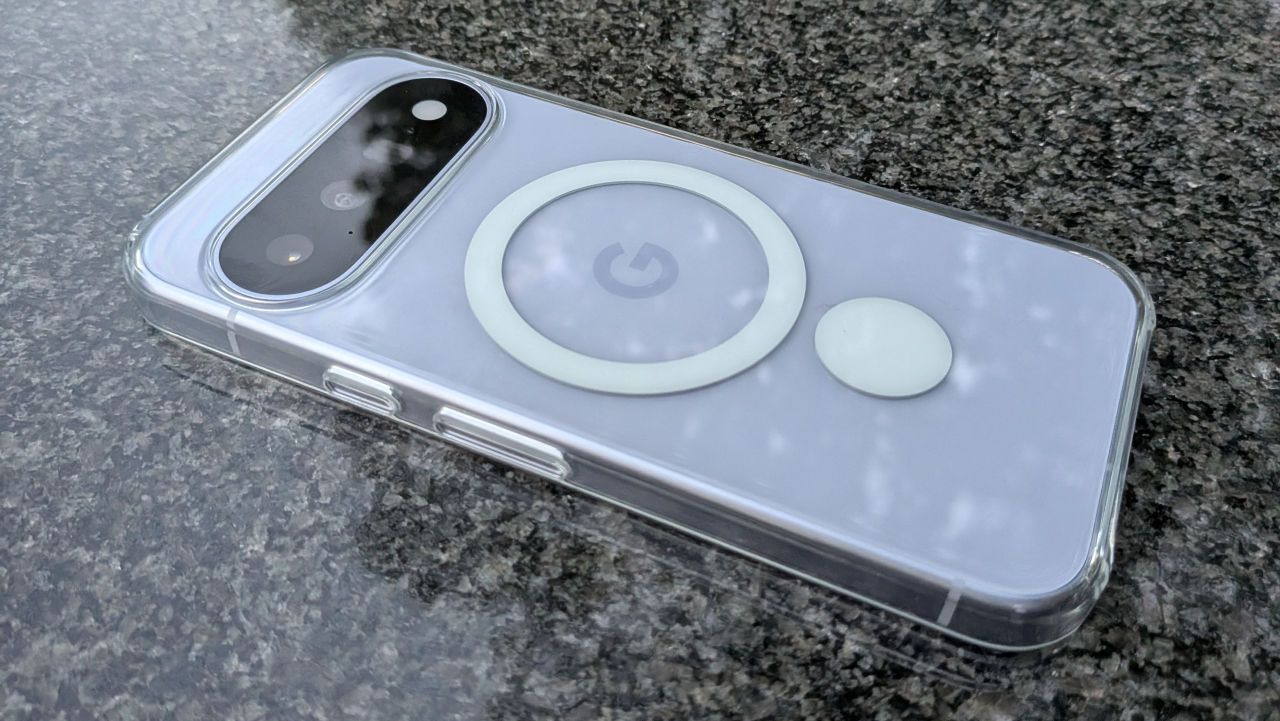
The most noticeable difference is around the back. The camera bar is roughly 40 percent thinner and sticks out far less, while the phone itself drops from 204 grams to 197. Seven grams sounds like nothing on a spec sheet, but on a phone this size you do notice it during prolonged use. It also sits flat on a desk without irritating wobble, which is hardly a technological revolution, but after doing it fifty times a day it may prove more useful than half the AI demos enthusiastically spun around on a keynote stage.
At least Google still believes phones are allowed to have colors. Alongside Frost, there is Pistachio, Hibiscus, and Obsidian, the latter naturally being for people who believe smartphones have no business visiting the cheerful half of the color spectrum. The aluminum frame and Gorilla Glass Victus 2 back retain a genuinely premium feel, while IP68 resistance is now simply expected at this price. Google’s industrial design is not more revolutionary this year. It is simply more mature.
Key specifications:
- Display: 6.3″ Actua OLED, 1080 × 2424 pixels, 422 PPI, 60–120Hz, 3,000-nit peak brightness
- Processor: Google Tensor G6, Titan M3 security coprocessor
- RAM: 12GB
- Storage: 256GB or 512GB
- Operating system: Android 17 with seven years of OS, security, and Pixel Drop updates
- Rear cameras: 48MP main + 13MP ultrawide + 10.8MP 5x telephoto, up to 30x Super Zoom
- Front camera: 10.5MP with autofocus
- Battery: 4,985mAh
- Wired charging: around 55% in 30 minutes with a 30W+ USB-C PPS charger
- Wireless charging: Pixelsnap, Qi2.2, up to 25W
- Connectivity: 5G, Wi-Fi 6E, Bluetooth 6, NFC, USB-C 3.2, GNSS
- Dust and water resistance: IP68
- Dimensions: 152.8 × 72 × 8.6mm
- Weight: 197g

The same display, and that is not an insult
The Pixel 11’s 6.3-inch Actua OLED panel is, on paper, effectively the same display used by the Pixel 10: 1080 × 2424 pixels, 422 PPI, a 60–120Hz refresh range, and 3,000-nit peak brightness. In other words, if you bought the “astonishingly bright” marketing pitch last year, Google is not trying to sell the exact same screen again with another imaginary 500 nits attached. It remains an excellent panel. Outdoor visibility is strong, colors are vivid without becoming Samsung-level candy, and 120Hz is one of those features that takes about five minutes to stop feeling like a luxury and start feeling mandatory.
One odd detail is that Smooth Display was disabled by default on some review units, so it is worth checking the display settings after setup. The Pixel 11 is obviously still usable at 60Hz, but it feels a little like collecting a premium car and discovering that sixth gear has to be manually enabled in a settings menu. Comfort View and Night Light provide detailed control over evening use and color temperature. LTPO remains absent, meaning the base model still cannot drop below 60Hz, another distinction Google reserves for its Pro lineup.
This is the first place where the entire philosophy of the Pixel 11 becomes obvious. Nothing is worse than it needs to be; in fact, it is extremely good. Google simply leaves enough space above it to justify the Pro. The problem is that at a $899 starting price, it is getting increasingly difficult to think of this as an “entry” flagship. This is an expensive premium phone that simply happens to have two even more expensive Pixels sitting above it.

Tensor G6: faster, although Snapdragon did not stand still either
The Tensor G6 is more interesting than benchmark tables suggest and simultaneously less impressive than Google would like you to believe. The company claims 25 percent faster web browsing, 15 percent quicker app launches, and 50 percent more TPU compute, with certain on-device AI workloads running up to 3.5 times faster while consuming far less energy. In ordinary use, what this translates into is an extremely fast, smooth, responsive phone. App switching feels immediate, Android 17 animations are silky, Night Sight processing is noticeably quicker, and the system rarely gives you any reason to wonder what its Geekbench score might be.
But if Google wants to charge 2026 flagship money, the numbers cannot be thrown out completely. In Tom’s Guide testing, the Pixel 11 scored 2,664/7,347 in Geekbench 6 compared with the Pixel 10’s 2,345/6,581. That is a perfectly respectable roughly 12 to 14 percent CPU improvement, while the graphics uplift is only a few percent. In the same tests, the Galaxy S26 and iPhone 17 remain substantially ahead, particularly on the GPU side, meaning the Tensor G6 is once again not the obvious choice for people whose idea of mobile use begins and ends with demanding games.
This is the familiar Tensor paradox. The Pixel 11 does not feel slow because it simply is not slow. Google’s chip is built less to destroy Qualcomm and Apple in every synthetic chart and more to accelerate Google’s own camera and AI workloads. The base Pixel 11 still lacks a vapor chamber, so long gaming sessions and sustained heavy loads can hit thermal limits sooner than they do on the Pro models and several competing flagships.
Droid-Life also noted that performance is throttled more aggressively once the battery falls to around 20 percent, as the system tries to preserve remaining charge. That is hardly disastrous in normal use, but it neatly illustrates Google’s priorities: AI acceleration and efficiency still matter more here than winning the benchmark war. There is nothing inherently wrong with that. We just should not pretend the Tensor G6 is the most powerful mobile silicon on Earth, because Snapdragon and Apple’s A-series might start laughing.

Android 17 and Gemini: the phone is smart, availability is less universal
One of the Pixel 11’s greatest strengths remains something that cannot be photographed next to a spec table: its software. Android 17 on a Pixel feels remarkably coherent, fast, and pleasant, with excellent haptics, carefully considered notifications, smooth animations, and visual details that remind you hardware and software come from the same company. Google guarantees seven years of Android, security, and Pixel Drop updates, which is genuinely meaningful for anyone who does not replace a phone every twelve months. The Pixel remains the reference Android experience, except it is far less sterile than it was a few generations ago.
The big marketing phrase this year is naturally Gemini Intelligence. Rambler does more than simply dump a literal speech transcript into a text field: it can remove filler words, cope with corrections and abandoned thoughts, and turn natural speech into cleaner text. Magic Capture simultaneously records video and analyzes the scene, examining roughly 400 frames and extracting well-timed 12-megapixel stills without forcing you to stare through the viewfinder the entire time. This is the kind of AI feature that actually makes sense. Rather than attempting to install a chatbot in a toaster, it solves an ordinary problem.
Google is also pushing proactive cards, contextual suggestions, multi-app tasks, and deeper Gemini integration. Mention dinner plans in a conversation and the phone may offer to make a reservation; discuss an upcoming flight and the relevant information can surface automatically; need a membership number and the system can try to find it for you. In theory, this is the next logical stage of the smartphone. Instead of forcing us to dig through several apps, the device should understand what we are trying to accomplish.
The catch is availability. Google’s own support documentation currently limits the Pixel 11’s new Proactive Assistance to selected countries and languages, while Magic Cue on the new generation has its own geographic restrictions. This means Google may sell you a phone “designed for Gemini Intelligence” while some of its headline intelligence can remain unavailable depending on where you actually live. AI launches are increasingly starting to resemble streaming-service catalogs: everybody gets the poster, not everybody gets the same content.
There is also a rather strange value decision. Pixel 11 Pro models include six months of Google AI Pro, while the standard Pixel 11 does not. At $899, that feels a little like being told the restaurant is premium but napkins only come with the more expensive menu. It does not determine whether the Pixel 11 is a good phone, but it absolutely matters when discussing value.

Camera: Pixel is still at its best when you do not want to become a photographer
At first glance, the Pixel 11 camera system looks almost identical to last year’s: a 48-megapixel main camera, 13-megapixel ultrawide, 10.8-megapixel 5x optical telephoto, and 10.5-megapixel selfie camera. The important upgrade is the main sensor. The Pixel 10’s 1/2-inch sensor has been replaced by a substantially larger 1/1.56-inch unit, which Google says provides 56 percent better light sensitivity. In dim scenes, that is more than marketing arithmetic: you get more detail, cleaner shadows, and much faster Night Sight processing.
Thanks to the Tensor G6’s updated image pipeline, Night Sight can process shots up to 4.5 times faster, which is more important than it sounds. One of the most annoying things about computational mobile photography is watching the moment disappear while the phone is still thinking about it. That happens much less often here. Pull the Pixel 11 out, press the shutter, and in most situations you get the familiar Pixel result, created less by absurd hardware specs than by years of refinement in Google’s computational photography.
The 5x telephoto remains one of the biggest reasons the standard Pixel no longer feels like a deliberately crippled flagship. Maximum digital zoom rises from 20x to 30x, and although algorithms are obviously doing serious work at the far end, the results are more useful than the sensor size would suggest. Around 10x, the system can be genuinely impressive. The Pro phones naturally have more ambitious camera hardware, but for ordinary photography the Pixel 11’s triple-camera setup covers nearly everything most people actually use a phone camera for.
Magic Capture is the genuinely interesting camera addition this year. Start recording and the phone captures video while continuously analyzing the scene, selecting moments worth saving as still images. Children, pets, sports, parties, anything unpredictable becomes far easier to capture than by holding down burst mode and later excavating a hundred nearly identical frames in the hope of finding one where nobody looks as though they are about to sneeze.
Camera Looks brings customizable shooting styles that can be saved for later, while Instant Night Sight makes low-light photography far more immediate. Pixel is still not the phone that puts the most manual switches in front of you. Its real strength is that it produces excellent photographs for people who neither know nor care what ISO, shutter speed, or white balance means.

Battery: slightly larger, much better wirelessly
The 4,985mAh battery is barely larger than the Pixel 10’s 4,970mAh cell, so anyone expecting a physics-defying two-day miracle should adjust expectations. Tensor G6 is more efficient, and Google now advertises more than 30 hours of typical battery life. Independent testing paints a more nuanced picture: under heavy use, this is still primarily a dependable full-day phone rather than something you unplug on Friday morning and forget about until Sunday evening.
With around five hours of screen time, Droid-Life typically finished the day near the 20-percent mark, although heavy photo and video use could force an early-evening top-up. That is perfectly acceptable, just not class-leading. The more interesting battery story is wireless charging. The Pixel 10 topped out at 15W; Pixel 11 pushes Pixelsnap and Qi2.2 to 25W, and that is the kind of improvement you can notice without opening a spreadsheet.
Wired charging remains less exciting. A 30W or higher PPS charger can take the phone to roughly 55 percent in half an hour, and naturally the charger is still sold separately. By 2026, outrage over this practice is getting difficult because the entire industry has apparently signed a collective agreement that the part connecting your several-hundred-dollar phone to the wall is now an optional luxury accessory. It remains irritating anyway.
Verdict: from a Pixel 8, absolutely; from a Pixel 10, why?
Two apparently contradictory statements are both true about the Pixel 11: it is an excellent phone, and it is not a particularly exciting upgrade. The lighter chassis, slimmer camera bar, larger main sensor, faster Night Sight, 30x zoom, Tensor G6, 25W Qi2.2 charging, and 256GB base storage are all genuine improvements. None of them, however, should cause Pixel 10 owners to wake up in a cold sweat because their phone has suddenly become obsolete.
Coming from a Pixel 8 or Pixel 9 is a different story. Several generations of improvements start adding up: a proper 5x telephoto lens, better battery behavior, faster processing, stronger on-device AI, improved wireless charging, and seven years of support in a handset that remains comfortable enough for one-handed use. At that point the Pixel 11 again demonstrates what Google phones do best. Their strength has never been one spectacular specification, but how naturally the camera, Android, and Google’s services work together.
Price is now a much louder part of the conversation. The $899 US starting price is $100 higher than the Pixel 10’s launch price, and while 256GB storage is now standard, the Pixel 11 is dangerously close to the point where spending another $200 for the Pro starts sounding reasonable. Promotions and trade-ins can obviously change the equation, but anyone already holding a Pixel 10 will struggle to call this a rational annual upgrade.
The Pixel 11 therefore does not repeat the Pixel 10’s dramatic leap. It does not have to. It takes a very good phone, sands down a few rough edges, improves the camera and charging, and layers another generation of Google AI on top. The trouble is that some of that AI layer remains geographically restricted while the full price tag is available everywhere the phone is sold. The Pixel 11 is still one of 2026’s best Android phones. It is simply the first standard Pixel in a while where “is it worth it?” no longer produces an automatic yes.
-Gergely Herpai „BadSector”-
Pros:
- Excellent camera system with a larger main sensor, proper 5x telephoto, and much faster Night Sight
- Lighter, more refined design and finally 25W Qi2.2/Pixelsnap wireless charging
- Android 17, seven years of support, and still one of the best software experiences on any phone
Cons:
- Tensor G6 still trails the strongest competitors significantly in raw and especially graphics performance
- Very little reason to upgrade from a Pixel 10 despite the higher price
- Several headline Gemini features remain geographically restricted, while the base phone gets no six-month Google AI Pro offer
Google Pixel 11
Design - 9.2
Hardware - 8.6
Software - 9.3
Camera - 9.2
Price/value - 8.1
8.9
EXCELLENT
The Pixel 11 is lighter, more polished, and better than the Pixel 10 in several meaningful ways, but it lacks the generational leap that made last year’s model so easy to recommend. Its camera remains among the best in the category, Android 17 is excellent, and Tensor G6 feels extremely fast in everyday use even if benchmarks still leave it behind the strongest Snapdragon and Apple chips. It is a terrific upgrade from a Pixel 8 or Pixel 9, while Pixel 10 owners can comfortably sit this generation out. The biggest problem is not the phone itself, but the combination of a higher price and an AI experience whose most heavily promoted features are still not universally available.





![DLSS 5’s Neural Rendering Barely Works on a GeForce RTX 3080! [VIDEO]](https://thegeek.games/wp-content/uploads/2026/08/vnews-02-rtx3080-1280x720-1-302x180.png)