
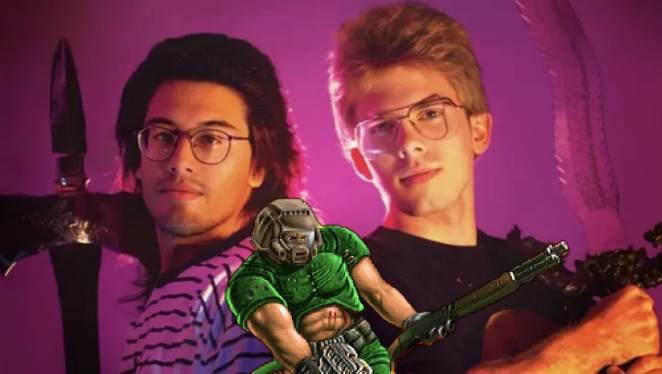
The studio that has provided us with so many enjoyable moments over the past few decades is celebrating its 35th anniversary, and John Romero and his colleagues are marking this milestone.
To mark the occasion, co-founder John Romero released a video about one of id Software‘s lesser-known games, Catacomb 3-D. The video features Romero’s memories, as well as those of id veterans Tom Hall, John Carmack, and Adrian Carmack. id began developing Catacomb 3-D in October 1991 after finishing Commander Keen: Aliens Ate My Babysitter. At that time, the studio was operating briefly in Madison, Wisconsin, after leaving Shreveport, Louisiana, but before settling permanently in Texas.
Catacomb 3-D was part of an agreement between id and Softdisk, the founders’ former employer. id’s first games were developed in two-month cycles and distributed by Gamer’s Edge, Softdisk‘s monthly subscription demo disc, until the release of Wolfenstein 3-D. Catacomb 3-D was not id’s first FPS, but it contained significant improvements over Hovertank One. While the team continued to improve the graphics and design, John Carmack experimented with texture mapping. This technique seems natural in 3D graphics today but, before the release of Catacomb and Ultima Underworld, it could only be run on expensive Silicon Graphics workstations and was not compatible with much less powerful consumer hardware.
On the topic of things that go without saying, “FPS” wasn’t even considered a separate genre at that point. id Software‘s early FPS games were often compared to top-down, arcade-style shooters. John Carmack referred to them as arcade coin-op games ported to the PC, but he described Catacomb 3-D as id’s flagship game design effort. Romero revealed that id only made $5,000 from Catacomb 3-D through its contract with Gamer’s Edge. Commander Keen was more profitable and popular. In early 1992, shortly after completing Catacomb 3-D, the team began developing Commander Keen 7, but they realized they had stumbled upon something transformative: the immersion Tom Hall had mentioned. Carmack and Romero both point to an incident involving an artist named Adrian Carmack as a kind of “eureka” moment:
“It didn’t have the overarching story and depth that people felt the PC was better suited for. We were still kind of striking out, saying, ‘No, action and fast twitch are still great, viable gaming things to do.’ We just had this one new, super novel perspective, literally, by putting it in 3D.” One of my cherished memories of making Catacomb was when Adrian almost fell out of his seat after turning around to face a troll. That’s when we knew we were on the right track. The future of gaming is not looking at little sprites moving around on the screen and getting tense. It was the sense of shock. That was the moment that cemented in my mind that we were onto something new in this genre and style of play,” said Carmack.
Tom Hall noted that, due to technical limitations, id decided to use an internal view in its early 3D games. However, as with other breakthroughs in game design, this limitation resulted in something special. “It was costly to draw large objects onscreen. We didn’t want to slow down the game. We could have done it over the player’s shoulder, but it was easier to aim when something was in the center. It was simple and fast to draw, too. It also increases player immersion, making it feel like ‘this is me,'” Hall claimed. “It just automatically sucked you in visually. You couldn’t help it. That’s just what your eyes and mind did. It was one of the craziest things I’d ever seen in a video game. We definitely knew that we’d found a new type of game,” Adrian Carmack recalled.
After only two weeks, id abandoned development of Commander Keen 7 and never returned to the series. According to Romero, Catacomb 3D was a critical step on the path to Wolfenstein, Doom, and Quake—and to the FPS genre, 3D graphics, and 3D design as we know them today. “One night, we talked about how Catacomb 3D was just the beginning of a new way to play games and that the future was 3D. Within an hour, we had decided what our next game would be: Wolfenstein 3-D, the grandfather of first-person shooters. It all began with Catacomb 3-D,” said Romero.
The Romero Games website offers a classic-style, boxed PC re-release of Catacomb 3-D, as well as other extras, such as a boxed edition of Sigil and Romero’s game development memoir, Doom Guy. After the turmoil caused by Microsoft, it seems that John and Brenda Romero’s studio is back on track and will release its long-awaited next-generation FPS.
Source: PCGamer








![The System Requirements for Fable Are In! [VIDEO]](https://thegeek.games/wp-content/uploads/2026/08/vnews-05-fable-1280x720-1-302x180.png)






Leave a Reply