
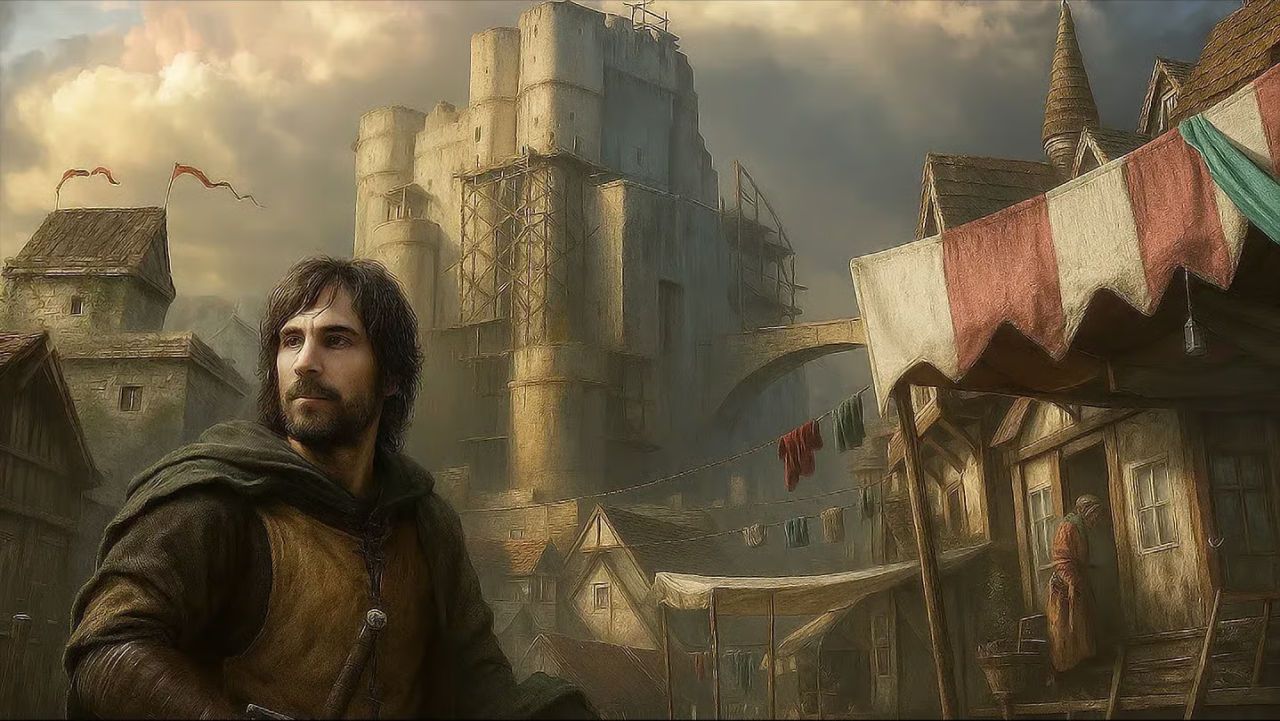
REVIEW – At first glance, City States: Medieval may look like a straightforward medieval city-builder, but it quickly becomes clear that it is trying to hold together far more than that: city management, long-distance trade, resource chains, and tower defense-style sieges. Reverie World Studios’ game is not fully polished in every area yet, but it already has a strong strategic core with a clear identity, aimed at players who do not want to choose between building and fighting.
City States: Medieval takes us to medieval Europe, a world where city-states, trading hubs, political bargains, and dangerous routes can matter just as much for survival as walls and soldiers. The basic setup is simple: we take charge of a rising city-state that must build its own economy while maintaining the trade connections that give it power. That is already a solid starting point, but the more interesting part begins when commercial decisions directly feed back into defense and war.
This is not the kind of strategy game where we calmly place a few buildings and then resolve a battle in a separate menu at a completely different pace. Here, city growth, the movement of goods, connected markets, and the defense of supply lines are tied into one system. If we expand too quickly without thinking about protection, our caravans and routes can quickly come under threat. If we spend every resource on walls and military security, the economy can easily stall, leaving us with a safe but insignificant medieval enclave instead of a trade empire.

The City Is Not Set Dressing, but the Engine of the Whole System
The city-building layer of City States: Medieval is not simply about placing a few buildings on the map and waiting for the numbers to rise. The settlement works as an economic and logistical network: resources must be produced, processed, moved, and sent to markets, while the needs of the population and the city’s defensive requirements constantly force new decisions. The game works best when success does not depend on one spectacular choice, but on many small, connected steps.
Construction, production chains, trade routes, and defense are always linked. What we produce at home becomes the foundation of our wider economic influence. If our production base is weak, we move fewer goods, expand from a weaker position, and make poorer use of distant markets. The game therefore does not only ask what we build, but also how that building fits into a broader strategic loop.
The game offers three different starting options that pull campaigns in different directions: Genoa strengthens the trade and diplomacy route, Granada emphasizes the tension between defense, economic growth, and internal politics, while Novgorod focuses on building an economic center surrounded by hostile principalities and nomadic raiders. These starting positions do a lot to keep runs from falling into the same pattern, even if the game’s Early Access state naturally means the content does not yet feel final.
The greatest strength of the city-building is that it does not become a sterile puzzle. Trade, production, faith, military development, and building chains all suggest that the city is not growing for its own sake, but trying to survive on a larger map. That is an important distinction, because in many strategy games the economy is only a waiting room before the war. Here, the economy is both one of the causes of war and one of its most important vulnerable points.

Trade Sets the Rhythm, War Punishes the Mistakes
One of the best ideas in City States: Medieval is that trade is not treated as a background money-printing machine. Routes leading to distant markets gain real strategic value, and every expansion carries risk. If we open toward a new region, move more goods, or try to gain stronger economic influence, we also need to protect our routes. This creates a simple but effective dilemma: growth is always tempting, but every new connection becomes a new target.
The trade goods system gives the game a lot of flavor. The goods chain, from honey to spices, fits neatly into the world of medieval trading cities, and it is not there merely as decoration. The game becomes most interesting when we have to weigh resource production, route choices, and market targets while knowing that the next attack could hit exactly the route on which our entire economic plan depends.
The hero system is also a good direction. Historical figures and leaders are not merely colorful characters, but strategically meaningful actors: they can play a role in diplomacy, warfare, the establishment of outposts, or even crusades. The most important part, however, is that their presence affects how directly we can control a given situation. If the hero is not on the frontline, we rely more on high-level orders; if they are present, we get much more direct control. That creates useful strategic pressure, because hero placement is not cosmetic, but meaningful.
The rhythm of the game is therefore more interesting than it first appears. It is not enough to build a city, not enough to trade, and not enough to fight. The three elements pull at each other: the city produces, trade takes risks, and war punishes overconfidence. In its best moments, City States: Medieval really does make us feel as though we are trying to maintain the fragile power of a medieval city-state among larger kingdoms, dangerous routes, and hungry rivals.

Sieges Through a Tower Defense Logic
Combat does not appear as traditional RTS battles, but more as tower defense-style real-time defense. When a trade route or important position comes under threat, the game shifts pace, and we need to hold back attackers with units, defensive elements, and positioning. This is not a minigame bolted onto the side; it is a consequence of the economic system. If we defend poorly, the trade network and the city’s economy feel the impact.
This gives the game a distinct character. On the wider map, we think like empire managers, building routes, connecting markets, and developing our city, then suddenly we move down to a more immediate level and have to survive concrete attack waves. The shift may feel unusual at first, especially for those expecting a pure city-builder or pure grand strategy game, but it is exactly this hybrid structure that separates City States: Medieval from similar medieval strategy titles.
The system is not always as elegant as it could be. The Early Access state is visible: some engagements can feel repetitive, the tower defense logic sometimes dominates more strongly than tactical depth, and not every defensive situation is equally exciting. Still, the concept is strong because battles are not self-contained. We are not fighting just because the game says it is time to fight; we are fighting because our own trade decisions created the risk.
Players who enjoy 4X-style economic planning but miss more direct action may find something here. Those who enjoy tower defense games but want more than a sequence of simple maps and waves may find the city-building and trade background gives the battles more weight. The two sides do not always blend perfectly, but when they work, City States: Medieval genuinely feels like an uncommon mix.
Early Access, but the Direction Is Already Visible
City States: Medieval is currently an Early Access game, and that cannot be ignored. The system is more ambitious than what one might expect to arrive fully polished in this state. The interface, pacing, variety of combat situations, and longer campaign rhythm all leave room for refinement. However, the core idea is distinctive enough that it cannot simply be dismissed as another medieval city-builder.
Replayability comes from the different starting situations, the way trade routes can be developed differently, and the changing defensive scenarios. Because city-building decisions directly influence where and how we will later need to defend ourselves, not every campaign runs down the same track. This connectedness is the game’s most important strength: decisions in one layer do not disappear, but return in another.
Technically, the game does not ask for an absurd machine, but the stated requirements show that it is not designed for the weakest hardware either. The minimum side lists a 2.4 GHz dual-core processor, 3 GB of RAM, and a GTX 1070 or Radeon RX Vega 56-level graphics card, while the recommended configuration asks for 5 GB of RAM and an RTX 2060 or Radeon RX Vega 64-level GPU. That is not outrageous for a strategy game, but it does show that the visuals, maps, and battle scenes come with a certain technical appetite.
The biggest question is how well Reverie World Studios can balance the three main pillars in the long run. If the city-building remains deep enough, trade does not become mere number pushing, and tower defense combat gains enough variety, then City States: Medieval could grow into a very good niche strategy game. Right now, its Early Access state still shows, but its identity is already clear, and in Early Access that often matters more than a few missing comfort layers.
-Gergely Herpai “BadSector”-
Pro:
+ Well-connected city-building, trade, and defense systems
+ Strong medieval city-state atmosphere with interesting starting positions
+ Tower defense combat carries real economic consequences
Contra:
– Still noticeably rough in Early Access
– Combat encounters can become repetitive at times
– The balance between the three main systems still needs tuning
Publisher: indie.io
Developer: Reverie World Studios
Release Date: April 20, 2026 (Early Access)
Genre: city-building strategy, trade management, tower defense strategy
City States: Medieval (Early Access)
Gameplay - 7.6
Graphics - 7
Story - 6.2
Music/audio - 6.8
Ambience - 7.8
7.1
JÓ
City States: Medieval is strongest because it does not separate building, trade, and combat, but arranges them into a single strategic loop. The game is not fully polished yet, but the world of medieval city-states, the defense of trade routes, and tower defense-style sieges give it a distinctive enough profile for strategy fans to keep an eye on it.






![Vampire - The Masquerade Redemption – Love Song for a Vampire [RETRO – 2000]](https://thegeek.games/wp-content/uploads/2020/03/theGeek-Vampire-the-Masquerade-302x180.jpg)





Leave a Reply