
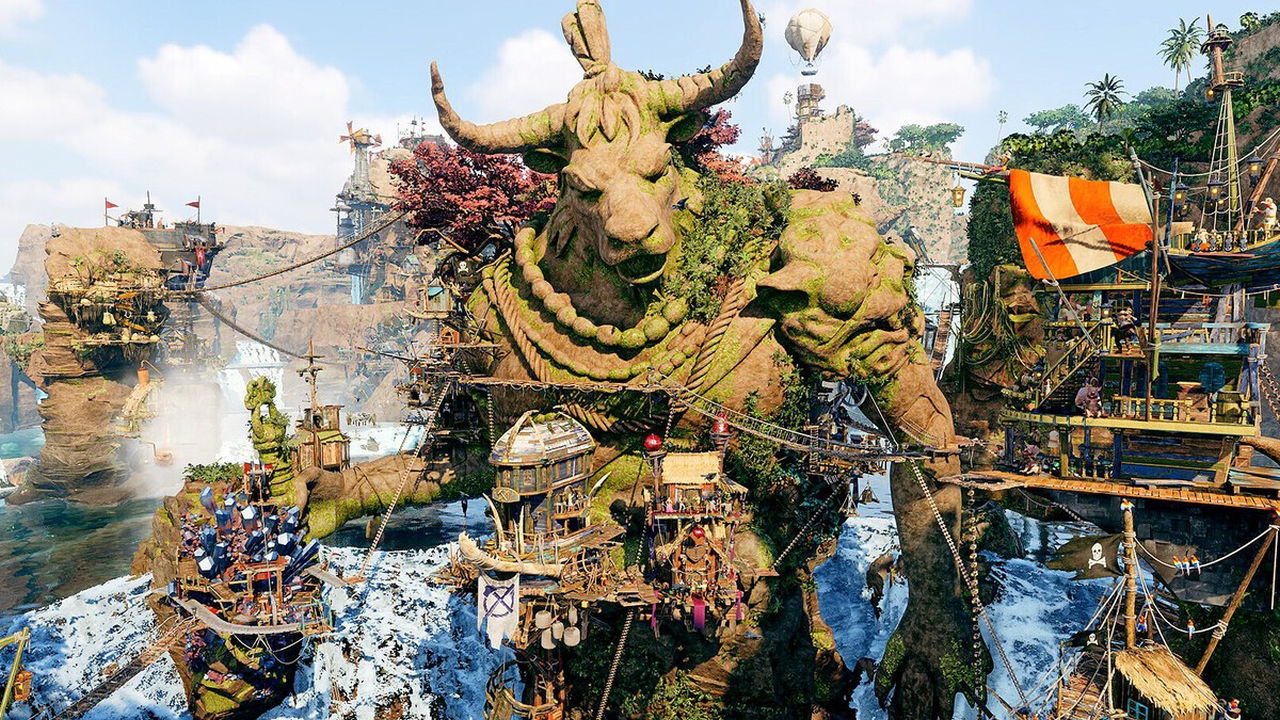
REVIEW – It’s a city-building game with a pirate twist. It’s not as straightforward as SimCity, not as laid-back as Tropico, and not as poorly optimized as Shitties Cities: Skylines. However, from the very first moment, Limbic Entertainment’s game can be downright ruthless, and it’s by no means certain that it will loosen its grip later on, however figurative that may sound.
You might find yourself muttering, “What the hell is this?” the moment Corsair Cove drops the empty map in front of you. And yes, despite that, this is what you have to work with.

Flat Ground? Well, There Isn’t Any Here
It’s rare to see such a hilly and uneven area on which we are expected to build, and yet there’s a ladder here, an elevator there, and a walkway over there. Slowly but surely, we can connect the structures built on the available land, which need to link up with the pirate camps. At first glance, the whole thing seems ridiculous, but everything will eventually come together on this little island, where we have to build ourselves up from our shipwrecked beginnings. You’ll see this in the architecture too, as some buildings look so rickety that a few pieces would probably fall off if you merely imagined blowing on them. All the while, they adapt to the gaps and contours of the terrain. Is this some kind of abstract Tetris?
Then, of course, we have to take care of accommodation and food, and that’s where the good old production chain comes into play. We have to acquire the necessary resources from specific sources. Nature itself will not be the obstacle; the real challenge is how we assemble the chains. For example, let’s say we need gunpowder. Fine, for that, we need a charcoal kiln, but we shouldn’t just place it somewhere random because we also need wood from fertile soil and, believe it or not, seagull droppings from the guano center. This isn’t a sentence caused by heatstroke; this is genuinely how Corsair Cove works.
Of course, the game does not ignore water transportation either, since we are trying to keep a crew of pirates alive. However, the type of ships we build also matters because they have different requirements. We unlock the more serious vessels through pirate activities, although having to grind for them could be particularly annoying at times. Larger ships require more crew members, which can harm the upkeep of our island, but if we fail to assemble a powerful enough fleet, we will not be able to progress through the missions.
This balancing act is precisely where the game finds its excitement: it does not reveal all its secrets easily, but it is not outrageously difficult either, like some kind of Kaizo hack for a retro game. The missions are usually the expected sort: see a merchant ship? Attack it. Got some goods that need to be smuggled? Set sail. We can add the grog-induced coma and hallucinations also seen in The Caribbean Sail, where we seriously have to fight zombie pirates.
The missions are varied and do not repeat themselves too often, so they cannot really be called boring. Limbic Entertainment has taken the right approach in this regard.

See You at the Whale!
Sometimes we will come across a giant whale. We have to flee from it or we will sink, but there are also several other tasks to complete. Sometimes we have to defend ourselves, while on other occasions we must launch a counterattack using defensive cards. At other times, we have to create distance using movement cards so that we do not lose members of our crew. Some cards are more powerful, but they require more resources in return. If we completely deplete those resources, our crew members may be injured or the ship itself may take damage.
It is worth experimenting here to find the right combination of the captains’ unique abilities, the ship’s category, and the bonuses provided by the crew. It is not particularly difficult to learn, and it is certainly pleasant to hear because the sound effects hit hard. Ultimately, Corsair Cove finds its place by allowing us to play at our own pace. We should not try to do too much too quickly, or the Spanish royal ships will tear us apart.
Of course, it is not perfect: browsing identical building types is not particularly easy, even though the interface itself is not that bad. However, color-coded paths show efficiency levels, and pop-up windows also warn us when something is going wrong. We can then pause the game and deal with the problems. On the other hand, the game may put considerable strain on the computer, and perhaps an 8 GB GPU and a six-core CPU are not enough for the recommended system requirements.
Poopy Pirate Practices
The placement of the droppings did not always seem easy to manage, but apart from that, it can perhaps be said that Corsair Cove is a worthy addition to the Hooded Horse catalog. Rather than veering too far into the clichéd direction we might initially have expected, it charted a somewhat more comfortable course for itself and navigated quite smoothly across that particular plank. With less grinding and better performance, its rating would be a little more rounded, but even so, it is fair to say that it is pretty good. Harr harr fiddle dee, sipping grog in the heat is no misery.
-Gergely Herpai „BadSector”-
Developer: Limbic Entertainment
Publisher: Hooded Horse
Genre: city building with pirates
Release Date: July 31, 2026
Pros:
+ You can build in even the trickiest areas
+ You can play at a comfortable pace
+ The audiovisual presentation is pretty good
Cons:
– What is optimization?
– In some places, you have to grind quite a lot
– Whose stupid idea was it to make us plan around guano…?
Corsair Cove
Gameplay - 7.7
Graphics - 7.8
Story - 6.7
Music/audio - 7.8
Ambience - 8
7.6
GOOD
It feels unusual at first, but then it begins to show what it can do, and that is when it really gets going.

![[GC 2026] Ontos: A Look at Crombie's Experiment [VIDEO]](https://thegeek.games/wp-content/uploads/2026/08/theGeek-Ontos-302x180.jpg)
![[GC 2026] Zoopunk: Three Little Animals Kick and Punch—and Then Some [VIDEO]](https://thegeek.games/wp-content/uploads/2026/08/theGeek-Zoopunk-302x180.jpg)
![[GC 2026] Billy Boyd Joins the Cast of There Are No Ghosts at the Grand [VIDEO]](https://thegeek.games/wp-content/uploads/2026/08/theGeek-There-Are-No-Ghosts-at-the-Grand-302x180.jpg)
![[GC 2026] The Creature-Collecting Roco Kingdom Is Coming to Us from China [VIDEO]](https://thegeek.games/wp-content/uploads/2026/08/theGeek-Roco-Kingdom-clean-302x180.jpg)
![[GC 2026] Tarae: The Unbound: A New Far Eastern Flavor from Krafton [VIDEO]](https://thegeek.games/wp-content/uploads/2026/08/theGeek-Tarae-The-Unbound-302x180.jpg)
![[GC 2026] Like or Die: A Showdown Between Streamers from NCSoft [VIDEO]](https://thegeek.games/wp-content/uploads/2026/08/theGeek-Like-or-Die-clean-302x180.jpg)
![[GC 2026] Final Fantasy VII Revelation: The Planet's Crisis [VIDEO]](https://thegeek.games/wp-content/uploads/2026/08/theGeek-Final-Fantasy-VII-Revelation-302x180.jpg)


![Tides of Annihilation’s New Trailer Unleashes Its Wild Arthurian Fantasy Action [VIDEO]](https://thegeek.games/wp-content/uploads/2025/11/theGeek-Tides-of-Annihilation-302x180.jpg)
![[GC 2026] Ontos: A Look at Crombie's Experiment [VIDEO]](https://thegeek.games/wp-content/uploads/2026/08/theGeek-Ontos-300x365.jpg)
![[GC 2026] Zoopunk: Three Little Animals Kick and Punch—and Then Some [VIDEO]](https://thegeek.games/wp-content/uploads/2026/08/theGeek-Zoopunk-300x365.jpg)
![[GC 2026] Billy Boyd Joins the Cast of There Are No Ghosts at the Grand [VIDEO]](https://thegeek.games/wp-content/uploads/2026/08/theGeek-There-Are-No-Ghosts-at-the-Grand-300x365.jpg)
![[GC 2026] The Creature-Collecting Roco Kingdom Is Coming to Us from China [VIDEO]](https://thegeek.games/wp-content/uploads/2026/08/theGeek-Roco-Kingdom-clean-300x365.jpg)
Leave a Reply