
Jon L. Noble, a former British soldier, volunteered to test a neural implant that could one day make paralysis far more bearable for people living with it. What he has now demonstrated is not just a technological marvel, but a powerful sign that even severe paralysis does not necessarily mean losing access to the digital world forever.
In recent days, it has once again become painfully clear how difficult it can be to reclaim anything close to a normal life after an accident leaves much of the body immobile. Cases like these highlight not only the physical burden, but also the crushing emotional weight of being unable to live as one once did. Fortunately, science continues to move forward in ways that may ease some of that suffering, and one of the most striking recent examples is the story of Jon L. Noble, who has been testing one of the first cybernetic implants developed by Elon Musk’s company Neuralink and has managed to return to one of his favorite pastimes: video games.
The former British Army soldier was involved in a traffic accident in 2016 that left him severely paralyzed and almost entirely unable to use his four main limbs. As a result of quadriplegia, he could not move independently and became bedridden. Nearly ten years later, he volunteered to test Neuralink’s N1 implant and entered the program as Patient 18. The device is designed to translate the brain’s electrical impulses into signals that can be interpreted by external systems, allowing the user to interact with computers and other devices again through thought alone.
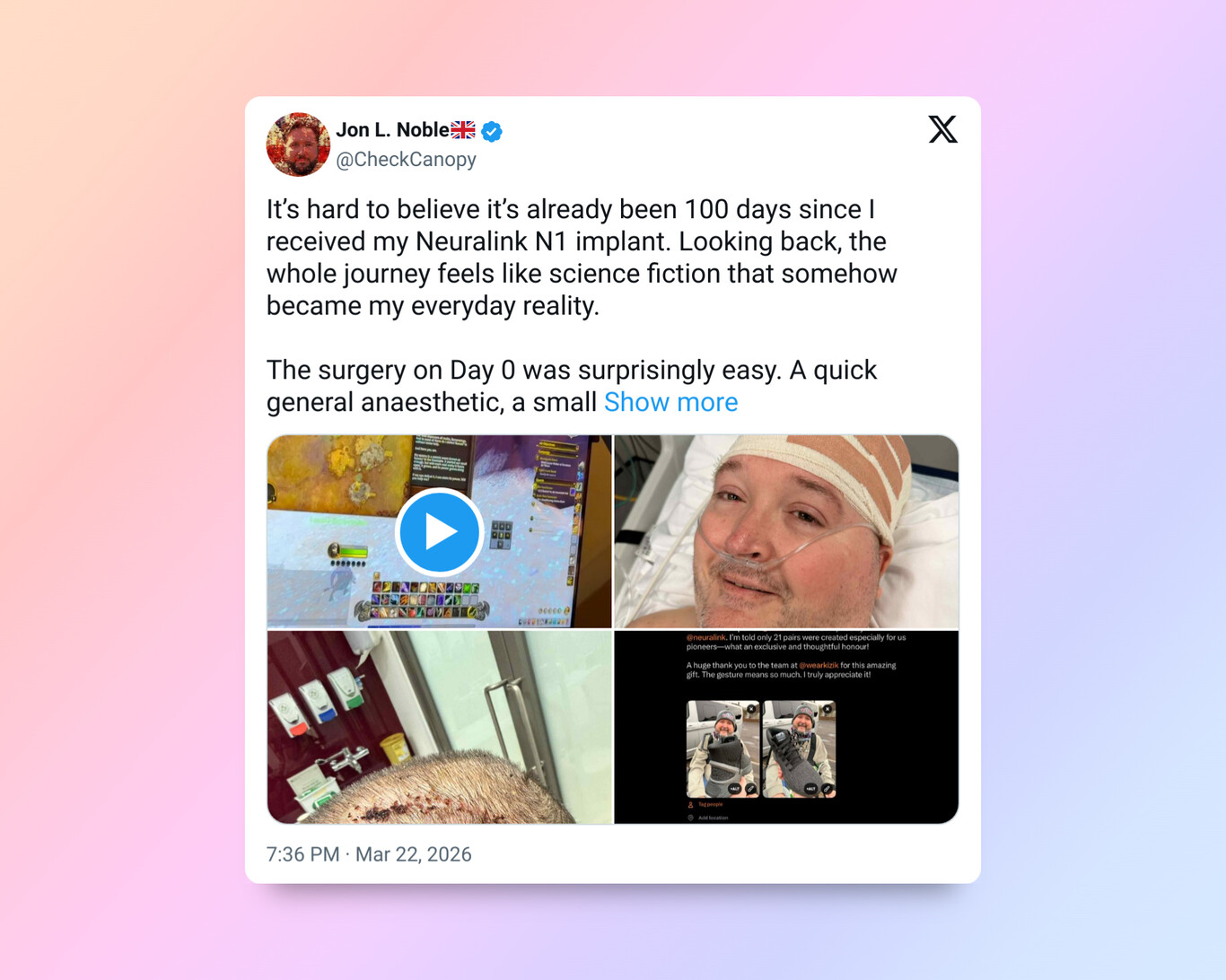
Digital telekinesis in World of Warcraft
That is exactly what Jon L. Noble has now achieved. Around three months ago, he underwent surgery to have the N1 implanted into his cerebral cortex. At first, he struggled to adapt to using a computer with nothing but his thoughts, but within a few weeks he became so comfortable with the system that, in his own words, it started to feel almost like “second nature.” The truly remarkable part came shortly after that: roughly 80 days after beginning to use the implant actively, he decided he wanted to play World of Warcraft again.
At first, it took him some time to regain control of his character, but after a few days he was reportedly handling it as though he were using a conventional mouse and keyboard to play Blizzard’s MMORPG. He was not only able to move fluidly through the world, but also to fight effectively, and he even joined a raid where he performed on par with the rest of the team and helped defeat the boss. In practical terms, Noble managed to play and succeed in World of Warcraft using what he himself described as “digital telekinesis.”
A glimpse of what future recovery could look like
The obvious goal of the implant is not simply to allow people with paralysis to return to gaming, even if that makes for a vivid and compelling demonstration. What Noble’s achievement really shows is that the N1 may be a viable tool for restoring at least some degree of independence to people living with severe paralysis. The fact that he could function in a game such as World of Warcraft, which demands a high number of actions per minute and fast reactions in activities like raids, simply by thinking through what he wanted to do, is a strong indication of that potential.
The technology may eventually be capable of far more. For now, it remains in the clinical trial stage, but if cases like Noble’s continue to succeed, then broader applications become much easier to imagine. In the years ahead, one possible development would be compatibility with external mobility systems, allowing people with severe paralysis to use exoskeletons or robotic limbs to regain some degree of physical movement, perhaps even walking again or interacting with objects directly. That remains a matter for the future, but the progress already demonstrated by Jon L. Noble and other patients in the program is undeniably promising.
Source: 3DJuegos














Leave a Reply