
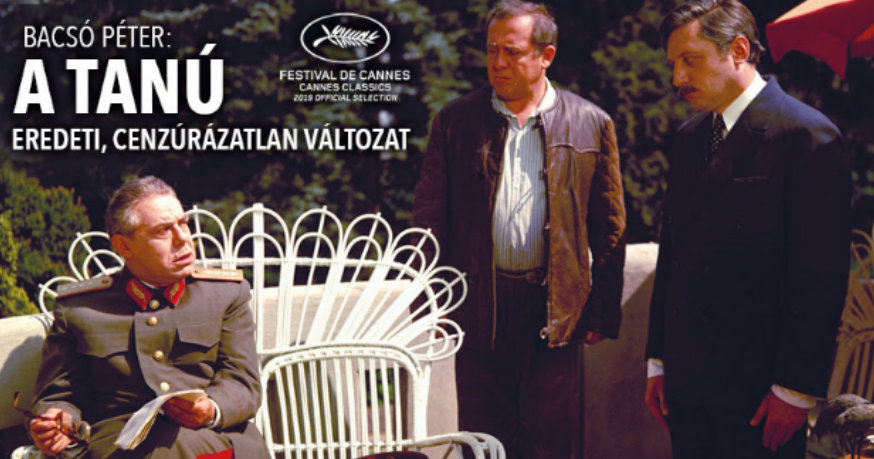
RETRO MOVIE REVIEW – “The international situation is escalating,” “Hungarian orange,” which is “a little sour, but ours,” “Let us leave sexuality to the opium of the decadent West,” “They do not even want to assassinate Comrade Bastya anymore?! Am I worth nothing now?!”, “Life is not a cream cake!” – these are just some of the lines that became catchphrases, mocking not only state socialism, but also the Fidesz-style, Orbánist, demagogic, brain-dead populism of our own time, along with the blood-chilling absurdity of dictatorships in every era. Even though the uncensored, restored version of The Witness evokes a past of more than seventy years ago, in certain respects it could hardly be more relevant to present-day Hungary.
Péter Bacsó’s 1969 film, banned for ten years and later released in cinemas only in censored form, The Witness, remains to this day one of the outstanding achievements of Hungarian cinema. Much like George Orwell’s 1984, its message is eternal, and its dry, bitter humor holds up a distorting mirror to demagogic populism and dictatorships, even if it is set very specifically in 1950s Hungary, in the era of the show trials.
What makes it more – and what makes it different?
Let us quickly look at what makes this newer version different – the one that was recently screened in Cannes and, perhaps unsurprisingly, whose subtitled version was received perfectly well by a more cultivated audience that fully understood its dry humor. As we learned before the screening, around the time when the Hungarian Film Laboratory had already completed the restoration of Péter Bacsó’s eternal classic, they came across those deleted scenes and the censored ending which even the director himself had long thought lost.
During the introduction before the screening, we also learned that the restored film is in 4K, something we did not really notice much in the small, rather outdated arthouse cinema where we watched it: the colors looked faded and the picture seemed fairly blurry. In another theater with better technical parameters, the visuals will surely look much better, but then again, of course, we do not watch The Witness for the quality of its visuals…
The two different endings
Péter Bacsó had to carry out the self-censorship because a film inspired by the Rajk trial, and one that portrayed the Rákosi era “dangerously” accurately even with the deleted parts restored, could never have made it into cinemas under the Kádár regime, not even after its ten-year shelf sentence. Even so, it is something of a minor miracle that we were allowed to see this film at all, since Kádár himself had taken part in the show trial of László Rajk.
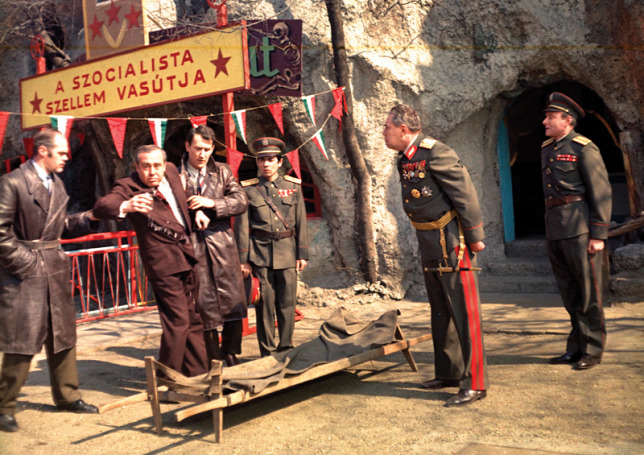
I remember the “original” The Witness quite well, and I really noticed two differences in this “director’s cut”: an extra scene was reinstated – Pelikán visits Zoltán Dániel in solitary confinement – and the scene intended as an “epilogue,” which Bacsó had added only later to soften the ending a bit, a la Blade Runner, has now been removed. In that scene, years later, a washed-up, disgraced Comrade Virág (Lajos Őze) jumps onto the packed Number 6 tram and, after yelling at the indignant crowd (“What pain am I to you people?!”), runs into Pelikán (Ferenc Kállai): “You will miss me yet!” (Virág) “I would not dare swear to that.” (Pelikán). Instead, the ending here is much simpler. I do not want to spoil it – it is worth seeing for that alone. To be honest, I liked that tram ending better.
Why does The Witness still hit so hard today?
I already wrote in my introduction why The Witness still feels relevant, but why is it that its humor still lands perfectly, while such “modern” Hungarian “film comedy” monstrosities as Kata Dobó’s Kölcsönlakás are not even in the same league? For one thing, its political humor – its ruthless satire of grotesque, demagogic communist propaganda – is such a bull’s-eye in the way Bacsó’s script and direction bring it to life that, at present, I could hardly name not only a Hungarian but even an international example that truly matches it.
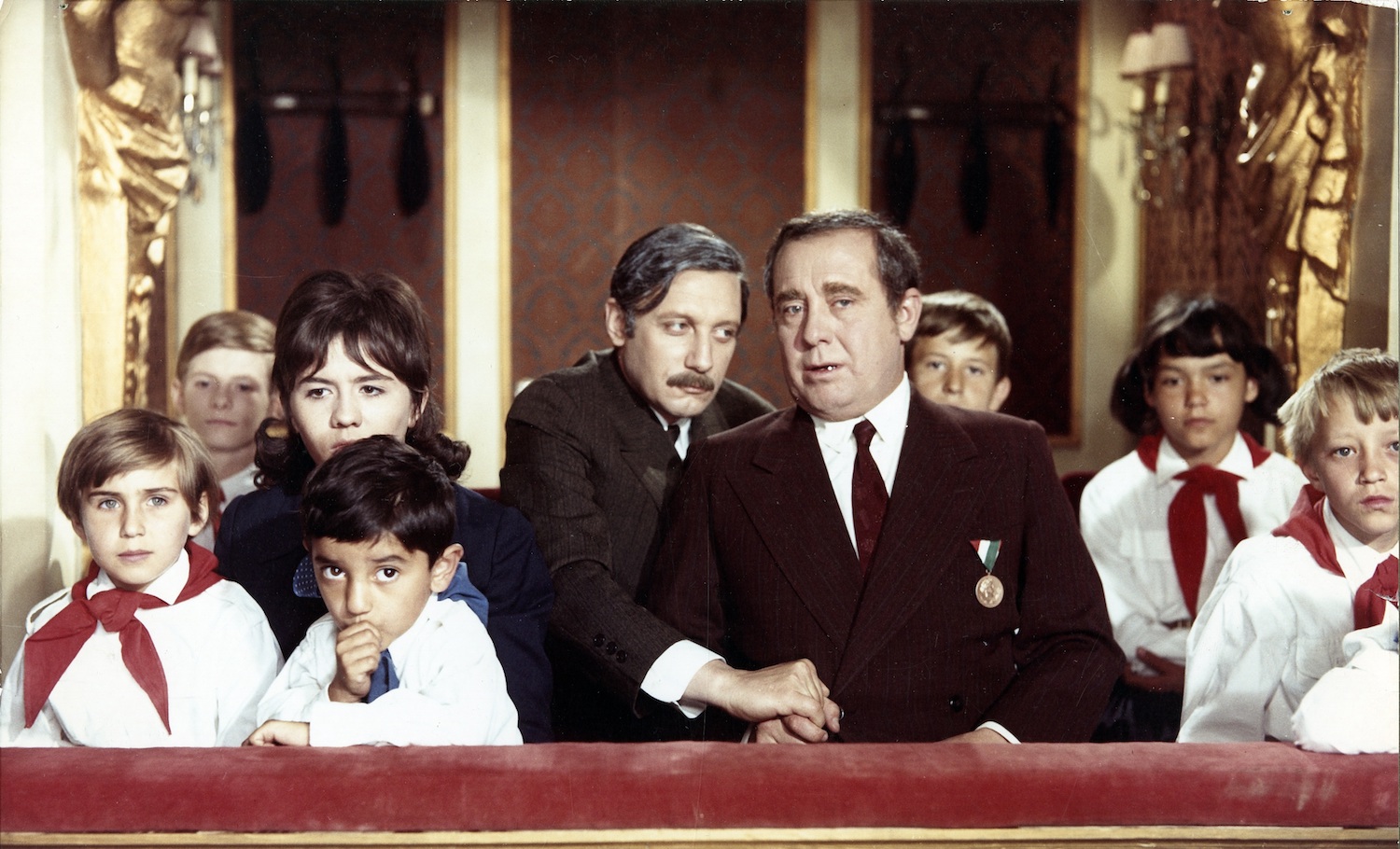
The scenes are, for the most part, simple and clean, and the camera focuses only on the actors and above all on the astonishingly professional performances of the two brilliant leads, Ferenc Kállai and Lajos Őze. The film’s humor is every bit as irresistibly funny, bittersweet, and dry as the taste of the lemon Comrade Bastya (Béla Both) bites into in the film’s iconic scene.
There are many more ways one could analyze Péter Bacsó’s masterwork, but the real point is that The Witness is an unavoidable, indispensable film, even for those who are not necessarily fans of political satire. With its dry humor, its lines and exchanges that have since become catchphrases, it helps us understand and survive both past and present alike. Against the “Comrade Bastyas” of the modern age, there is still no better line of defense than sarcastic humor – and even today there is no finer weapon for that than this brilliant, iconic film, now fifty years old.
-Gergely Herpai BadSector-
The Witness
Direction - 10
Actors - 10
Story - 10
Musique/Audio - 10
Ambience - 10
10
MASTERPIECE
Péter Bacsó’s masterwork could still be analyzed in countless different ways, but the essential point is really this: The Witness is an inescapable, indispensable film, even for those who are not necessarily fond of political satire. With its dry humor, and with lines and exchanges that have since become part of everyday cultural memory, it helps us understand - and survive - both the past and the present. Against the “Comrade Bastyas” of the modern age, there is still no better line of defense than sarcastic humor, and even today there is no more fitting weapon than this brilliant, iconic film, now fifty years old.







Leave a Reply