
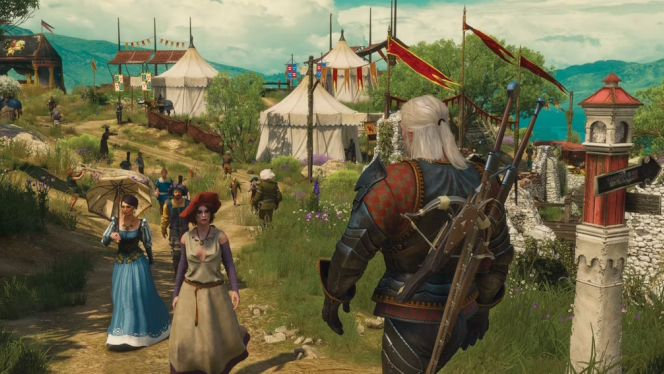
The Witcher 3: Wild Hunt was shaped by plenty of development pressure, and one of its most memorable locations came from a problem that needed solving fast. The Land of a Thousand Fables, introduced in the Blood and Wine expansion, was not originally the plan. CD Projekt RED needed a different kind of area, ran out of time for the obvious solution, and ended up creating one of the most beloved places in Geralt’s final adventure.
Video game development often produces its best stories somewhere between careful planning and pure survival, and The Witcher 3: Wild Hunt is no exception. Geralt of Rivia’s adventure was built through challenges, stressful stretches, and strange creative turns at CD Projekt RED. Paweł Sasko, associate director on Cyberpunk 2 and former quest designer on The Witcher 3, recently looked back on one of those moments while the announcement of Songs of the Past, the RPG’s third expansion planned for 2027, brought old production memories back into focus.
According to Sasko, the development of Blood and Wine was anything but simple. The second expansion for The Witcher 3 was originally called Bells of Beauclair, or BoB, before the Polish team decided it needed a stronger title: something more captivating, easier to spell, easier to pronounce, and better suited to the essence of the story. The ambition around the expansion was huge from the start. It needed a completely new country, a main storyline, new characters, monsters, mechanics, a vineyard, and a narrative strong enough to close Geralt’s journey properly. It also had to be better than the base game and Hearts of Stone, which is not exactly the sort of target that makes production meetings relaxing.
The Land of a Thousand Fables Was Not the Plan – It Was the Escape Route
By that point, CD Projekt RED had already been designing quests for Toussaint and had a clear sense of the expansion’s themes and atmosphere. The main story arrived relatively late in production, but that was not the disaster it might sound like. Sasko said that when the team implemented it, most of the components they had already designed were in place, and only a handful of adjustments were needed. The real creative collision came from one specific requirement: the writers needed a forest.
That forest was supposed to be a Druid Forest, required for a specific plot point without which the narrative could not breathe properly. When the team brought the idea to the environment artists, it received the answer nobody wants in the middle of a demanding schedule: there was not enough time, and they could not afford it. Building an entirely new forest environment was too costly for the production reality they were facing, so the developers changed strategy. Instead of forcing the original idea, they asked a more interesting question: what if they built a fairytale world instead, one where fairytales had gone rotten and wild?
That pivot became the foundation of the Land of a Thousand Fables, known internally as “Kraina z Bajki”, or the land of fairy tales. The new concept was no longer about a normal natural environment. It was about twisted archetypes, corrupted stories, and a visual language The Witcher 3 had not really explored before. Fairy tales would not appear as safe, innocent little narratives, but as unstable, grotesque spaces where familiar motifs returned in broken form. The artists said yes because the style intrigued and inspired them, turning a production problem into a chance to make something visually and tonally sharper.
The irony is that this emergency solution did not actually turn out to be cheaper. Sasko admitted that the fairytale area ended up being much more expensive to design than the Druid Forest would have been. The difference is that the more expensive and riskier idea did not merely patch a narrative hole. It gave the expansion a location with its own identity. The Land of a Thousand Fables became more than a background space. It stood apart from the sunlit elegance of Toussaint by suddenly pulling the player into a darker, stranger, more absurd logic of storybook violence and broken fantasy.
That is why the result worked so well. The Witcher universe has always drawn from folklore, myths, legends, and dark fairy-tale material, but the Land of a Thousand Fables was not just another folkloric reference inside the world. It let the game step directly into the body of stories and show what happens when the safe, polished layer of fairy tales peels away, leaving violence, desire, selfishness, and corruption underneath. Blood and Wine became not only bigger because of it, but stranger. That strangeness is part of why the location has stayed so strongly in players’ memories.
The development anecdote is especially revealing because it shows how creative pressure does not always produce a weaker compromise. CD Projekt RED did not get the thing it originally asked for, but the deadline, the resource problem, and the limits of environment production pushed the team toward an idea that ultimately became much more memorable than the safer option. A Druid Forest probably would have worked. The Land of a Thousand Fables became iconic.
Blood and Wine remains one of the strongest parts of The Witcher 3, and the Land of a Thousand Fables is a major reason why. It is strange, colorful, unsettling, playful, and still completely compatible with the cruelty of Geralt’s world. The best part of the story is that it was not born from a calm, perfectly scheduled creative process. It came from someone needing to solve a narrative problem quickly when the traditional solution was no longer possible. Sometimes the best locations are made that way: not because everything went according to plan, but because nothing did.
Source: 3DJuegos










Leave a Reply