
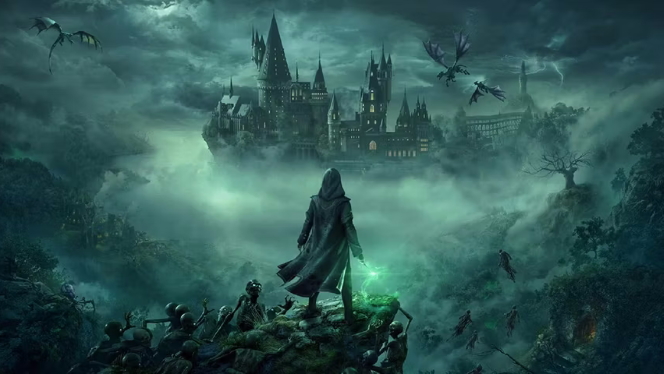
Commercial agreements with theme parks and the need to create a castle that could actually be lived in reshaped the Hogwarts you already knew. Avalanche Software did not simply copy the film sets, but built a wizarding world whose internal logic also works while you play.
The first time you enter the Great Hall in Hogwarts Legacy, something does not quite add up: the proportions are different, the light falls differently, and yes, the tables, candles and stained-glass windows filtering that golden hue are there, but the space is not exactly what you remember. It does not feel like the Hogwarts from the films, and as you explore the castle, you notice that feeling growing stronger. However, this is not a mistake, but rather a question that needs to be answered in a different way: why is it different, and who decided it should be?
The short answer is that Avalanche Software made a conscious decision not to copy the films, but the longer version begins by acknowledging something many people do not know: the cinematic Hogwarts was not even consistent within itself. The castle in Harry Potter and the Philosopher’s Stone does not have the same corners as the one in Harry Potter and the Prisoner of Azkaban, and neither is identical to the one we see destroyed in Harry Potter and the Deathly Hallows. It changed from film to film, with its exteriors filmed at Alnwick Castle and Durham Cathedral, its interiors at Leavesden Studios, and that central model that served as a visual reference. There was no canonical Hogwarts to work from, so Avalanche had to fill in the gaps.
A Castle Has to Work on the Inside
Alan Tew, the game’s director, summed up the challenge in a single sentence on the official PlayStation Blog: “There were hundreds of decisions to make between the lore and the gameplay, and also between the differences between each film and each book.” Making a castle work as a playable space demands a consistency that film never required, since in a movie it does not matter if the kitchen does not match the location of the basement. In a video game, things change, especially if it is open-world: the player can go from one location to another in 30 seconds, and any inconsistency becomes immediately apparent.
To resolve this, Avalanche used the books as a structural reference and the films as an emotional one. Boston Madsen, the castle’s artistic director, described it in an interview with Screen Rant as “reaching a compromise” between the two versions: the main intention was to capture the most nostalgic aspects of each without copying either verbatim. The result is not a recreation, but rather an interpretation, and in several aspects this interpretation is more faithful to the books than to the films themselves: the layout of certain classrooms, the logic of the moving staircases, and the spaces that the films ignored and the game reclaims by making them habitable.
Being set in the 19th century gave the team a degree of creative freedom that would have been impossible in another era. The game takes place almost a hundred years before the novels, which justifies some differences, but also provides an opportunity for creativity without betraying the established canon. The Whomping Willow, for example, is not present because it was not planted until 1971, and the Screaming Shack does not yet exist either. The developers themselves confirmed these absences and acknowledged that they had made a “rookie mistake” when they included the tree in early promotional materials, but they were able to correct it before launch. The time period was not just a narrative device; it was a design tool.
Licences, Parks, and the Version No One Can Copy
There is a layer to this story that almost never appears in analyses of the differences between the game and the films, one that has to do with commercial agreements. Since 2010, Universal Studios has operated The Wizarding World of Harry Potter under an exclusive licence signed with Warner Bros., so it owns the rights to a specific version of the castle based on the film design. Warner Bros. also has a vested interest in Hogwarts Legacy being its own version of the universe, but not a replica of the space a competitor uses in its parks.
Although licensing is not discussed in design meetings, its consequences are noticeable in the final product. The important thing is that this restriction, far from harming the game’s final result, pushed Avalanche in the right direction: the team did not try to replicate something lacking a coherent plan, but rather built a castle that worked from within. Thanks to this, they had a space with its own internal logic, one where everything makes sense in its place and where moving from one area to another is logical without the game manipulating loading times.
In the early 2000s, Harry Potter games recreated fragments of the cinematic castle with the fidelity that technology allowed at the time. They were recognisable spaces, but they were also closer to being an interactive museum than a habitable place. Hogwarts Legacy took that to the next level with a castle that functions as a continuous and coherent environment, so you can walk from the dungeons to the Astronomy Tower without the experience breaking. Unfortunately, that continuity comes at a price in visual fidelity to certain specific images from the films, but it is a price worth paying.
If you think about Hogwarts in Harry Potter and the Goblet of Fire, your memories of the film probably do not quite match what you saw in the game, and that makes perfect sense. This is a direct consequence of taking seriously something no previous version had fully considered: building Hogwarts so that someone could actually live in it. Boston Madsen spoke of the castle as a living entity with secrets and passageways for the player to discover. This idea, of a castle that breathes, that has its own logic, and that holds its own mysteries, cannot be inherited from a set; it has to be built from scratch.
What Avalanche delivered is not J.K. Rowling’s Hogwarts, Chris Columbus’s, the director of the first two films, or David Yates’s, the director of the final four. Their castle is the first designed to be played, so it comes with all the decisions, restrictions and freedoms that entails. Therefore, if while exploring it you feel something does not quite match your memory, it might be worth asking yourself if what you remember was as coherent as you thought, or if it was simply very beautiful to look at.
Source: 3DJuegos




![Moon Studios Has Postponed the Release of No Rest for the Wicked! [VIDEO]](https://thegeek.games/wp-content/uploads/2024/04/thegeek-no-rest-for-the-wicked-2024-302x180.jpg)

![Dragon’s Dogma II: Dark Arisen: Major Free Update Ahead of the DLC [VIDEO]](https://thegeek.games/wp-content/uploads/2026/09/dragons-dogma-dark-arisen-1280x720-2-302x180.jpg)






![Moon Studios Has Postponed the Release of No Rest for the Wicked! [VIDEO]](https://thegeek.games/wp-content/uploads/2024/04/thegeek-no-rest-for-the-wicked-2024-300x365.jpg)
Leave a Reply