
![Driver: Parallel Lines – Repainted, Waxed and Souped Up [RETRO – 2006]](https://thegeek.games/wp-content/uploads/2026/07/theGeek-Driver-Parallel-Lines.jpg)
RETRO – Driv3r was such a massive disappointment that everyone awaited its sequel with extreme skepticism. Released a year later on older consoles and in 2007 on PC, Driver: Parallel Lines tried to correct the previous installment’s mistakes with a new hero, a new era and GTA-style gameplay elements, while retaining the essence of the series… The console version of Driver: Parallel Lines turns 20 this year, which is why this retro review has been updated.
What happens when a development team completely screws up the much-anticipated third installment of a well-established, successful brand? Well, they can pack up, call it a day and disband the team, or perhaps move on to another line of work. Or they can make a completely new game in which they can proudly show just how innovative they are. Then there is a third option: pull themselves together properly, weed every single mistake out of the game and perhaps freshen it up with “new” features that have already proven themselves elsewhere. The team made famous by the Driver series, Reflections, chose the latter solution…
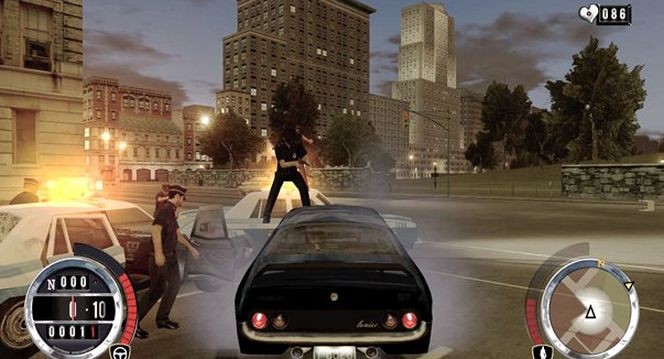
Come on baby light my car…
The first, and perhaps one of the most important changes, concerned the game’s era and its protagonist. Instead of good old Tanner, the supercop embedded among criminals, we get to welcome a new “driver.” TK is a tough New York kid, and apart from looking strikingly like Val Kilmer in The Doors, he is a genuine criminal, not some cat-and-mouse-playing “undercover cop” like Tanner was in the earlier installments. I assume the creators wanted to strengthen the GTA angle with this choice, because TK is not a particularly exciting character otherwise: he is a forcedly cool bad boy, nothing more. I found Tanner, played by Michael Madsen, to be a much stronger and more distinctive figure, whereas this time our hero’s fate did not interest me in the slightest because he was so unlikeable. The other characters are not terribly exciting either. Unlike in the previous game, where Reflections made a huge effort to ensure that the roles played by well-known stars felt as original as possible, here we got horribly bland and uninteresting characters. That is a shame, because the game’s atmosphere would otherwise be first-rate once again thanks to the cutscenes.
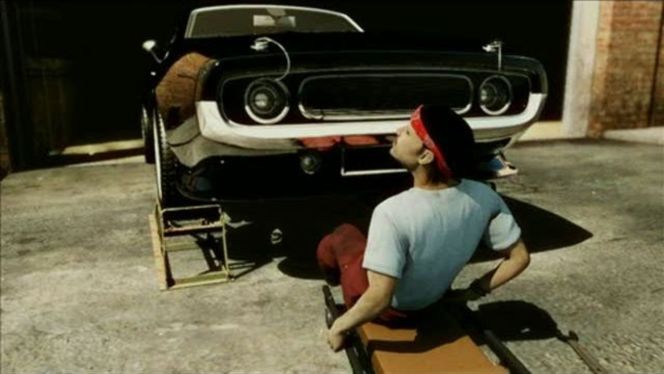
The cinematic interludes are fantastically atmospheric. Whoever created them was blessed with an incredible sense of style. It feels as if we were watching some stylized mix of a Martin Scorsese or Quentin Tarantino film and, say, Starsky & Hutch: washed-out colours, film-like effects and excellent camera angles. The story takes us to New York in 1979, where, alongside our driver who is naïve yet rotten to the core, we have to transport gangsters, prostitutes, petty criminals and more serious offenders, or carry out missions for them. Just like in GTA, there are no good guys or bad guys here, only interests, smaller and larger bosses, and big fish that eat the little ones, or the other way around if we find ourselves on the weaker side and play our cards well. This setup would not be uninteresting if they had managed to find compelling characters for the story…
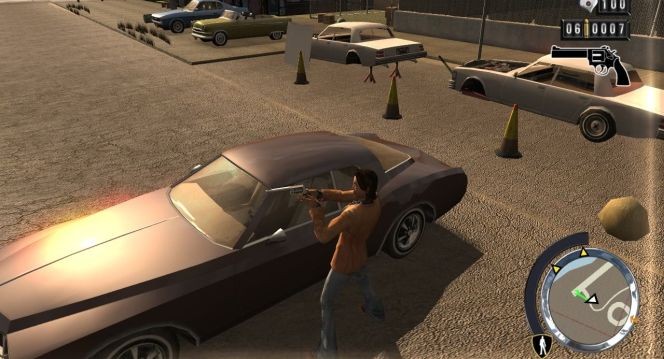
Grand Theft GTA
The other novelty is the introduction of GTA elements, something that had not characterized the series before. While in earlier installments we completed missions in a linear fashion, one after another, here we can decide for ourselves which mission to take on by selecting it on the large map and driving to the appropriate location. This sounds good in theory, but in practice the missions are terribly unimaginative, and it is obvious that the creators made no real effort to develop them properly. I maintain that the missions in Driv3r were miles more exciting and integrated into the story far better. There, the problem was rather that some of them were so hellishly difficult that after enough attempts you simply lost the will to continue. That is why the creators have now included missions with several difficulty levels, which can be picked up at different locations around the city. At the beginning of the game, for example, we have to collect $1,500 to progress to the later missions.
It does not matter at all which missions we take on, as long as we earn the required amount of cash from them. Many of the tasks are identical, differing only in difficulty. To make the GTA comparison even more complete, we can also take on various quick side missions. If we feel like it, we can participate in street races or even traditional car races. (See the box.) Elsewhere, a car is parked with an eye above it, just waiting for us to jump in and swiftly get a robber away from the scene of a bank heist. So this is typical GTA design, which the Reflections team shamelessly and somewhat unimaginatively lifted from Rockstar. It undeniably benefits the gameplay, but I liked Driv3r’s story-driven missions much more, even if there were often times when I slammed the gamepad to the floor because one impossible mission or another made me so angry.
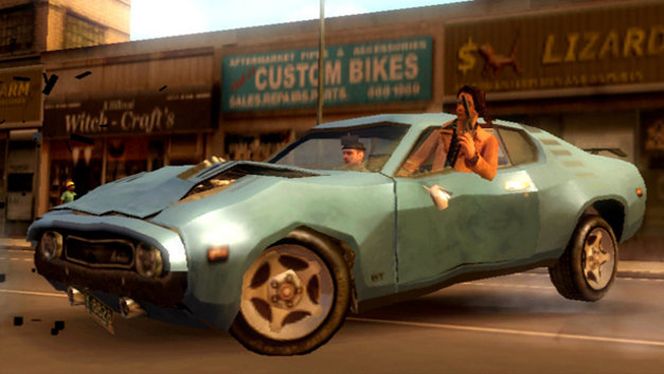
Max Pain
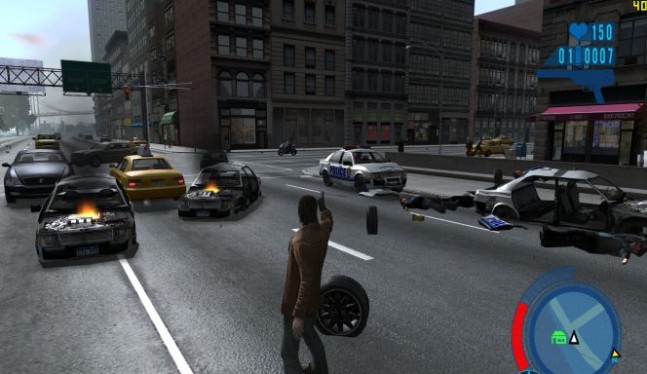
If you are already stealing from GTA, then you are obliged to borrow the TPS part too, right? Driv3r also had third-person, on-foot action, and it was rather dreadful, so we do not escape it here either. The shooting in Parallel Lines is fortunately not quite as terrible, but it is nowhere near as manageable as one would expect from a modern game. Here too, we have to mark targets with a rather lousy targeting system, and it does not feel nearly as natural as it does in Max Payne or Tomb Raider, but at least the game does not force us into these sections terribly often.
Aside from the TPS sections, we can also shoot out of the car window, and certain missions require it. It may sound like a fantastic experience to try hitting someone with a gun while hanging out of a speeding car, but the truth is that the controls were not implemented particularly well either. Whenever I could, I avoided the shooting, made my escape, or, when necessary, smashed the enemy car to pieces in collisions instead of waving a gun through the window.
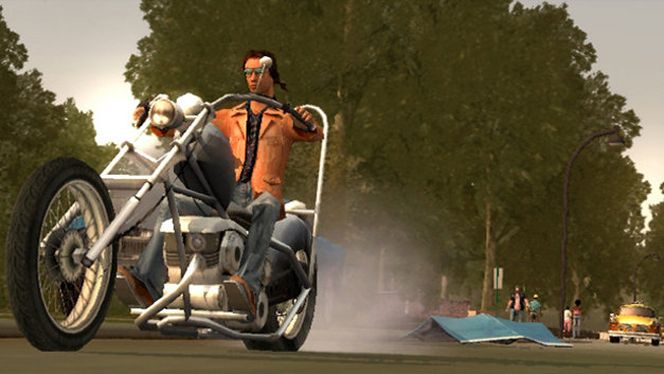
I Was Driving Before the Talkies…
At the same time, one thing did not change in Driver: Parallel Lines: the usual hair-raising chases and the handling of the vehicles. Parallel Lines uses roughly the same engine as Driv3r, so the physics and handling of the vehicles are exactly the same as in the previous game. Cars break just as realistically here, and they are nowhere near as easy to drive as they are in the GTA games, for example. I really liked this in the first game and in Driv3r, where the missions focused solely on chases and escapes, but here it can become frustrating when we have to crawl from one end of the city to the other just to pick up a task.
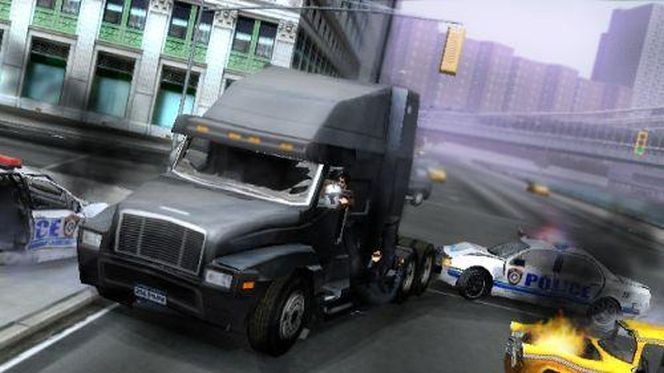
The car racing section was also terribly irritating with this engine, so I did not push it much. Even so, the heart of the game is once again the chase element, and Reflections has once more handled it perfectly. We can take part in fantastic, hair-raising pursuits while both the enemy cars and our own vehicle become increasingly battered, damaged and worn down. In this respect, Driver has always been first-rate, and it does not disappoint this time either.
“Put Your Hands on the Wheel, and I Don’t Want to See a Single Move!”
The police artificial intelligence is somewhat “better,” or at least stricter, than what we are used to in the GTA games. There is no speeding with impunity here: if the cops see you driving fast, crashing, or merely running a red light, they are immediately on your tail. We therefore have to pay close attention to the traffic code, and this can be especially annoying when we are carrying out a mission, chasing someone and the law instantly latches onto us. At the same time, if we do not enter the police cars’ field of view, nothing happens: we can run over everyone or crash into anyone. This field of view naturally expands gradually as our wanted level rises.
It is an excellent idea, and I never understood why the GTA games do not do this, that there are separate measures for the mayhem we cause on foot and the trouble we cause in cars. So if we have been causing havoc in a vehicle but the police did not see our hero get out, then stealing another car somewhere discreet will get us rid of the cops. The AI is just as aggressive as it used to be, and it is slightly funny that the police will chase us across the whole city and riddle us with bullets for something as simple as running a red light. It can be quite frustrating when, in order to avoid this, we constantly have to slow down while travelling from one corner of the city to the other, otherwise the police launch a life-or-death chase…
Not a Spring Chicken
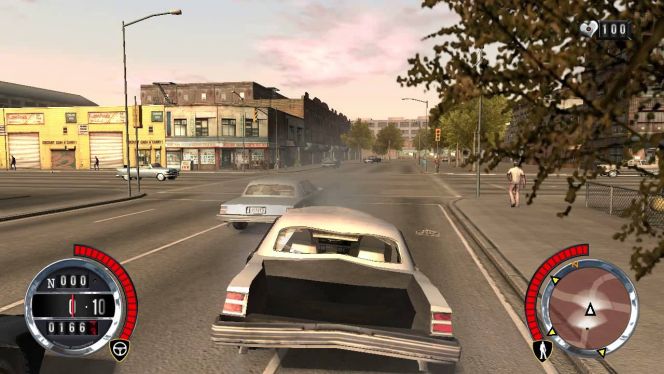
Parallel Lines uses Driv3r’s graphics engine and was also made for the previous generation of consoles, namely the PS2 and Xbox, so I assume it does not come as much of a surprise that terms such as “beautiful” and “revolutionary visuals” do not really apply to the game. At the same time, PL is not ugly either: compared to an old-school console port, the graphics are quite decent in terms of the city and vehicle rendering, and I encountered some city districts that were developed with genuinely striking detail.
The characters, however, look fairly dreadful, especially Slink, the Black crime boss who gives us missions. It is a shame that the characters were botched, because otherwise the presentation could have surpassed the graphics of Scarface, which has remained in our memory as the most impressive GTA clone released on PC up to that point. The animation is mixed as well: the movement and physics of the cars are perfect, but the way people gesture is unbelievably ridiculous in certain situations, and unfortunately this is not intentional parody on the developers’ part…
Slink, for example, flails around like some oversized, drugged-up orangutan, and that seriously damages immersion… Overall, Driver: Parallel Lines is a proper console port: we have seen prettier games, but uglier ones too, and it is definitely a step forward compared to Driv3r…
“Da music, man…”
Alongside the uneven graphics, the game’s huge advantage is the incredible sense of style that characterized every entry in the series. The end of the 1970s is brought to life perfectly through the cutscenes, the characters’ clothing and the fantastically chosen soundtrack. I never thought I would say this, but even the GTA radio stations have to hide next to the exceptionally atmospheric tracks selected with flawless taste, which we can listen to after getting into the cars. We can hear artists from the era such as David Bowie, Blondie, Parliament, Marvin Gaye and War, among many others. It becomes easy to overlook the occasionally ugly or average visuals when we can listen to one catchy song after another.
It Deserves as Much as the Year It Takes Place In…
Believe it or not, the game deserves exactly the same percentage as the year in which it takes place: 79. It is not a bad attempt, and it is undoubtedly more polished than Driv3r, but the story is much weaker, the characters are uninteresting and boring, and overall we are dealing with a fairly unimaginative, tired GTA clone with relatively outdated graphics. Its enormous strength, however, is the fantastic atmosphere created by the brilliant cutscenes and the very well-chosen music. It is a shame that this did not extend to the entire game, because then the Driver name could have become beautiful again, “worthy of its great old reputation.” As it stands, though, it is only an average sequel and clone among many others…
-Gergely Herpai BadSector-(2007)
Pros:
+ A relatively enjoyable appropriation of GTA elements
+ Fantastically selected music tracks
+ Pleasant graphics
Cons:
– Fairly monotonous and boring missions
– Completely uninteresting characters
– Less is sometimes more
Publisher: Atari
Developer: Reflections Interactive Limited
Genre: Action-Racing
Release: 2006(PS2) 2007(PC)
Driver: Parallel Lines
Gameplay - 7.9
Graphics (2006) - 8.2
Story - 7.6
Music/Audio - 8
Ambiance - 7.8
7.9
GOOD
Driver: Parallel Lines takes the series to 1970s New York and adopts a more open, GTA-inspired structure instead of Driv3r’s linear design. Its driving, high-speed chases, cinematic presentation and excellent soundtrack remain its biggest strengths, but bland characters, weak storytelling and repetitive missions limit its impact. Twenty years after its console debut, it stands as a flawed but stylish entry that improved on Driv3r without fully restoring Driver’s former glory.








Leave a Reply