
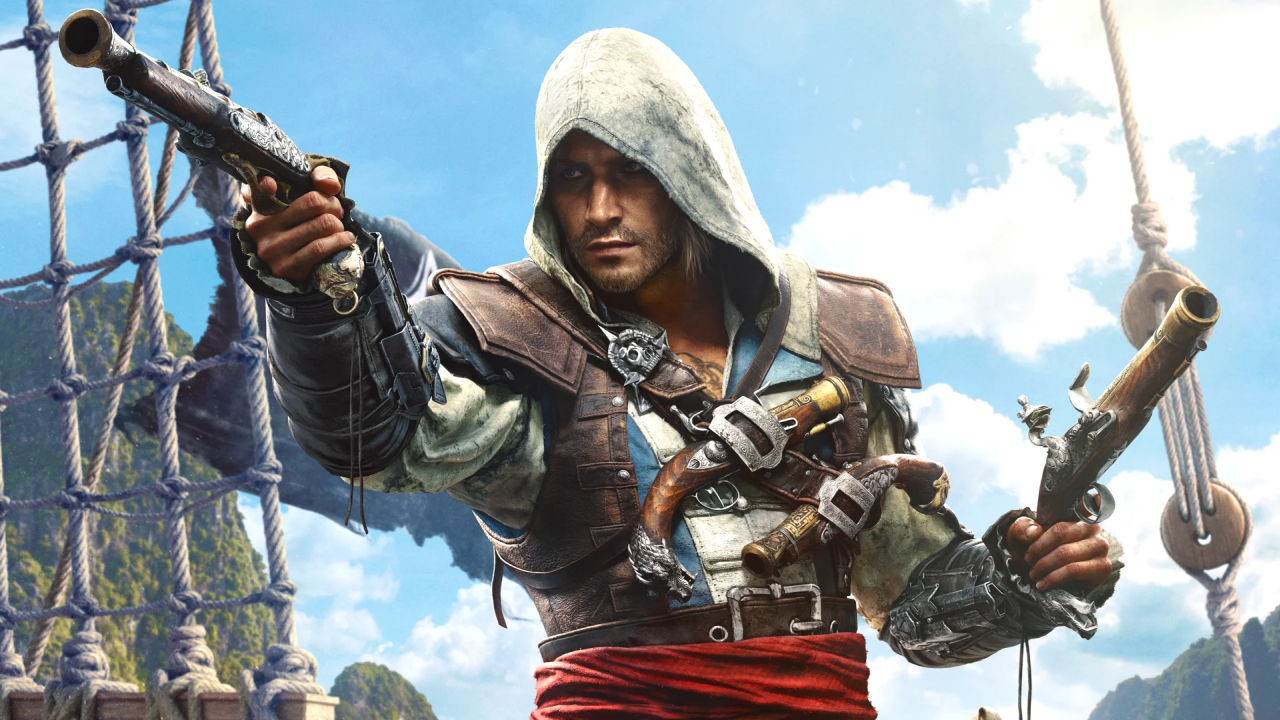
REVIEW – We tested Assassin’s Creed Black Flag Resynced on PlayStation 5, and thirteen years later Edward Kenway’s adventure is not simply prettier, but more comfortable, more flexible, and better paced in several important ways. Ubisoft Singapore modernised one of the franchise’s most beloved entries without covering it in levels, gear scores, and three separate currencies simply because another console generation had passed. The result is a spectacular pirate adventure proving once again that sometimes all you need is a good ship, a barrel of rum, and the disciplined work ethic required to rob every Spanish galleon in sight.
Thirty-nine years ago, Sid Meier’s Pirates! set the tone for me. As a child, I played it relentlessly first on Commodore 64 and later on Commodore Amiga 500, and for the C64 version I even turned a Caribbean map cut from a magazine into my own pirate chart. I burned its edges, scorched parts of the paper, and smeared it with red paint to make it look bloodstained. Looking back, it probably resembled evidence from a minor house fire more than the secret route of a notorious pirate, but at the time I was entirely convinced that finding buried Spanish gold was merely a matter of patience.
That is also why Assassin’s Creed IV: Black Flag struck the right nerve in 2013. In my original review, I already argued that Ubisoft’s game was at its best whenever it forgot, just a little, that it was an Assassin’s Creed title and behaved more like a modern Pirates!. Exploring the Caribbean, attacking ships, trading cannon fire, looting cargo, and boarding enemy decks created such a powerful gameplay loop that the main mission regularly remained untouched for hours because another ship, island, or fort always looked more urgent.
The remake’s greatest achievement is that it never tries to replace that feeling with a system somebody decided was more modern. Resynced does not attempt to turn Black Flag into a different game. It rebuilds the version many people remember: a prettier ocean, more dramatic storms, smoother movement, less irritating missions, and a Caribbean where taking a job on dry land once again feels entirely unreasonable after visiting the first port.

Edward Wants the Loot First, the Creed Can Wait
Edward is still not the kind of protagonist who wakes up at seven, puts on a hood in the name of an ideal, and spends the entire day speaking solemnly about freedom. He begins as a British privateer and becomes a pirate, while his initial goal remains refreshingly simple: he wants money, preferably a great deal of it, to secure the future of the wife he left behind and build a more comfortable life for himself. After stealing the identity of a defeated Assassin, he enters the Assassin-Templar conflict much like an ordinary person becoming trapped in an unfortunate company-wide email thread.
On paper, the story outline is hardly revolutionary. A selfish, solitary, carefree man becomes involved in a conflict much larger than himself and slowly learns that something other than money may exist in the world. It works because of Edward’s personality, Matt Ryan’s excellent returning performance, and the memorable people surrounding him. Blackbeard, Anne Bonny, Mary Read, Benjamin Hornigold, and Stede Bonnet are not historical cameos waiting to be recognised. They have their own ambitions, secrets, and failures, and many of them teach Edward more than any formal Assassin mentor.
Resynced preserves the central arc of the original story while rewriting several scenes, inserting new missions between familiar events, and expanding Edward’s relationship with important supporting characters. The new officer missions are especially successful. Members of the Jackdaw’s crew finally exist for more than shouting together on deck, receiving personal stories of their own, including shipwright Lucy Baldwin and a former pirate who became a priest.
The modern-day Abstergo sections are gone. In their place, the remake introduces Rifts, alternate “What If?” scenarios that revisit major events with different outcomes. They are not a complete substitute for the original present-day narrative, and longtime fans may reasonably feel that part of the wider Assassin’s Creed world has disappeared. Others will simply be pleased that a Caribbean naval battle is no longer followed by a mandatory session of hacking office computers.
The larger omission is Freedom Cry. Adéwalé’s story was not only a strong expansion, but also engaged more directly with the slave trade and the historical brutality of the period. Ubisoft explained that the remake was entirely focused on Edward’s Caribbean journey, but it remains difficult not to miss content that was both thematically important and historically relevant to the legacy of the original Black Flag.

Get Spotted, Draw Your Sword, Not a Loading Screen
Stealth, sword fighting, and parkour remain the three pillars of the land-based gameplay, but all of them are more comfortable now. The best change is the removal of automatic mission failures from sections originally built around mandatory stealth. If a guard spots Edward in tall grass, or if we get too close during a tailing sequence, the game no longer throws up an immediate desynchronisation screen. We can continue, improvise, or simply draw our swords and explain that this is a louder interpretation of stealth.
Edward can now crouch with a dedicated button, raise his hood, use smoke bombs, hide in vegetation, and strike from above. Revised level design generally allows several routes through the same area, making it possible to approach patiently from the rooftops or openly with two swords and as much gunpowder as we can carry.
In that respect, Resynced feels pleasantly more flexible than Assassin’s Creed Shadows. Naoe often made stealth feel nearly mandatory, while Yasuke’s open combat could feel slower and more limited than his strength suggested. Edward remains viable in both situations. Quietly clearing an entire garrison is satisfying, but the game does not punish us when the plan collapses at the third guard and turns into a respectable public brawl.
The combat system has been rebuilt, although it never becomes an elaborate action RPG. Light and heavy attacks are available, precise parries form the centre of defence, and breaking an enemy’s guard opens the way for spectacular executions and chained takedowns. Edward can sweep opponents off their feet, kick them into walls, interrupt attacks with pistols, and use the rope dart to pull enemies toward his blade as though Scorpion had recently joined the Assassin Brotherhood.
Progression remains restrained. There are no gear levels, endless stat numbers, or enemies surviving a sword through the chest because a smaller number happens to be floating above our head. We can expand ammunition and healing capacity, find stronger weapons with unique benefits, equip talismans, and gradually widen Edward’s possibilities. Certain special blades, including Naoe’s swords, can even enable chains of up to four consecutive takedowns.
The system is immediate, flashy, and fun, but still not particularly deep. Parries become routine, target selection can grow chaotic in larger crowds, and enemy artificial intelligence remains capable of ignoring Edward from two metres away before identifying a seagull behind a bush as an urgent threat to national security. The light, cinematic swordplay of the original survives, however, and the new animations ensure that almost every encounter looks impressive.
Parkour flows more naturally too. Edward recovers from drops more quickly, links jumps, swings, and vaults with less hesitation, while side and back ejects return to the movement system. Large cities once again feel like proper playgrounds. Moving across Havana’s rooftops can be enjoyable without any destination at all, while Nassau’s rougher streets create a different rhythm. Edward still occasionally chooses to climb a barrel instead of entering the open doorway beside it, because the ancient Assassin code apparently forbids travelling in a straight line, but movement is far better than in several recent entries.
The Main Mission Can Wait, the Jackdaw Has Already Sailed
The true protagonist of Black Flag is still not Edward, but the Jackdaw. The moment we gain control of the ship, the story quickly falls into the background while we sail away with a firm plan to inspect one nearby wreck. Two hours later, we have robbed four brigs, captured a fort, hunted animals on an unknown island, and entirely forgotten which port contained the historical figure waiting for the next story mission.
Sailing remains fantastic. Turn off the HUD, let the crew sing sea shanties, and watch new islands, storms, and unfamiliar sails appear on the horizon, and the game creates a sense of freedom few open worlds achieve so naturally. There is no need to tick icons every minute. Choose a direction and let the world decide what the next problem will be.
A merchant vessel may appear carrying valuable cargo. Two large warships may be fighting in the distance. A storm may cover the sky while the waves begin throwing the Jackdaw around. Or a ship three times more powerful than ours may appear, at which point a sensible person would turn away, while a Black Flag player thinks: it probably has metal.
Dynamic weather is more than a visual effect. Wind and waves influence the ship’s movement, while storms make manoeuvring genuinely difficult. Naval weapons now have secondary firing modes, new offensive options have been added, and enemy ships defend themselves more effectively. Some captains charge directly into a Man-O’-War at full speed, while others soften it from a distance with mortars and cannon fire. Both methods can work, although the first sometimes becomes a very brief but highly educational lesson in navigation.
Severely damaged ships can still be boarded. We swing onto the enemy deck, eliminate officers, cut down the flag, and then decide whether to add the captured vessel to our fleet, reduce our wanted level, or use it to repair the Jackdaw. The last option is particularly useful when every reasonable argument says it is time to return to port, but another wealthy-looking ship appears on the horizon.
Upgrading the Jackdaw remains one of the strongest motivations in the game. A stronger hull, improved cannons, mortars, heavy shot, and defensive upgrades gradually transform a vulnerable brig into the Caribbean’s floating tax authority. Great Inagua grows alongside Edward and becomes a genuine home base, with new buildings and useful rewards. Returning eventually feels like coming home, except most homes have fewer cannons aimed at the entrance.
The locations remain remarkably varied. Havana’s elegant density, Nassau’s dirtier pirate atmosphere, fishing villages, untouched islands, Mayan ruins, and underwater areas continually offer new scenery. The remake expands the diving sections, adds new ship and character customisation, hides more sea shanties around the world, and includes additional side stories that give even players who methodically looted the original something new to discover.
Visually, the game is extraordinary. Rebuilt with the latest Anvil technology, the Caribbean is not merely more detailed. Crystal-clear water, dense vegetation, distant islands, sunlight sparkling across the waves, and skies turning black during storms create a world that regularly makes stopping for no practical reason feel entirely justified. I sometimes stopped the Jackdaw simply to look around, which is probably a disciplinary offence for a pirate captain but perfectly understandable for a player.
Quality mode produces such a sharp and richly detailed image that the lower frame rate is easy to forgive, while Performance mode makes parkour and combat even smoother. The draw distance constantly suggests another detour, and Photo Mode will probably extend some players’ time more than several complete side missions. Small issues remain: swords clip through clothing, collars occasionally collide with Edward’s chin, and cloth physics do not always behave properly.
Some side activities also preserve less valuable pieces of the 2013 design. Assassin Contracts are too simple, certain collectibles become boxes to tick, and a few old mission structures feel dusty. These weaknesses are minor compared with how effectively the complete pirate sandbox still works. Resynced takes few reckless risks, but its foundation was too strong to justify changing things merely for the sake of change.
The original Black Flag received a 9.1 from me, and Resynced earns that additional tenth. Not because it fixes every flaw, and not because it makes the older version meaningless. It earns it because it demonstrates again why Edward Kenway’s adventure escaped the boundaries of Assassin’s Creed and remained one of the finest pirate games ever made. The Caribbean is prettier, sailing is even better, unnecessary obstacles have been reduced, and the game still has only one serious flaw: we are expected to do something else the next morning.
-Gergely Herpai “BadSector”-
Developer: Ubisoft Singapore
Publisher: Ubisoft
Genre: open-world action-adventure
Release date: July 9, 2026, PlayStation 5, Xbox Series X|S, PC
Pros:
+ The Caribbean is more beautiful, alive, and inviting than ever.
+ Sailing, naval combat, and exploration remain brilliantly addictive.
+ The new stealth, combat, and quality-of-life features significantly improve the original formula.
Cons:
– Combat is spectacular but still slightly shallow over time.
– Enemy AI and several side activities remain stuck in the past.
– The absence of Freedom Cry is a difficult loss to justify.
Assassin’s Creed Black Flag Resynced
Gameplay - 9.3
Graphics - 9.6
Story - 9
Music/audio - 9.5
Ambience - 9.2
9.3
AWESOME
Assassin’s Creed Black Flag Resynced does not attempt to reinvent Edward Kenway’s adventure, but makes it prettier, more comfortable, and more enjoyable in every important area. Its spectacular Caribbean, fantastic sailing, improved stealth, and new content establish a new standard for pirate video games. Several old weaknesses and the absence of Freedom Cry still hurt, but the moment the Jackdaw reaches open water, we quickly forget why we planned to continue the main story.




![[GC 2026] Final Fantasy VII Revelation: The Planet's Crisis [VIDEO]](https://thegeek.games/wp-content/uploads/2026/08/theGeek-Final-Fantasy-VII-Revelation-302x180.jpg)




Leave a Reply