
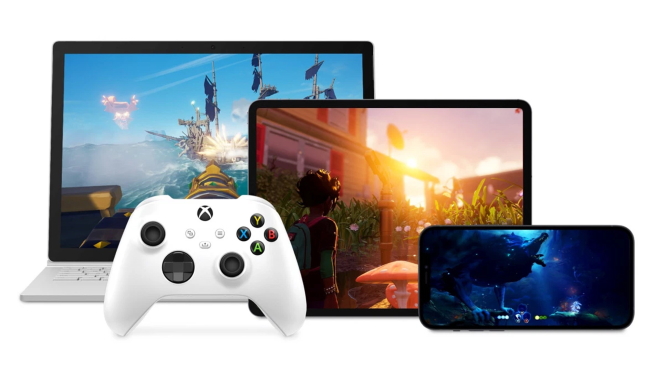
The latest changes to Game Pass have reignited the debate over the future of cloud gaming. Several experts who have followed the technology for years believe it has still failed to achieve a genuine breakthrough, while the rapid expansion of AI is now creating yet another major obstacle.
Cloud gaming has fascinated major technology and video game companies for years. On paper, it is a technology capable of removing one of gaming’s biggest barriers to entry by allowing people to play modern titles without purchasing an expensive console or powerful computer, potentially opening the industry to new markets with less purchasing power. In practice, however, the concept has never truly achieved widespread adoption. Even today, despite increasingly prohibitive console and PC component prices, cloud gaming remains far from mainstream, and the latest changes to Game Pass have once again fueled considerable pessimism among experts who have been following the technology for years.
Cloud Gaming Has More Problems Than Ever
Technology journalist Alex Perry shared his thoughts on the current state of cloud gaming on Bluesky. “I was in the OnLive beta [a 2010 cloud gaming system] and covered the launch of Google Stadia. I’ve been following cloud gaming systems since before most people even knew they existed. I’ve never been more certain that it won’t be a viable way to enjoy video games in the long run. For me personally, the latency and buffering issues are very hard to ignore. The problem, however, is that companies are ruining these services even for people who can afford to ignore them,” he wrote.
Perry’s assessment was backed by Matt Piscatella, an analyst at U.S. research company Circana. “I spent countless hours in my Activision office playing the OnLive version of Homefront back in 2011, I caught COVID in 2020 while playing Gylt on Stadia in a Santa Clara hotel, I own an Amazon Luna controller, and I’ve tried every streaming service that’s ever existed. And yes, I completely agree,” the analyst wrote on Bluesky.
One of cloud gaming’s biggest paradoxes is that while it could theoretically offer a solution to increasingly expensive hardware partly driven by the rise of artificial intelligence, it is also becoming another victim of AI’s expansion. Streaming games requires powerful server infrastructure that is not only costly but could also be used for more profitable computing workloads such as artificial intelligence. According to Windows Central, Microsoft told the publication that because of the computational demands created by AI, Xbox Cloud Gaming becomes unprofitable when a user plays for more than 15 hours per month. “They’re not very happy when space in an Azure server rack is used for anything other than AI,” the outlet commented.
Taken together, these problems make the fully cloud-based future once envisioned by several major companies appear increasingly unrealistic. If the model ultimately fails to become broadly viable, companies will need to find different ways to expand into new markets and grow their user bases. This could be particularly relevant for Sony and Nintendo, both of which continue to rely heavily on exclusive titles while taking a much more cautious approach to the PC market.
Source: 3DJuegos












Leave a Reply