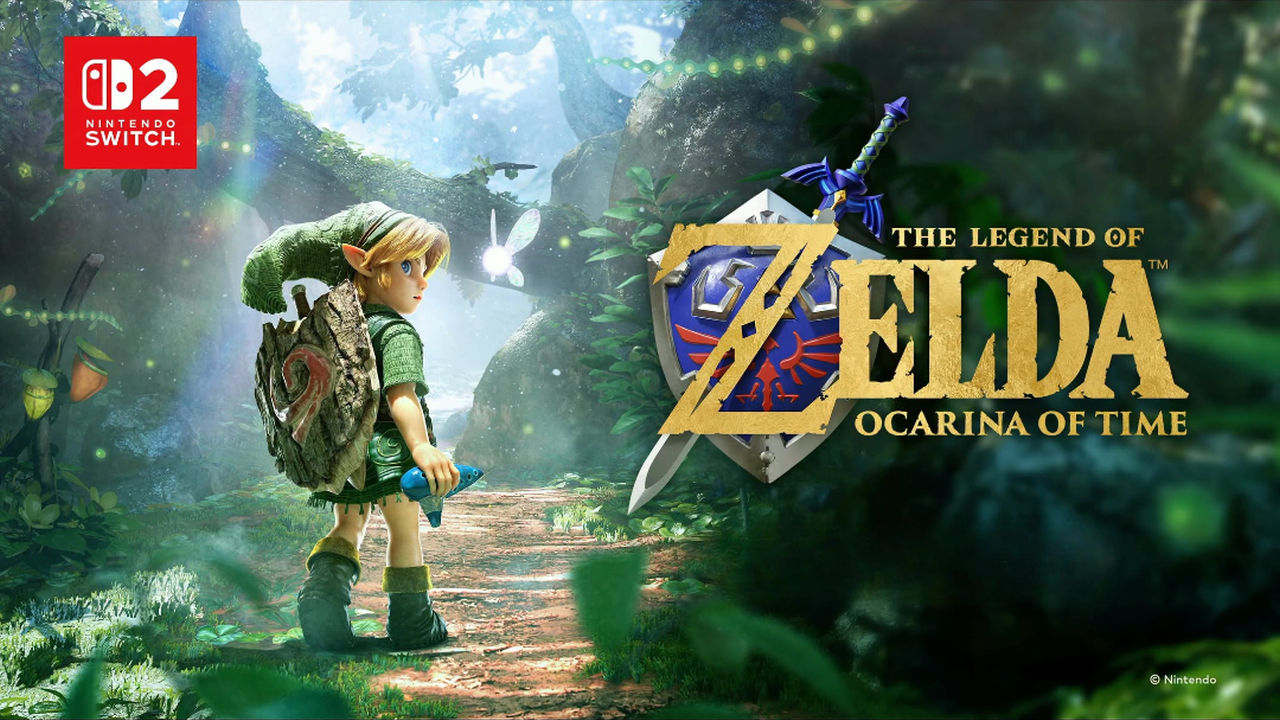
Digital Foundry’s first technical assessment of The Legend of Zelda: Ocarina of Time remake suggests Nintendo is targeting a stable 60 fps presentation on Switch 2, with most of the gameplay footage appearing to render at 1080p. The early analysis is encouraging from a performance standpoint, although the absence of NVIDIA DLSS may already be leaving some visible image-quality problems that modern reconstruction could potentially reduce.
Nintendo finally gave players an extended look at its full remake of The Legend of Zelda: Ocarina of Time during the recent Direct celebrating the franchise’s 40th anniversary. The presentation covered the dramatically redesigned visuals, gameplay adjustments, and several new features, but one area remained conspicuously vague. Nintendo did not provide detailed specifications for resolution, frame rate, or possible differences between handheld and docked play on Switch 2. Digital Foundry has now started filling in some of those blanks by examining the footage Nintendo released.
The initial results are promising. Based on the material available for analysis, Oliver Mackenzie and Digital Foundry believe the gameplay is running at 1080p while maintaining a largely stable 60 frames per second. That would represent a substantial technical upgrade for one of Nintendo’s most celebrated adventures, especially considering how much more elaborate the remake’s environments, lighting, geometry, and character models are compared with every previous version of the game.
Ocarina of Time Remake Resolution and Frame Rate
One of Digital Foundry’s more intriguing observations concerns the technology running underneath the remake. Some players had assumed the game was being built with Unreal Engine 5 because of its visual presentation, but Mackenzie does not believe that is the case. Instead, he suspects Nintendo may be relying on proprietary technology or an engine associated with one of its regular development partners. Monolith Soft has been floated as one possibility, given its work assisting on The Legend of Zelda: Tears of the Kingdom and its extensive experience building the large 3D environments of the Xenoblade series.
The exact engine remains unknown, so any direct connection to Monolith Soft’s technology should still be treated as speculation. What Digital Foundry considers more meaningful is the apparent decision not to use Unreal Engine 5. A more tightly controlled internal solution could make it easier for Nintendo to target Switch 2’s hardware directly, potentially helping explain why the footage maintains 60 fps despite the substantial increase in visual detail.
The resolution also appears to vary depending on what is being displayed. While the 3D gameplay itself seems to operate around 1080p in the footage examined, Digital Foundry identified interface and menu elements rendered at 1440p. That suggests Nintendo may be assigning different rendering targets to the game world and less demanding UI layers. It is still too early to build a complete technical profile, however, because all of these findings come from prerelease footage rather than the final retail build.
The 60 FPS Target Looks Strong, but DLSS Could Have Improved Image Stability
The biggest reservation raised in the analysis involves NVIDIA DLSS. Switch 2 hardware supports NVIDIA’s machine-learning reconstruction technology, yet Digital Foundry does not see evidence that the Ocarina of Time remake is currently using it. According to Mackenzie, the missed opportunity may be more noticeable in image quality than in raw frame rate, since the game is already displaying impressive performance without it.
Some open areas show visible instability in fine foliage, including flickering or shimmering as vegetation moves across the image. Those kinds of thin geometric details can often benefit from a strong temporal reconstruction solution, and DLSS could potentially produce a cleaner, more stable result than the technique currently visible. The remake still looks sharp and fluid overall, but Digital Foundry believes Nintendo may have left additional image quality on the table by not taking advantage of the technology.
There are still important reasons not to treat these observations as final specifications. Nintendo has not officially confirmed the game’s internal rendering resolution, the precise behavior of docked versus handheld modes, or the reconstruction and anti-aliasing methods used in the finished release. Development also continues ahead of launch, leaving room for further optimization and visual adjustments before players receive the final build.
The Legend of Zelda: Ocarina of Time remake launches for Nintendo Switch 2 on November 5, 2026. Alongside its rebuilt graphics, the new version will feature added voice acting, refined gameplay mechanics, and a newly orchestrated symphonic soundtrack. If Digital Foundry’s early findings carry over to the finished game, one of Nintendo’s biggest technical accomplishments may be delivering this dramatically modernized version of Hyrule while still holding the adventure to a smooth 60 fps target.
Source: 3DJuegos