
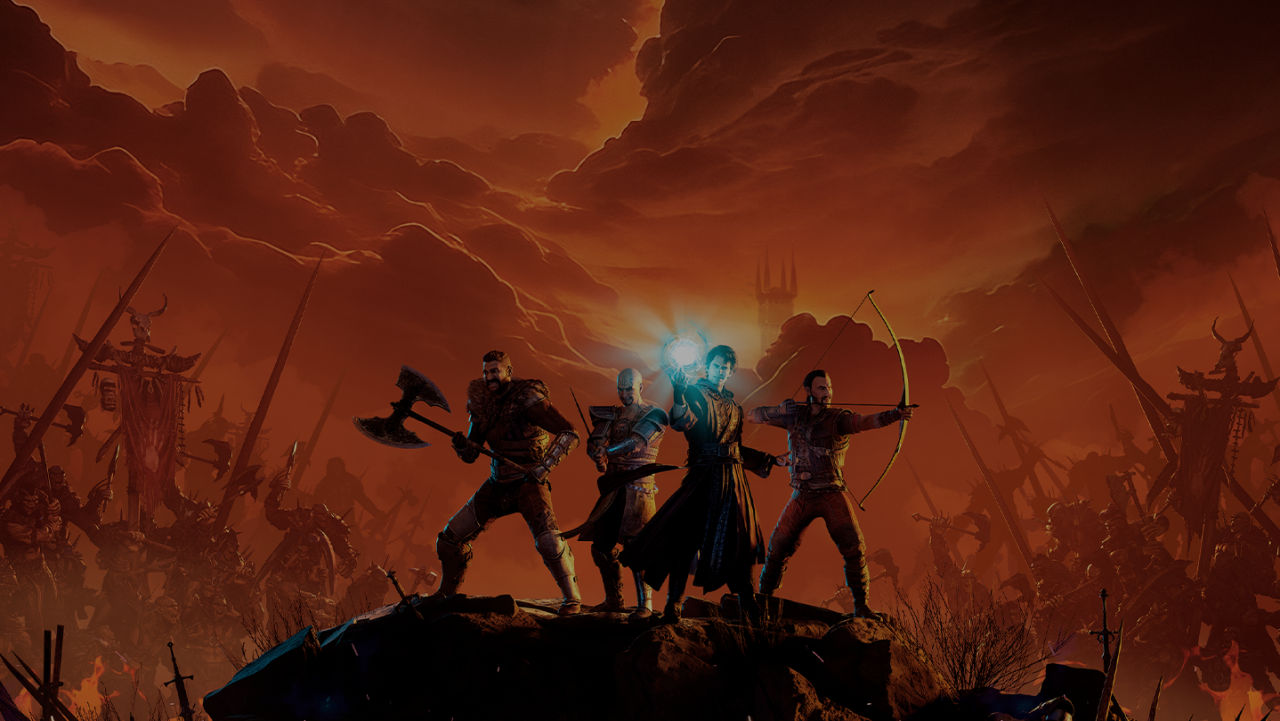
REVIEW – Gothic Remake brings back the 2001 German cult RPG while letting go of almost nothing that once felt excitingly raw but now often feels simply tiringly old-fashioned. The Valley of Mines is more spectacular, more detailed, and more atmospheric, but with its clumsy combat, lack of convenience features, and stubbornly preserved old pacing, this remake is primarily for those who truly want the same Gothic experience back – discomfort and all.
What does it mean today when someone says they want Gothic? The old, real Gothic? The question is when they last played it. Ten years ago? Twenty? Or twenty-five years ago, when Piranha Bytes’ 2001 RPG still felt fresh, raw, and completely different from almost anything else on the market? Because if someone still revisits the original every couple of years, knows every corner of the Colony by heart, and wants exactly that kind of stubborn, unfriendly RPG back, Gothic Remake clears things up very quickly: that is exactly what they are getting. Better graphics, more modern lighting, a new technical shell, but essentially the same spirit, the same pacing, and often the same irritating legacy.
Everyone else, however, should cool the nostalgia a little. Gothic seemed enormous in 2001 because it was a relatively dark, more mature open-world RPG built around factions and a certain degree of freedom of choice at a time when that was still rare. Back then, beyond Ultima 9, Might & Magic 6, Daggerfall, or Vampire: The Masquerade, there were not many comparable games, and the genre still had nowhere near the comfort, narrative, or combat-system foundations it has today. In that environment, Gothic really was a defining work: rough, angular, uncomfortable, and memorable precisely because of that. The problem is that what looked like pioneering boldness for the genre back then often feels, in 2026, like a game system that is simply outdated.
The Valley of Mines Gets a New Light
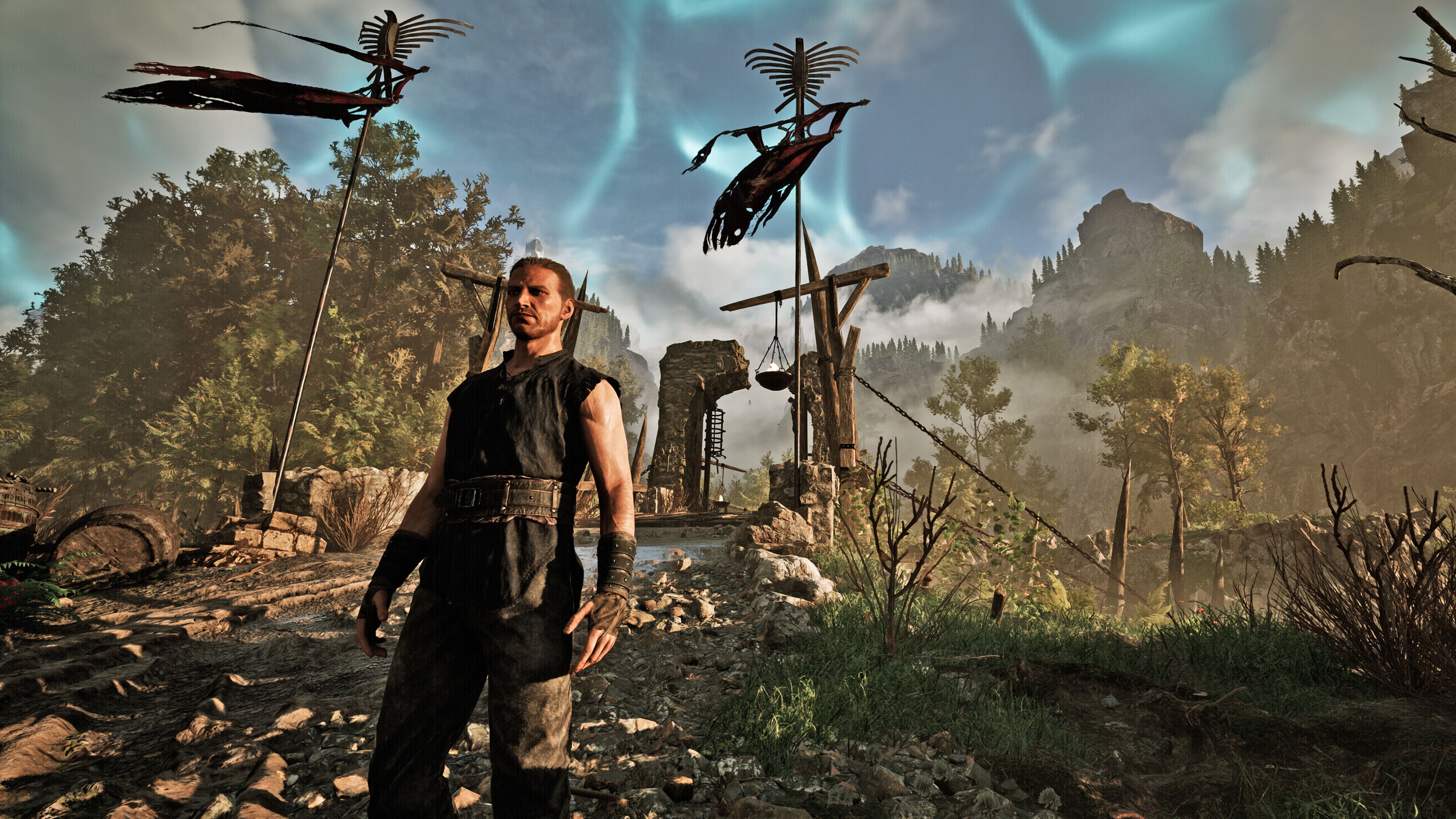
From the very first moment, the visual world of Gothic Remake is clearly one of its strongest elements. The small, handcrafted world of the Valley of Mines is now more detailed, more richly lit, far more atmospheric, and simply pleasant to look at. It is not the most beautiful game in the genre, nor does every visual element stand next to the biggest modern RPGs, but Alkimia Interactive has done excellent work bringing back the mood of the old Colony with modern technology. The water, rocks, forests, lighting, and the overall image of this closed, threatening valley often make a strong impression, and for old fans, they immediately trigger that familiar nostalgic reflex.
The trouble begins when one looks beneath the shinier surface: barely anything has really changed. Movement remains slightly sluggish throughout, animations are stiff, characters often behave rigidly or unnaturally, and while this can partly be read as the remake not wanting to move too far from the original, that is not always an excuse during play. The hero turns slowly, reacts slowly, and in the opening hours there is a lot of walking from one point to another. In 2001, this felt natural; today, it often feels like time-wasting. The lack of fast travel and convenient teleportation is not a sin in itself, but when one has to swallow long, mostly uneventful back-and-forth walks, the old atmosphere very quickly turns into exhausting stubbornness.
It is especially telling that even the personal huts, beds, or important points found in camps and fortresses often seem to be placed in the most inconvenient locations possible relative to entrances and later transport points. This is not really a case of the game deliberately trying to annoy the player, but rather of preserving a design logic that felt natural a quarter of a century ago. Back then, we did not really know better; today, we approach it after twenty-five years of gameplay evolution. That is why the first major question around Gothic Remake is not whether it is faithful, but how much good that faithfulness actually does for it.
The absence of quest markers, however, is not necessarily a problem. The world is small enough to become familiar after a little time, maps can be obtained, and navigation basically works. In fact, this is one of the old elements that can still add something to the experience, because it genuinely forces exploration. Ironically, the more modern, more detailed graphics can sometimes make orientation even harder, because the visual density of forests, rocks, and small environmental objects washes the surroundings into a more uniform mass, while the original’s simpler, low-polygon shapes were often easier to distinguish. Still, this is the area where the remake’s old-fashioned nature is not necessarily a disadvantage, but part of the world’s character.

The Price of the Old School
The real test of Gothic Remake begins when the player realizes how much has to be kept in mind. Even early on, the camps are full of NPCs, and from a few meters away, many of them look rather similar. Fletcher, Guy, the figures standing around the arena, the various quest givers and semi-quest givers quickly begin to blur together, while the game is not very interested in helping through the usual tools of modern RPGs. There is no convenient map marker for every small character, no constant hand-holding, and yes, for some players, that gives back exactly the feeling of the old Gothic. The question is how many players still want that even if they have to put the game aside for a few days and, on returning, no longer know where to find whom.
In 2001, convenience was a rare luxury; in 2026, it often decides whether someone continues playing a game after two hours. In this regard, Gothic Remake is almost provocatively old-fashioned. You have to take notes, pay attention, remember, and the game is not always difficult because it builds challenge intelligently, but because it does not explain enough, or because its own rules do not always feel logical. This becomes especially obvious when measured against today’s RPG field. Banishers, Clair Obscur, or Avowed already offer more comfort, smoother pacing, and better-dosed motivation in their opening hours, without necessarily giving up character or atmosphere.
The core idea of Gothic is still strong. In a fantasy world ravaged by war, the king needs weapons and magical ore, and that valuable resource comes from a valley sealed off by an impenetrable dome after a magical accident. Convicts can be thrown in, goods can somehow still move, but getting out is practically impossible. The former mine slaves take control, their factions, interests, compromises, and internal order take shape. This microcosm is still an exciting foundation, and it was also a good decision not to turn the world into something gigantic. The manageable size of the Valley of Mines, its handcrafted density, and its distinctive layout are worth far more than an endless fantasy landscape made of copied terrain.
At the beginning of the game, we are thrown into this setting as a nameless convict, without equipment, shelter, or any real foothold. A sword has to be found, a place to sleep has to be secured, and one has to learn who stands with whom, who should be feared, and who can be used. This concept still works today, and it is no coincidence that Dark Souls or Kingdom Come: Deliverance also built serious strength around making the player initially insignificant, vulnerable, and alien in the world. The difference is that developers have since learned a great deal about when to teach, when to hint, and when to let the player make mistakes. Gothic Remake often does not look for that finer balance; it simply says: solve it the way you would have back then.
Healing is a good example. The game quickly teaches that sleeping is useful because food, potions, and every other healing option are scarce at the start. The problem is that sleeping does not always work as intuitively as one might expect. If too little time has passed since the previous rest, you may not heal in the way that would seem logical, and going back to bed after two fights while badly injured will not necessarily help. The game’s rigid internal rules override common sense. Kingdom Come: Deliverance uses a similarly grounded system, but there the connection between food, sleep, and healing is clearer and immediately understandable. Gothic Remake instead often creates the feeling that the world is not hard – the system itself is clumsy.
Combat Drags It Down the Most
The theft system works surprisingly well, and it is one of those old mechanics that still gives something to the game. If we get caught, we are not necessarily killed immediately; the victim and the guards grab us, punish us, take something from us as compensation, and life goes on. This is much more interesting and organic than a simple death or game over. In practice, however, one quickly slips back into 2001 reflexes: quicksave, quickload, constant hammering of F5 and F9, because the rest of the game – especially the combat – regularly gives us reasons not to trust natural consequences.
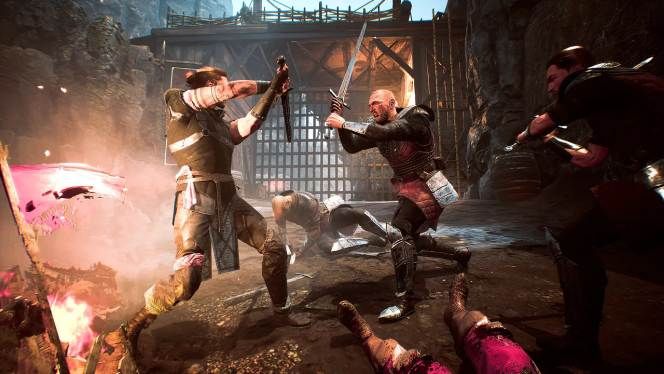
Melee combat is especially unpleasant in the first hours. Before we get magic or more interesting weapons, we have to get by with swords and a few basic attacks, all of which are slow, clumsy, and only gradually form something like a half-usable combo system. Later, more weapons and a few weapon types appear, spells expand the options, and the character becomes noticeably stronger. Does combat get better? Yes, somewhat. Does it ever become good? Not really. As a hybrid system, Gothic Remake wants to be both action game and RPG, but its action side is fundamentally old, stiff, and badly aged.
Blocking, lunging, and timed counterattacks are all in the system, but nothing ever becomes truly elegant or fluid. There is no need to demand Ghost of Tsushima-level sword duels from it, because this is obviously a completely different game, but even the far more cumbersome and unreliable combat system of Kingdom Come: Deliverance feels more interesting. In Gothic Remake, most fights ultimately come down to the number of enemies. A single enemy’s patterns can be learned quickly, two enemies are still manageable, but three can often be deadly during the first half of the game if they are not just filler opponents.
The problem is not only damage or the character’s weakness, but also the fact that the hero’s sluggishness does not really change. With leveling, we hit harder, take less damage, and the numbers improve, but the basic rhythm and awkwardness of movement remain. When three enemies attack at once, the timing windows can easily fall apart, while the artificial intelligence is both predictable and stupid. The most reasonable solution is often to exploit that stupidity, split the group apart, lure enemies toward guards, or pick them off one by one. This could be emergent gameplay; too often, it feels more like escaping the combat system.
All of this hurts especially because Gothic Remake already starts slowly. In the opening hours, the hero is almost comically pathetic: one or two bad hits, a few wild animals, or a poorly judged fight are enough to put him on the ground. Old games often stretched playtime this way, since smaller worlds could not be filled with infinite content. If Gothic allowed us to immediately run everywhere and chop everyone to pieces, the story would be over in a few hours. Instead, it becomes a longer adventure, but the price is that the opening stretch too often feels like suffering rather than an exciting learning curve.
Technology Can Be as Much of an Enemy as the Beasts in the Valley
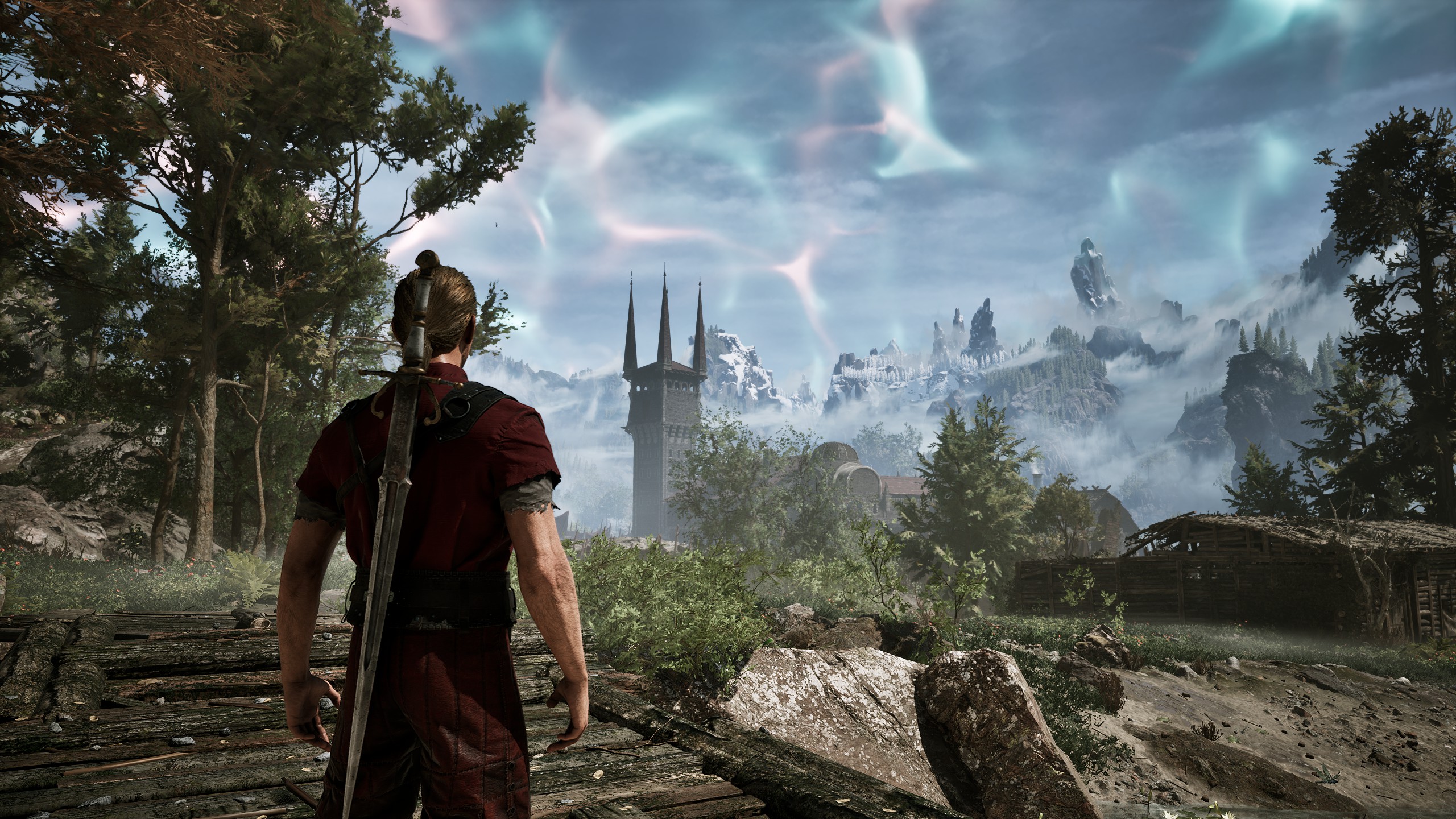
Technically, Gothic Remake has two faces. Visually, it is often excellent: the world is stylish, the water, lighting, rocky passages, wooded areas, and carefully assembled locations work very well. The characters are not embarrassingly ugly either, and the modern reworking of the old environments often produces exactly the effect one expects from a remake. Underwater sections, sunlit gorges, and handcrafted little details all prove that the developers understood why the spatial structure and atmosphere of the Colony mattered.
The optimization is far less convincing. Even on strong hardware, it is clear that Gothic Remake asks a high price for its visuals, and DLSS does not always save performance cleanly. In other games, upscaling can be a spectacular and clean lifeline; here, it often comes with ugly image breakup, heavy tearing, and distracting instability. On lower settings, the result becomes much more playable, but anyone who wants a clean 60 fps without serious compromise will need strong hardware.
Stability is not flawless either. Several crashes can occur, and autosave is not frequent enough to safely preserve every lost stretch of collecting, wandering, or fighting. If one spends a long time simply roaming the world, killing enemies, picking up items, and handling side activities, a crash at the wrong moment can be a painful loss. Oddly enough, exploiting the AI, sprinting into orc territory, luring enemies toward guards, and playing survival chaos can sometimes be more entertaining than several of the game’s more regular sections.
The audio is in better shape, at least partly. Kai Rosenkranz’s return matters a lot, and the rearranged, expanded versions of the old melodies nicely bring back the early-2000s fantasy atmosphere. It is not certain that one would now listen to it endlessly on vinyl, but during play it works and creates a real connection to the memory of the original Gothic. The voice acting and dialogue, however, are far more problematic. What once felt raw, mature, or edgy now often comes across more as bad manners, adolescent posturing, or tabletop role-playing club excess.
This is not solely the actors’ fault. The script and dialogue simply do not work the same way today as they did twenty-five years ago. Risen also went down this path and already felt old by the end of its own run; next to the dialogue of Banishers, Clair Obscur, or even Avowed, Gothic Remake often feels like an amateur fantasy campaign written by enthusiastic but still very inexperienced storytellers. The big core idea, the impenetrable magical dome and the prison world living by its own laws, remains strong. What the game draws from it narratively now feels much thinner.
Verdict – It Respects the Original, but That Does Not Always Help
The greatest strength and greatest weakness of Gothic Remake are the same: it is faithful. Very faithful. It brings back a genuine classic, treats it with respect, beautifully rebuilds its world, and does not try to turn it into a fashionable, modern, comfortable RPG. That is a respectable decision in itself. But the remake genre has come to mean something very different in recent years. The reimaginings of Resident Evil 2, Resident Evil 3, and Resident Evil 4 showed that an old game can be modernized not only in appearance, but also in structure, rhythm, usability, and pacing, while still preserving its identity.
Gothic Remake is more cautious in this regard, and often too stubborn. The graphical overhaul is excellent, and when the game runs stably, the Valley of Mines looks fantastic. But in gameplay, convenience, combat systems, and partly narrative, even mid-tier RPGs feel much more modern. GreedFall offers more interesting characters, smoother systems, and a more comfortable experience, while Elex – despite all its flaws – feels more up to date, even though it is hardly held up as a model RPG. One does not need to compare Gothic Remake to the genre’s peaks to see the problem: endless unnecessary walking, clumsy combat, and poor convenience options are no longer romantic flaws in 2026, but real obstacles.
At least a few optional quality-of-life features would have helped a lot. It would not have been necessary to betray the original, nor to fill everything with arrows, icons, and map markers, but greater respect for the player’s time would not have made Gothic Remake any less Gothic. As it stands, the game deliberately remains stuck in the past. It speaks exactly to those who are looking for the same experience as before, only with much better visuals. For them, it may be a treasure. For everyone else, there are now 40 or 50 RPGs from the last decade that show how far the genre once decisively shaped by Gothic has evolved.
-Herpai Gergely „BadSector”-
Pro:
+ A beautifully rebuilt, handcrafted Valley of Mines
+ A strong core idea and a closed prison world that still works
+ Kai Rosenkranz’s music nicely brings back the old atmosphere
Contra:
– A clumsy, outdated, and often irritating combat system
– Few convenience features and far too much unnecessary walking
– Weak optimization, DLSS issues, and stability problems
Publisher: THQ Nordic
Developer: Alkimia Interactive
Genre: action RPG, open-world RPG
Platforms: PC, PlayStation 5, Xbox Series X|S
Release Date: June 5, 2026.
Gothic Remake
Gameplay - 6.1
Graphics - 8.2
Story - 6.3
Music/Audio - 7.4
Ambiance - 7.8
7.2
GOOD
Gothic Remake really does bring back the 2001 cult RPG, but it does not always distinguish between valuable legacy and outdated baggage. The striking visual overhaul, the compact yet characterful world, and the nostalgic music count for a lot, but the stiff movement, tiring combat, limited convenience features, and technical issues make this remake primarily for players who know exactly what kind of past they want to return to.




![Stranded Deep 2: After Two Years, We Finally Get to See More of It! [VIDEO]](https://thegeek.games/wp-content/uploads/2026/09/Stranded-Deep-2-1280x720-1-302x180.jpg)
![Sony Is Following the Same Path Xbox Took in 2013! [VIDEO]](https://thegeek.games/wp-content/uploads/2026/09/Live-TV-on-PS5-1280x720-exact-302x180.png)









Leave a Reply