
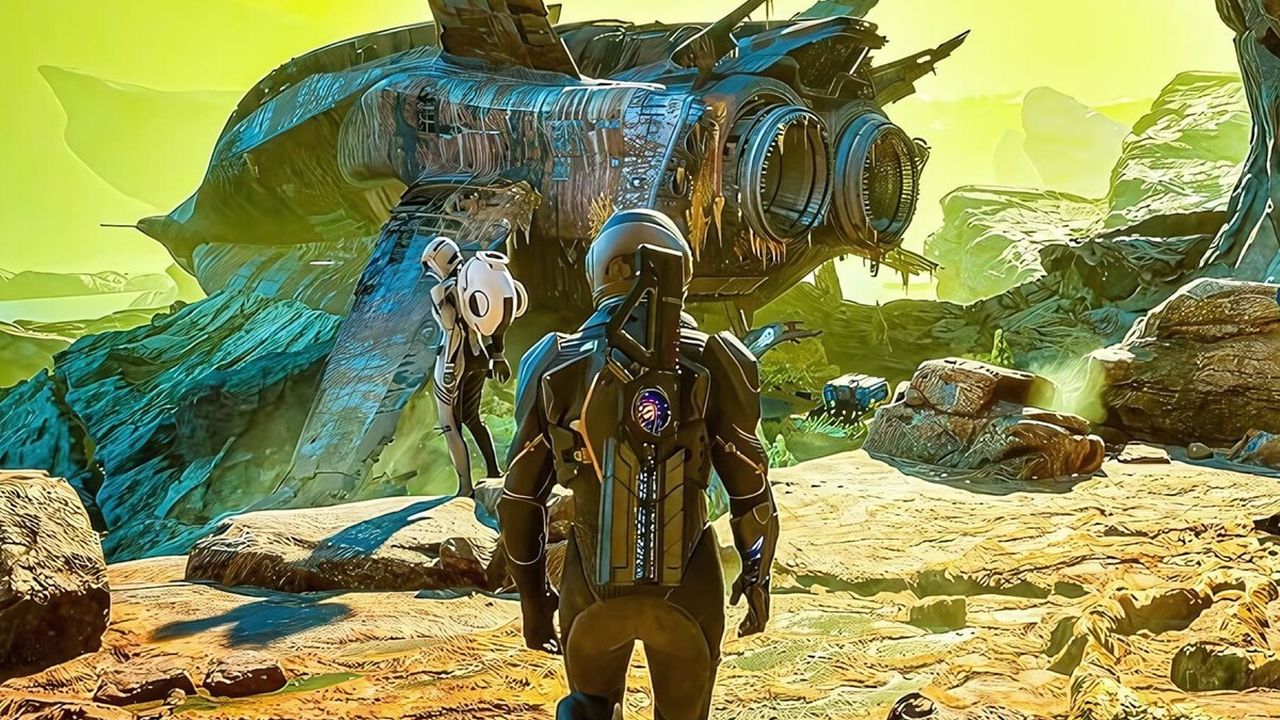
Archetype Entertainment has released a new 20-minute extended gameplay reveal video and fresh screenshots for EXODUS, its science-fiction action-adventure RPG. Due in early 2027, the game follows Jun Aslan, a scrappy salvager turned Traveler, as they cross the dangerous reaches of the Centauri Cluster in search of ancient ruins that may hold the key to saving their homeworld from the Rot, a Celestial virus pushing humanity toward extinction.
EXODUS has already looked like one of the more ambitious upcoming sci-fi RPGs, but this new 20-minute gameplay reveal finally gives a clearer sense of what Archetype Entertainment is building. The game centers on Jun Aslan, a scrappy salvager who becomes a Traveler and is pulled into the fight of a lifetime. The setting is the Centauri Cluster, a dangerous region of space filled with ancient ruins, alien technology, hostile threats, and a crew of companions who appear to be more than disposable mission chatter.
Jun’s mission is not merely about personal survival. The goal is to find something that could save their homeworld from the Rot, a Celestial virus that is driving humanity toward extinction. That is already a large enough premise, but EXODUS is not relying only on galactic disaster as spectacle. It also builds around choice, companions, technological progression, and time dilation. Players can customize Jun’s appearance and play as either a male or female Traveler, but the more important choice is moral and mechanical: Jun can follow the path of a virtuous Paladin or an ambitious Immortal, which changes not only how the world responds, but also which abilities can be upgraded and how powers evolve.
Traveler Tech Is Not Decoration, but the Spine of Combat
One of the most important parts of the reveal is the way Traveler Tech works. The Recycler shifts between several modes: Repeater mode provides steady mid-range fire, Shredder mode delivers close-quarters impact, and Piercer mode allows for longer-range precision attacks. That suggests EXODUS is not simply offering a list of weapons, but a flexible toolkit where players have to respond to the situation, the enemy type, and the shape of the battlefield.
The Gauntlet is just as central. As Jun salvages alien technology, this one-of-a-kind device upgrades and unlocks abilities such as Eruption, used to launch enemies and shape livestone terrain, and Lance, designed for piercing strikes and clearing bramble left by the Rot. The rest of the toolkit includes Precognition to mark enemy locations, stealth options such as Scramble Cloak, and Sonic Lure to draw hostiles into combat. The point does not seem to be locking Jun into a single combat identity, but allowing the player to adapt their methods to the terrain, the threat, and the moral path they have chosen.
The Crew Is Not Background Noise, but One of the Story’s Engines
EXODUS also puts considerable weight on Jun’s companions. Phaedra Nath is a renowned xeno-archaeologist whose story is tangled up with the Celestials in ways she is still discovering herself. Jun can fight alongside her, learn what drives her, and see how their relationship shapes both of their futures. Other showcased companions include Tom Vargas, an experienced Traveler who is more cautious and offers both guidance and moral perspective; Elise Charroux, an impatient mech pilot who prefers brute force and explosions; Salt, an Awakened octopus mercenary as deadly as she is intelligent; Houston, another Awakened ally; and the mysterious space cowboy C.C. Orlev, voiced by Matthew McConaughey.
The Awakened are one of the more interesting pieces of worldbuilding shown so far. Created through bioengineering and cybernetics, they are highly intelligent animals brought aboard ark ships, and they speak, think, work, fight, heal, and trade alongside humans. The reveal shows an Awakened elephant running a vendor stall and selling gear to Travelers, which says a lot about the social structure of this universe. In EXODUS, the Awakened are not just exotic companions. They are merchants, soldiers, medics, mercenaries, and everyday parts of society, making the surviving human world feel stranger and less conventionally human than a standard space opera settlement.
Choices Do Not Only Hurt Now – They Echo Later
One of the stronger moments in the gameplay reveal centers on a tense control-room decision. Jun has to choose between Elise and Tom. Elise wants to seize the chance, open the airlock, and purge a group of hostiles while the opportunity exists. Tom sees the risk: innocent people may be there as well. According to Archetype, these moments do not only matter inside the current scene. They echo through Jun’s crew, the wider story, and sometimes the lives of people back home. Some consequences play out immediately, while others take time to reveal their full impact.
That connects directly to one of EXODUS’ strongest science-fiction hooks: time dilation. In this universe, traveling near the speed of light across vast distances means that days for Jun may become weeks or months for the people left behind. That is a brutally useful RPG premise, because every decision moves the hero away from home not only in space, but in time. What players prioritize, which Remnants they decide to bring back, how they handle the journey, and how much time is lost along the way can all change the world waiting for them. EXODUS is due out for PlayStation 5, Xbox Series, and PC via Steam and Epic Games Store in early 2027.
Source: Gematsu







![Moon Studios Has Postponed the Release of No Rest for the Wicked! [VIDEO]](https://thegeek.games/wp-content/uploads/2024/04/thegeek-no-rest-for-the-wicked-2024-302x180.jpg)

![Dragon’s Dogma II: Dark Arisen: Major Free Update Ahead of the DLC [VIDEO]](https://thegeek.games/wp-content/uploads/2026/09/dragons-dogma-dark-arisen-1280x720-2-302x180.jpg)



Leave a Reply