
OPINION – Assassin’s Creed Black Flag Resynced may finally have delivered the success Ubisoft has needed for years. The remake’s achievement, however, does not resolve the problem of the series’ neglected present-day storyline, which has remained unresolved for almost two decades. The publisher still owes its fans a genuine, clear, and worthy conclusion.
Overall, Assassin’s Creed Black Flag Resynced is a success story. The franchise’s first proper remake is based on one of the community’s most beloved and acclaimed installments, and Ubisoft approached the source material with appropriate caution: it preserved its strengths, intelligently expanded certain elements, and smoothed out the rough edges that had previously weakened the overall experience. Naturally, the game can no longer have the same impact as the original did in 2013, since not enough time has passed for the remake to represent a truly radical transformation, and it is primarily aimed at those who were already convinced of Black Flag’s merits. After Ubisoft’s difficult years, however, everything indicates that the company has finally achieved the kind of commercial success it desperately needed.
The Story Disappeared Because Nobody Was in Charge
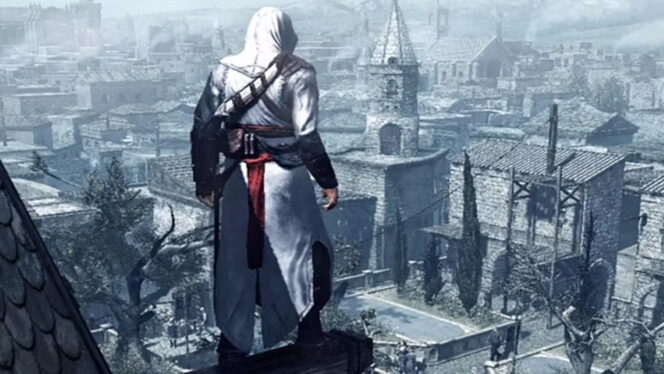
One of the most controversial decisions was the complete removal of the original storyline set in Abstergo’s offices. In the original game, we played as an employee from a first-person perspective, investigating strange phenomena before eventually discovering that Juno was still hiding within the company’s servers. The series’ supposed ultimate antagonist, who had allegedly been pulling the strings for millennia, then simply vanished without a trace. There is a comic book that hurriedly explains how the Assassins dealt with her, but that information is unlikely to have reached even one percent of the players. Resolving a cliffhanger developed across several installments in this manner is either astonishing negligence or proof that nobody is in charge of the franchise who can organize its ideas and carry them through consistently. The latter explanation is far more convincing.
The games starring Desmond still placed considerable emphasis on the present-day storyline. The real purpose of traveling into the past was to locate the Pieces of Eden so that the Assassins could find them in the present and stop a global threat. When Ubisoft killed Desmond in 2012, the people directing the franchise could have seized the opportunity to adopt a different model, allowing the series to continue with self-contained stories and lower stakes, without apocalyptic solar flares. Instead, following the popularity of shared universes, they retained the old structure without genuine commitment, a unified plan, or consistent leadership.
Within a few years, the overarching storyline had completely lost focus and increasingly became an irritating burden. The partial reset introduced with Assassin’s Creed Origins once again shifted the focus to a specific character, Layla Hassan, so for a while it looked as though the story was finally heading somewhere. After Layla’s journey concluded in 2020, however, uncertainty returned, and by now it is clear that Ubisoft does not know where to take this part of the saga. Removing the original Abstergo sequences from Resynced only confirms that the publisher does not want to burden new players with details that no longer matter. Juno is irrelevant, her plans even more so, which makes it easier to behave as though all of it has become nothing more than an insignificant part of the past.

The Fans Deserve More Than a Comic-Book Footnote
A significant portion of the community has been playing the series’ main installments for almost twenty years and has followed its story throughout that entire period. These players are demanding a fitting conclusion, not a comic book, not some kind of transmedia summary, and not a cheaply produced cinematic. They should receive a definitive and meaningful ending in a big-budget mainline installment. Ubisoft owes an enormous amount to its original audience, so it should prioritize resolving every storyline connected to the Isu, the gods of the various pantheons, the precursor civilization, Eden, and the roles played by Desmond, Layla, and Juno. A genuine, clear, and definitive ending is needed. This is almost a forbidden idea for profitable media empires, but allowing a long-running story to dissolve like a sugar cube in coffee is an undignified fate and a terrible precedent for any work that asks its audience for patience and trust across multiple installments.
Once the definitive conclusion has been delivered, the logical next step would be to transition to self-contained stories without unresolved threads or intertwined narratives that ultimately lead nowhere. It is clear that this is the direction Ubisoft actually wants to pursue. The franchise was created by the work of many developers who passed the torch from one team to another, not always treating their predecessors’ ideas with sufficient respect. A good ending, however, does not require the original creators to return. It only requires a clear decision, consistent execution, and a refusal by the publisher to lure the audience back with more empty promises, cheap soap-opera twists, or devices reminiscent of nineteenth-century melodrama.

The Lack of an Ending Is the Real Problem
With a satisfying climax and an ambitious conclusion, criticism concerning the absence of an overarching present-day storyline would almost entirely disappear. The absence itself is not what causes frustration, but the lack of respect Ubisoft has shown its audience regarding this issue. It is unacceptable to ask millions of players to invest years of their time, attention, and emotions, only to abandon them.
Almost every shared universe eventually enters a crisis. Audiences stagnate or decline over time, stories become excessively complicated, and the excitement disappears when everyone knows in advance that nothing profitable will be allowed to end at the right moment. Instead of concluding at their peak, these stories continue until they enter an inevitable decline. Escaping this natural cycle is extremely difficult, but endings truly matter. If a new chapter must begin afterward, it should be genuinely new, not a half-hearted attempt that retreats to safe solutions at the first sign of commercial instability. Assassin’s Creed is also in a much simpler position than other media empires: after a definitive conclusion, it could use its historical settings and characters with complete freedom, without every new game being constrained by a runaway continuity that has become almost impossible to sustain.
-Gergely Herpai „BadSector”-





![The JRPG Made by Final Fantasy and Dragon Ball Creators Got an unofficial PC port! [VIDEO]](https://thegeek.games/wp-content/uploads/2026/08/vnews-blue-dragon-reblue-300x365.jpg)
Leave a Reply