
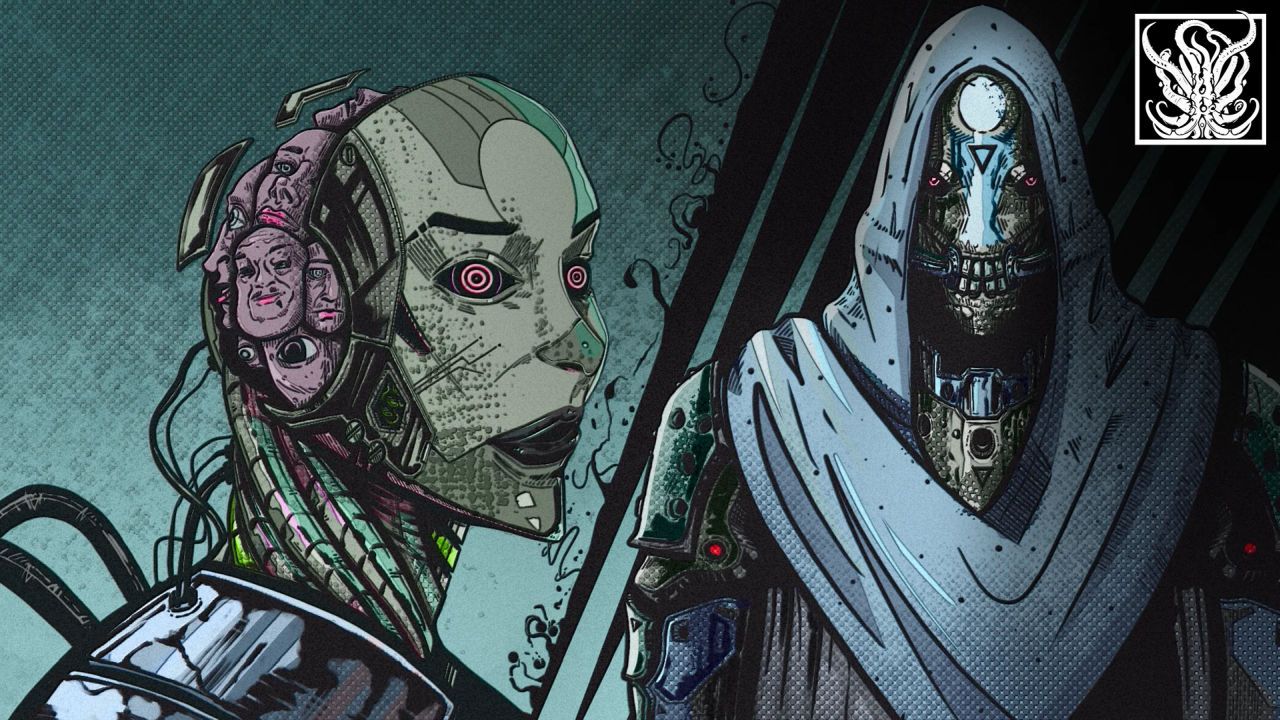
REVIEW – Celestial Return is a story-driven sci-fi RPG built around physical dice, following the path marked by Planescape: Torment, Citizen Sleeper, and Disco Elysium while trying to establish an identity of its own. Metaphor Games sends Detective Howard into the neon-lit, decaying streets of the fascistic Netherveil City, where dice represent opportunity, currency, and survival. Its political and artistic themes can be memorable, but technical problems, uneven writing, and too many predetermined outcomes hold it back considerably.
Celestial Return is exactly the kind of game that makes you prepare tea, find a notebook, and reach the mental state required to spend several minutes interpreting a talking rose with a human face. This is a three-part, text-heavy, dice-driven RPG that has little interest in becoming a conventional action game. It builds its world through choices, inner monologues, political pressure, and uncomfortable moral situations while openly drawing inspiration from several modern classics of the genre.
Netherveil City is more than cyberpunk scenery. It is a city collapsing beneath an authoritarian system that does not merely attempt to break people, but memory, art, and thought itself. Maintaining such a regime requires constant work: opponents must be silenced, public spaces controlled, and only approved images, texts, and ideas allowed to remain visible.
Our protagonist is Detective Howard, not a traditional saviour but a worn man in an even more exhausted city. He has his dice, he has his companions, including Rose, the talking flower with a human face, and he has a story ahead of him that wants to be a noir investigation, political parable, and psychological role-playing game at once. It sounds excellent on paper. In practice, the game often knows exactly what it wants to say but cannot always find the right words, images, or functioning dialogue options with which to say it.

The Dice Are Cast, but the Outcome May Already Be Decided
The central mechanic in Celestial Return is its limited pool of physical dice. Persuasion attempts, acrobatic manoeuvres, dangerous decisions, and social situations all require careful management of this supply, while dice are not merely abstract RPG tools. Characters within the world use them as currency, bargaining chips, and instruments for achieving their goals, while we spend those same objects to allow Howard to attempt different actions.
The idea works because every decision has a visible cost. Spend a die now and it may be missing later; preserve it for too long and an important opportunity may disappear. The system constantly asks how much you trust your luck and whether you are willing to remain consistent with the character you have created instead of always pursuing the optimal result. In an RPG like this, the most interesting outcome is not necessarily winning every encounter, but discovering how a chosen personality reacts to the world and how the world responds.
The game warns during its prologue that Netherveil will continue moving regardless of the direction in which we attempt to pull it. That is not inherently a problem, because no narrative RPG can provide an infinite number of stories. Trouble begins when successful rolls lead to exactly the same predetermined conclusion as failure. Spending a limited resource then stops feeling like a tragic choice and starts resembling unnecessary administration.
The treatment of failure is even more disappointing. Disco Elysium demonstrated that a failed check could begin a new conversation, alter a relationship, or at least provide a memorable humiliation. Celestial Return too often simply blocks the road ahead: no alternative story emerges, the interaction ends, and nothing is gained from the loss. The greatest cost is not the die itself, but the piece of narrative that never gets the chance to exist.

Even Saving Is a Risk in Netherveil
The forceful narrative direction might have been tolerable, but the technical problems directly attack the foundations of the experience. In a text-driven RPG, disappearing dialogue options, unresponsive choices, and broken text progression are not cosmetic inconveniences. They are obstacles that frequently require the player to reload an entire scene.
Reloading would provide a reliable solution if the save system itself could always be trusted. Dialogue choices may disappear after loading, the game may return the player to the wrong environment, or current text can begin scrolling across imagery belonging to an earlier scene. The safest method is to maintain several separate save files and hope that at least one of them behaves correctly. This is less a strategy than a digital superstition.
The instability is especially damaging because Celestial Return works best when we slowly surrender to its text and world. That process requires trust: the game must record our choices, allow the scene to continue, and avoid demanding a separate saving ritual before every important decision. When we start wondering which save file is least broken instead of thinking about the next line of dialogue, even the strongest political allegory becomes ordinary troubleshooting.

Several Excellent Ideas, Too Many Awkward Sentences
The quality of the writing fluctuates almost as much as the software itself. Some scenes contain genuinely poetic and unsettling descriptions of the city, thoughtful conversations about art, and effective explanations of how the political system functions. In those moments, Netherveil becomes more than a background. It feels like a suffocating, hostile environment that continuously reshapes the behaviour of the people living inside it.
Other conversations become stiff, fragmented, and repetitive. Short mechanical sentences, clichéd contrasts, and tired “not just X, but Y” constructions appear regularly. The game can become so concerned that the player may miss its message that it explains the same idea again, then returns to it once more for safety. This does not make the writing deeper, only longer.
Some character descriptions are difficult to defend as well. The narration repeatedly references one character’s “almond-shaped eyes” within a short period, as though no other method existed for indicating her background. In a game dealing with oppression, othering, and political violence, details like this require greater care and precision. There are also occasional spelling and grammatical mistakes.
The artwork is similarly uneven. Its combination of American comics, manga, and dark cyberpunk can create a strong atmosphere, but characters may change appearance between illustrations. Howard looks different in the menus, on the main screen, and in his interface portrait, while certain objects seem to follow a perspective unrelated to the environment around them. A warped flowerpot or strangely shaped book would be trivial alone, but together they make it difficult to distinguish intentional style from simple error.
The developers have repeatedly stated that the game’s text and artwork were made by humans without the use of generative artificial intelligence. That distinction matters. Celestial Return has arrived during a period when a malformed hand, unusual perspective, or repetitive sentence can immediately cause an audience to become suspicious. This is partly a consequence of the age rather than the game itself, but the finished work still needed more editing, consistency, and technical polish.
The Mural Can Be Removed, but the Question Remains
The strongest aspect of Celestial Return is its examination of the place and purpose of art. Netherveil’s fascistic government does not merely demand order, but obedience and complete control. Propaganda posters are permitted to remain because they speak the language of power, support government programmes, and gradually replace communal promises with open demands for compliance. Personal, unauthorised, or questioning art must be removed.
One of the best scenes has Howard and Rose discussing graffiti painted on a wall. The image depicts two robots getting married, and Rose cannot understand why anyone would paint it. The player decides whether Howard focuses on the artist’s intent, the work’s right to exist, or its illegality. In doing so, we shape not only Howard’s position, but Rose’s thinking and their shared interpretation of the world.
The scene works because it does not simply declare that art is important. It asks why it matters, whether it requires permission, whether it needs to be useful, and whether a single image can change anything in a city built to reinforce despair. It probably cannot transform the entire world, but it may change the person who stops to look at it. That is not nothing.
A cleaning drone removes the image immediately after the conversation. There is no public trial, no grand political speech, and no spectacular punishment. The system simply erases what it did not authorise and continues operating. The symbol is not subtle, but it is precise, and may be the most effective image in the entire game.
This is why Celestial Return cannot be dismissed easily. It contains good ideas, important themes, and several genuinely memorable scenes, but they are surrounded by technical problems, uneven prose, and inconsistent visuals. The dice system is original but does not always reward the resources invested in it. The story can be poetic in one scene and rigid or overwritten in the next, while saving bugs are unusually damaging in a game of this kind.
The result is an ambitious narrative RPG that frequently feels unfinished. Players interested in political themes, the mechanics of oppression, and conversations about the role of art may find genuine value here. Those seeking a stable and consistently written experience may discover that Netherveil City currently demands more patience than it gives back.
-Gergely Herpai „BadSector”-
Developer: Metaphor Games
Publisher: Shoreline Games
Genre: story-driven RPG, visual novel, interactive fiction
Release date: July 14, 2026 (PC, Steam)
Pros:
+ Strong political and artistic themes, with several genuinely memorable scenes.
+ The dice-driven system has a fresh and atmospheric central idea.
+ Netherveil City is frequently oppressive and fascinating.
Cons:
– Choices and dice rolls too often lead to predetermined outcomes.
– Saving and text progression bugs seriously damage the experience.
– The quality of both the writing and artwork is inconsistent.
Celestial Return
Gameplay - 6.2
Graphics - 6.8
Story - 7.2
Music/audio - 7
Ambience - 7.6
7
GOOD
Celestial Return is a narrative RPG built around important themes and intriguing ideas, with its best moments examining the relationship between art, oppression, and individual choice. Its dice system and the world of Netherveil City show considerable promise, but technical problems, uneven writing, and too many predetermined outcomes hold the experience back. It is not an uninteresting game and can be genuinely thought-provoking, but in its current state it too often asks for patience where it should be building trust.

![Shadow of the Road: You Can Now Try Out This Japanese Adventure [VIDEO]](https://thegeek.games/wp-content/uploads/2026/08/theGeek-05-shadow-of-the-road-1280x720-1-302x180.jpg)
![Etre: A Metroidvania with a sci-fi twist [VIDEO]](https://thegeek.games/wp-content/uploads/2026/08/theGeek-04-etre-1280x720-1-302x180.jpg)
![Greak 2: Alliance of the Storms: A Hand-Drawn Metroidvania Set in Synoraz [VIDEO]](https://thegeek.games/wp-content/uploads/2026/08/theGeek-02-greak-2-1280x720-1-302x180.jpg)
![Graveyard Keeper II: TinyBuild Joins the September Rush [VIDEO]](https://thegeek.games/wp-content/uploads/2026/08/theGeek-01-graveyard-keeper-ii-1280x720-1-302x180.jpg)


![Shadow of the Road: You Can Now Try Out This Japanese Adventure [VIDEO]](https://thegeek.games/wp-content/uploads/2026/08/theGeek-05-shadow-of-the-road-1280x720-1-300x365.jpg)
![Etre: A Metroidvania with a sci-fi twist [VIDEO]](https://thegeek.games/wp-content/uploads/2026/08/theGeek-04-etre-1280x720-1-300x365.jpg)
![Wolcen II: A Cautious Start, Strong Growth? [VIDEO]](https://thegeek.games/wp-content/themes/gameleon/assets/images/placeholders/300x365.png)
![Greak 2: Alliance of the Storms: A Hand-Drawn Metroidvania Set in Synoraz [VIDEO]](https://thegeek.games/wp-content/uploads/2026/08/theGeek-02-greak-2-1280x720-1-300x365.jpg)
Leave a Reply