
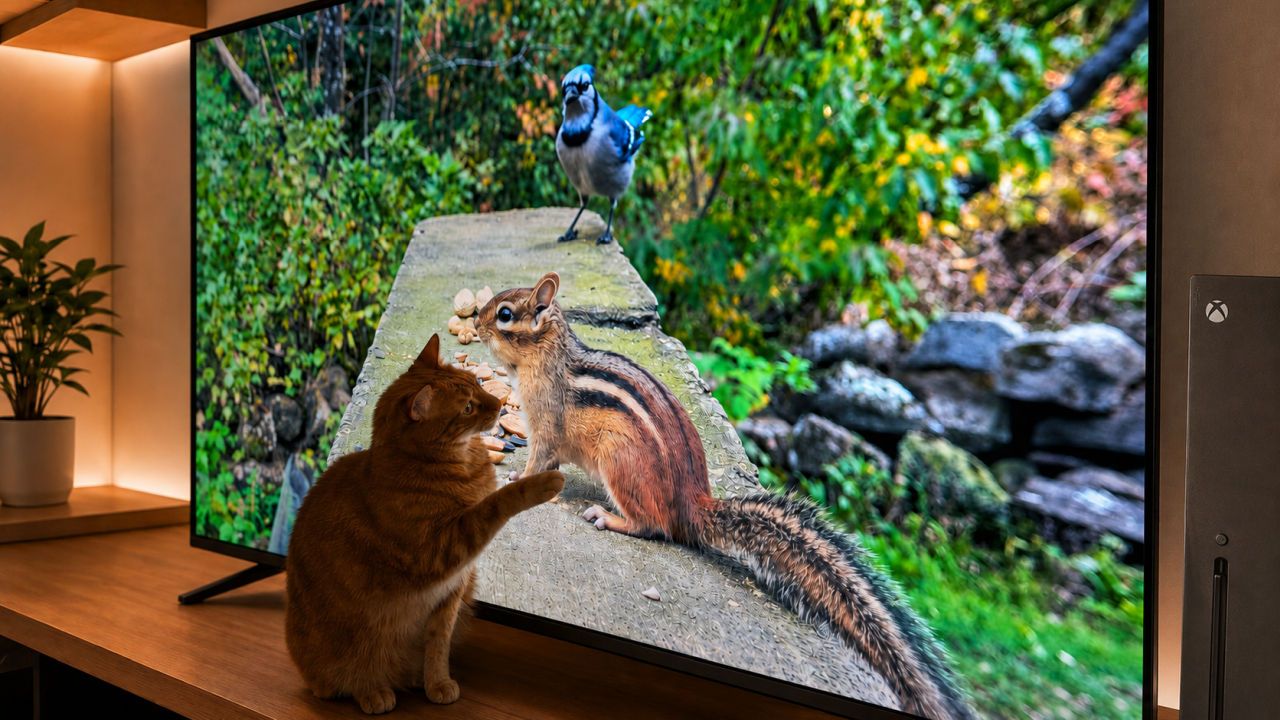
TECH REVIEW – The TCL P8L is a 65-inch QD-Mini LED television offering vivid picture quality, 144Hz gaming, HDMI 2.1, and Google TV at a price well below flagship models. It does not pretend to be an OLED-beating reference display, focusing instead on practical features, a large screen, and reasonable value. Its colorful presentation works particularly well with games, although our cats were equally enthusiastic when we played YouTube videos featuring birds and squirrels.
TCL has spent the past several years bringing technologies into the mid-range that were previously limited to far more expensive televisions. The P8L is a successful example of that strategy, combining a 4K QD-Mini LED picture with a native 144Hz panel, variable refresh, modern HDR formats, and a responsive smart platform. It delivers all of this in a television whose price remains connected to everyday reality. The tested 65-inch version appeared at Hungarian retailers for roughly 320,000 forints.
At this price, buyers can reasonably expect more than a simple large LCD. The P8L is not merely big, but technically modern enough to avoid feeling like an immediate bottleneck next to a PlayStation 5 Pro, Xbox Series X, or gaming PC. It also remains sufficiently balanced for films, series, and ordinary television viewing.
Its exact position in the market should still be understood. TCL’s more expensive C-series offers more local-dimming zones, stronger HDR highlights, and more precise backlight control, while OLED televisions remain ahead in black level and pixel-level contrast. The P8L does not compete in exactly the same league, but the price difference is substantial. Many buyers will care more about receiving a large, fast, colorful television prepared for modern gaming without moving beyond the half-million-forint mark. In that role, TCL’s model feels far more confident.

A Large Screen With a Respectable Finish
Even before it is switched on, the TCL P8L does not immediately reveal itself as a more affordable Mini LED television. Slim bezels surround the panel, the lower edge remains discreet, and brushed titanium-style details give it a restrained modern appearance. Much of the chassis is naturally plastic, but panel gaps are precise, the rear feels suitably rigid, and the television looks considerably more expensive than several older mid-range TCL models. It is not a design revolution, but it never appears cheap in a living room.
Two wide, slightly angled feet hold the 65-inch display securely. They leave sufficient space for an average soundbar, although the width of both the television and its supports makes careful furniture measurement essential before buying. Wall mounting is easier because the frequently used connections face sideways, preventing cables from being crushed between the display and the wall.
The included remote feels comfortable, its buttons respond quickly and decisively, and the most important streaming services can be opened directly. Google Assistant voice control works well, while a physical microphone switch on the television is available for users who do not want voice recognition permanently active. The menu initially offers a large number of options, but becomes familiar after a few days. Build quality and usability confirm that the P8L is not a luxury product, yet it never feels carelessly assembled or visibly stripped down. TCL has clearly tried to keep cost reductions away from the parts users see and touch most often.

Google TV and an Improvised Picture Test by Our Cats
Google TV is one of the P8L’s strongest features. Netflix, YouTube, Prime Video, Disney+, and major regional services are easy to install, applications launch at a reasonable speed, and moving through menus rarely involves long delays. Google Cast and AirPlay 2 also make it easy to send content from a phone, tablet, or computer. The home screen displays many recommendations, but combining programs from different subscriptions is convenient in practice.
The MediaTek Pentonic 700 platform, 3GB of memory, and 32GB of storage are sufficient for everyday operation. We experienced no regular freezing or unpleasantly slow application switching, and the television did not become noticeably sluggish during longer sessions. Picture settings are arranged more logically than on several older TCL models, although some specialized options still require deeper menu navigation. Profiles, children’s features, and voice search are useful in a shared household. The system is neither perfectly minimalist nor free of promoted content, but it ranks among the better platforms in this category for speed and app availability.
Part of the picture test followed a less conventional method. We played YouTube videos created for cats, with birds jumping between branches, squirrels running across tree trunks, and small animals moving directly in front of the camera. Our cats first raised their heads, then completely locked onto the television within seconds.
They approached the display, followed the birds with their eyes, attempted to catch squirrels disappearing beyond the edge of the picture, and occasionally looked behind the television to see whether the woodland continued there. This obviously does not replace instrument-based motion testing, but it demonstrated that the P8L displays small, fast subjects with sufficient clarity and detail. Feathers, branches, and sudden changes in direction remained easy to follow, while we saw no excessive long trails. Within minutes, the physical safety of the panel became a greater concern than its picture quality.

Strong Color, Good Contrast, Restrained HDR Brightness
The P8L uses a 10-bit HVA panel, quantum-dot color reproduction, and full-array local dimming. Its Mini LED system works with smaller light sources than conventional LED backlighting, allowing brighter and darker areas to be separated more precisely. The result is stronger contrast, less grey-looking blacks, and greater depth in dark scenes. It naturally cannot offer OLED-style per-pixel control, but the improvement over a conventional mid-range LCD is easy to see.
The panel’s native contrast ratio is around 6000:1, while DCI-P3 coverage reaches roughly 93 percent. Reds, greens, and blues therefore look suitably intense, with nature programs and animation appearing particularly vivid. Movie or Filmmaker Mode keeps the presentation more restrained and natural, while Dynamic raises brightness, contrast, and saturation more aggressively.
Peak brightness of roughly 450 nits clearly reveals where TCL had to compromise. Sunlight, explosions, glittering water, and metallic surfaces do not become as intense as they do on more expensive Mini LED televisions exceeding 1,000 nits. HDR10+, Dolby Vision, and HLG still improve tonal separation, gradients, and dark detail. HDR presentation is convincing in a dim or dark room, but becomes less dramatic in a strongly sunlit living room. The P8L provides good HDR, just not the spectacular brightness some buyers may expect from the Mini LED label.
Local dimming performs well for the class. Some blooming can appear around subtitles, lamps, or stars against completely black backgrounds, but it rarely becomes distracting during ordinary content. Upscaling is also respectable, keeping HD television and compressed streaming sources clean while handling blocking and digital noise reasonably well.
Viewing angles are less impressive. Contrast and color remain strong from the front, but both gradually weaken when the screen is viewed from a wider side angle. This is unlikely to become a major problem in an average living room, although seats at the extreme ends of a wide sofa receive a more washed-out image. Motion interpolation also deserves restraint. Strong Motion Clarity settings can introduce artifacts and the soap-opera effect, so films look better with a low value or with interpolation disabled.

Black Flag Resynced in Dynamic Picture Mode
I tested the television primarily with Assassin’s Creed Black Flag Resynced. The turquoise Caribbean water, dense vegetation, sunlit ports, and reflections across the waves suited the QD-Mini LED panel particularly well. Stormy sea scenes retained enough separation between dark clouds and bright lightning, while ship materials and Edward’s clothing remained suitably detailed. The large screen added considerable scale to naval combat.
I selected Dynamic through the Display / Picture Mode / Dynamic menu path. The separate Game Mode looked visibly flatter and less lively on the tested television, so I preferred the more spectacular setting during this single-player adventure. Dynamic raises brightness, contrast, and saturation, producing a far more forceful presentation of the game’s tropical world. It is not the most accurate preset, but it was more effective in this particular case.
The turquoise sea, green islands, and warm harbor colors became considerably more intense. Sunny scenes looked energetic and colorful, while Mini LED backlighting preserved sufficient depth during darker missions. White balance became slightly cooler, and some tones appeared more saturated than natural.
I would still select Movie or Filmmaker Mode for films or color-critical use, but calibration accuracy was not the main priority with Black Flag Resynced. The P8L’s native 144Hz panel also contributed to the experience, although the actual refresh rate naturally depends on the connected hardware and the game. VRR, ALLM, and AMD FreeSync Premium reduce tearing and help varying frame rates appear smoother. Two HDMI 2.1 inputs accept high-refresh 4K signals, allowing a console and a gaming PC to remain connected without constant cable swapping. A compatible PC can also use the 288Hz Game Accelerator mode at a reduced vertical resolution.
Input lag can fall to around 8 milliseconds at 120Hz, which is an excellent result for a television. Camera movement, parkour, sword fights, and naval combat all felt immediate, without distracting control delay. Game Mode may provide more consistently low latency, but the richer colors of Dynamic mattered more to me during a single-player adventure. Competitive gaming would naturally shift the priority back toward speed.

Usable Sound, Complete Connectivity, Realistic Compromises
The 65-inch P8L includes a 2.1-channel Onkyo audio system with two 10-watt speakers and a rear-mounted 15-watt woofer. Dialogue remains clear, maximum volume is sufficient for an average living room, and the woofer gives music, explosions, and naval cannons some additional weight. Sound does not become as thin as it does on many similarly priced flat televisions. It still cannot replace a serious soundbar.
Dolby Atmos and DTS Virtual:X attempt to create a wider soundstage, but the physical speaker arrangement cannot provide genuine surround sound. The internal system is perfectly usable for news, series, YouTube, and casual gaming. Films and louder action games benefit significantly from an external audio system.
Connectivity includes two HDMI 2.1 inputs, two HDMI 2.0 inputs, an eARC-capable HDMI connection, USB 3.0, optical audio, a headphone output, and composite AV. Wireless features include Wi-Fi and Bluetooth 5.4, allowing controllers, headphones, and other accessories to be paired easily. Four HDMI ports should comfortably accommodate a console, PC, media player, and soundbar. TCL imposes no serious compromises in this area.
Wired Ethernet is limited to 100Mbps. This is sufficient for Netflix, YouTube, and other streaming services, but can become restrictive with extremely high-bitrate 4K files played from local network storage. A stable wireless connection may actually provide better performance in that situation. It is a common cost-saving measure in this category, but remains irritating on a modern 4K television.
The final verdict depends on whether these compromises feel acceptable in exchange for the lower price. Its roughly 450-nit HDR brightness prevents it from becoming a premium home-cinema reference, viewing angles are average, and motion interpolation should be used carefully. In return, buyers receive a large, colorful, contrast-rich image, responsive Google TV, usable audio, a 144Hz panel, and serious gaming features. At around 320,000 forints in Hungary, it is a good rather than irresistible offer. More expensive televisions are visibly stronger in HDR, but the P8L can still become an enjoyable and versatile central display in most living rooms.
Our cats’ enthusiasm naturally does not appear in the official specification sheet, although they would probably award a higher score based on the bird and squirrel videos. For us, the television’s strongest qualities were its gaming equipment and the powerful picture produced by Dynamic mode. HDR brightness and cinematic accuracy inspired more reservations.
-Gergely Herpai „BadSector”-
Pros:
+ Vivid QD-Mini LED picture with strong contrast
+ 4K 144Hz, VRR, ALLM, and FreeSync Premium
+ Responsive Google TV and usable Onkyo audio
Cons:
– Roughly 450-nit brightness limits HDR impact
– Limited off-axis picture quality
– Ethernet connection is restricted to 100Mbps
Manufacturer: TCL
Model: 65P8L
Category: 65-inch 4K QD-Mini LED television
Release: 2026
TCL P8L
Design - 8.1
Display - 8.3
For Gamers - 8.8
For Movies - 7.8
Value for Money - 8
8.2
EXCELLENT
The TCL P8L is a strong mid-range television with its QD-Mini LED picture, native 144Hz panel, and comprehensive gaming feature set. Display / Picture Mode / Dynamic made the Caribbean world of Assassin’s Creed Black Flag Resynced look particularly vivid, while the separate Game Mode appeared more muted on our unit. Restrained HDR brightness and several technical compromises prevent it from becoming a premium display, but it remains versatile for gaming, streaming, everyday films, and even entertaining cats.





![DLSS 5’s Neural Rendering Barely Works on a GeForce RTX 3080! [VIDEO]](https://thegeek.games/wp-content/uploads/2026/08/vnews-02-rtx3080-1280x720-1-302x180.png)






Leave a Reply