
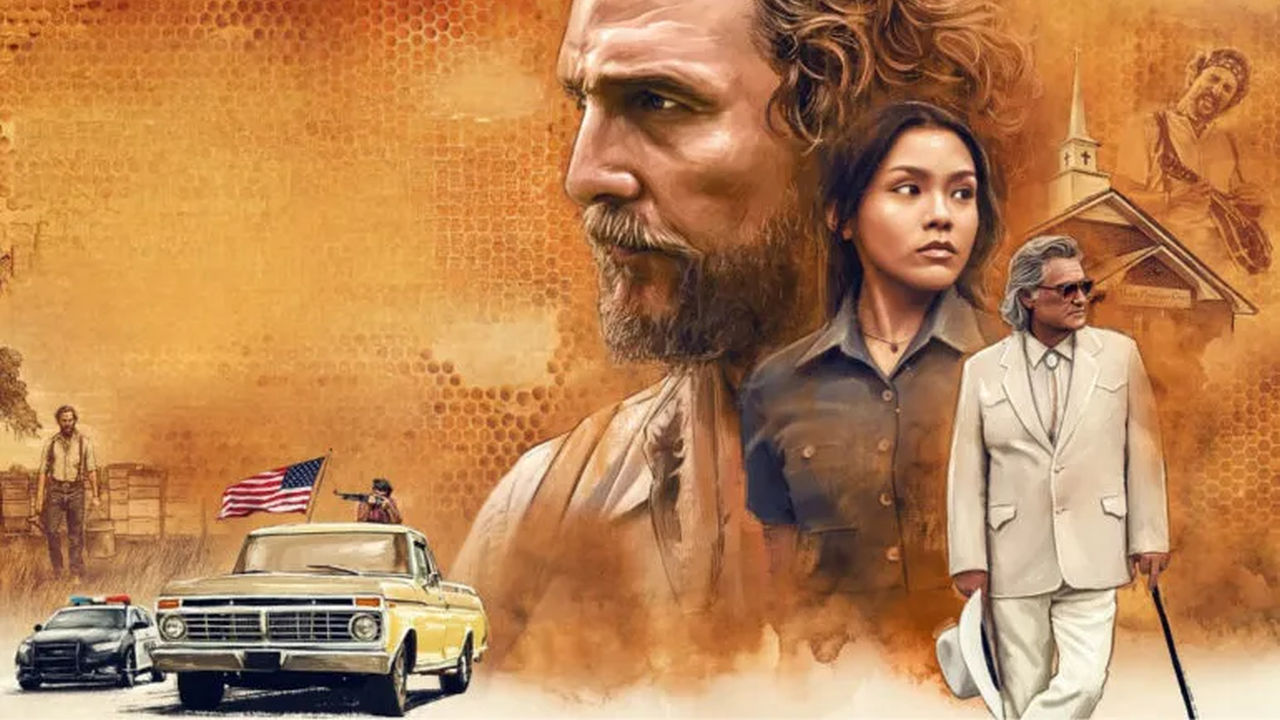
MOVIE REVIEW – Andrew Patterson’s second feature settles into rural Oklahoma with such deliberate calm that, at first, it barely seems interested in telling a conventional story. Beekeepers work, bluegrass music fills the air, old acquaintances talk, and Matthew McConaughey is handed the sort of character whose every gesture already feels strangely familiar. Then The Rivals of Amziah King gradually changes direction, turning its slice-of-life portrait into a crime story, a Western, a family drama, and eventually something close to a revenge ballad. That is both what makes Patterson’s film fascinating and what makes it unstable: it does not always know which of its stories it loves most, yet nearly all of them contain an image, a sound, or a human moment that makes the movie difficult to dismiss.
With The Vast of Night, Patterson was already more interested in places, voices, and atmosphere than in conventional narrative haste. Here he pushes that instinct further, spending much of the opening stretch simply asking us to live alongside these people for a while. Amziah King’s beekeeping operation, his band, his friends, and the small community that has grown around him gradually become a story in themselves. Honey is not an eccentric prop here, but an economy, a tradition, a form of labor, and an almost intangible connection to place.
It is no accident that Patterson repeatedly returns to the organization of the hive. The film perhaps explains a little too clearly how a community consists of workers, a queen, interdependent roles, and new members replacing those who have disappeared, but the metaphor still holds. For Amziah, family is not exclusively a matter of blood; it is a network of people he once sheltered, taught, or simply refused to abandon. The darker turns later in the film therefore matter less as an attack on a honey business than as a violation of this carefully assembled little world.

McConaughey has almost become a genre of his own
Patterson faces an obvious problem with Matthew McConaughey: the actor’s screen persona has gradually become stronger than almost any individual role he plays. The slow drawl, the Southern philosophizing, the mischievous smile, and the persistent impression that this man was barefoot on a porch with a guitar ten minutes before the camera started rolling have become a cultural language of their own. At first glance, Amziah King looks almost like the purest concentration of that familiar McConaughey figure. Patterson at least understands exactly which actor he has cast, so he never pretends that we are discovering this persona for the first time.
Amziah becomes more interesting when the movie reveals how much loss and conscious self-invention sit beneath his apparent ease. His wife’s death, Kateri’s disappearance from his life, and faint traces of a less peaceful past suggest that his serenity is not an innate quality but something he has spent years constructing. McConaughey is effective here not because he does something radically unfamiliar, but because he occasionally allows silence to appear beneath all those recognizable gestures. Whenever he stops talking, Amziah becomes a more mysterious man than the lovable rural philosopher we initially assume him to be.

Kateri quietly takes possession of the story
The film’s real gamble, however, is not McConaughey but Angelina LookingGlass. Kateri returns after more than a decade to the man who once fostered her as a child, moving through Amziah’s world as though she simultaneously remembers it and no longer belongs there. LookingGlass never tries to compete with the more expansive rhythm of McConaughey’s performance. She watches, waits, reacts, and through that restraint gradually pulls the film toward herself.
When the narrative’s center of gravity later shifts to Kateri, it may initially seem abrupt, but the film has already been preparing that inheritance. To her, Amziah is more than a father figure, and beekeeping is more than a trade she can learn; both offer a way of developing her own relationship with place, history, and identity. Her Native heritage becomes important here not as a decorative marker of identity but through the film’s growing interest in land, memory, ownership, and belonging. Patterson sometimes transforms Kateri from an uncertain young woman into an unusually resourceful adversary too quickly, but LookingGlass’ composure is strong enough to carry even the screenplay’s less convincing leaps.

When the rural ballad turns into a crime movie
The Rivals of Amziah King derives its greatest strength and its greatest weakness from the same decision: Patterson refuses to remain inside a single genre. The first third is almost an easygoing community portrait, until a sudden burst of violence changes the air, valuable hives disappear, and crime enters a world that previously seemed merely eccentric and welcoming. From there, the film bends toward noir, behaves like a modern Western, and occasionally becomes a heist movie or a revenge story. Those changes can feel exhilarating, but at other times Patterson seems to have grown bored with the previous movie before fully finishing it.
Kurt Russell’s late-arriving McCoy fits neatly into this uncertain genre space. Russell no longer needs to strain to make a pleasantly spoken man feel threatening, and Patterson wisely avoids turning him into a cartoonish honey baron. A criminal conflict built around the honey industry sounds almost absurd on paper, yet the film treats the local economy and the value of land seriously enough for the stakes to feel real. The problem is that the plot does not always grow to match the world Patterson has so patiently built around it.

The landscape and the music say more than the dialogue
Miguel I. Littin-Menz’s widescreen images leave enormous room for the sky, the flat land, and the people who appear very small beneath those horizons. Although the movie was shot in Alabama, Patterson is less interested in constructing a touristic Oklahoma than in creating a kind of mythic American borderland where modern commerce and older communal instincts overlap uneasily. Patrick J. Smith’s editing occasionally uses freeze frames to isolate particular moments, as though these characters are becoming figures in a local legend while they are still living it. The device can feel mannered, but at least there is a genuine cinematic idea behind it.
The music matters even more. Bluegrass, gospel, and Southern rock do not simply sit beneath the scenes as soundtrack, because playing music together becomes another expression of the community Patterson is describing. Amziah’s band is not an intermission from the story but another version of the hive: everyone produces a distinct sound, yet something larger exists only when they play together. The film is at its freest during these musical passages, precisely because it stops trying to be a crime thriller, a Western, a family drama, and a social allegory at the same time.

A sweet story with a more bitter aftertaste
In the end, Patterson’s film speaks most clearly about inheritance. Not the kind signed over in a lawyer’s office, but the inheritance built from knowledge, gestures, places, habits, and ways of looking at other people. Amziah tries to pass on to Kateri what he has decided matters in life, but she can only become his true heir by refusing to simply reproduce him. The film’s most interesting tension therefore exists less between rival beekeepers than between preserving somebody’s world and finding a way to carry it forward.
The Rivals of Amziah King is not a flawless film, and it is probably not an especially balanced one either. Its second half sometimes rushes to cash in ideas that the first half developed with remarkable patience, while several crime-thriller turns follow genre logic more readily than character logic. Yet the movie possesses a rare vitality: a distinctive landscape, its own rhythm, music that genuinely belongs to its world, memorable faces, and a story unafraid to change itself while it unfolds. It occasionally loses its way, but at least it does not get lost on a road that a hundred other movies have already worn smooth.
-Gergely Herpai „BadSector”-
The Rivals of Amziah King
Direction - 7.7
Actors - 8.5
Story - 6.8
Visuals/Music/Sounds - 8.4
Ambience - 8.1
7.9
GOOD
The Rivals of Amziah King is a strange, sprawling, but unmistakably alive American ballad in which beekeeping, family, music, Native heritage, and crime somehow find room beside one another. Matthew McConaughey delivers exactly the Southern charisma expected of him, while Angelina LookingGlass gradually takes possession of the film through far quieter means. Patterson’s genre wanderings do not always fit together perfectly, but his landscape, music, and vision of community remain long after the credits have ended.





![Power, Intrigue and Execution: How the Tudors Lost Their Heads Comes to National Geographic [VIDEO]](https://thegeek.games/wp-content/uploads/2026/08/noguchi-tudorok-official-1280x720-1-302x180.jpg)






Leave a Reply