
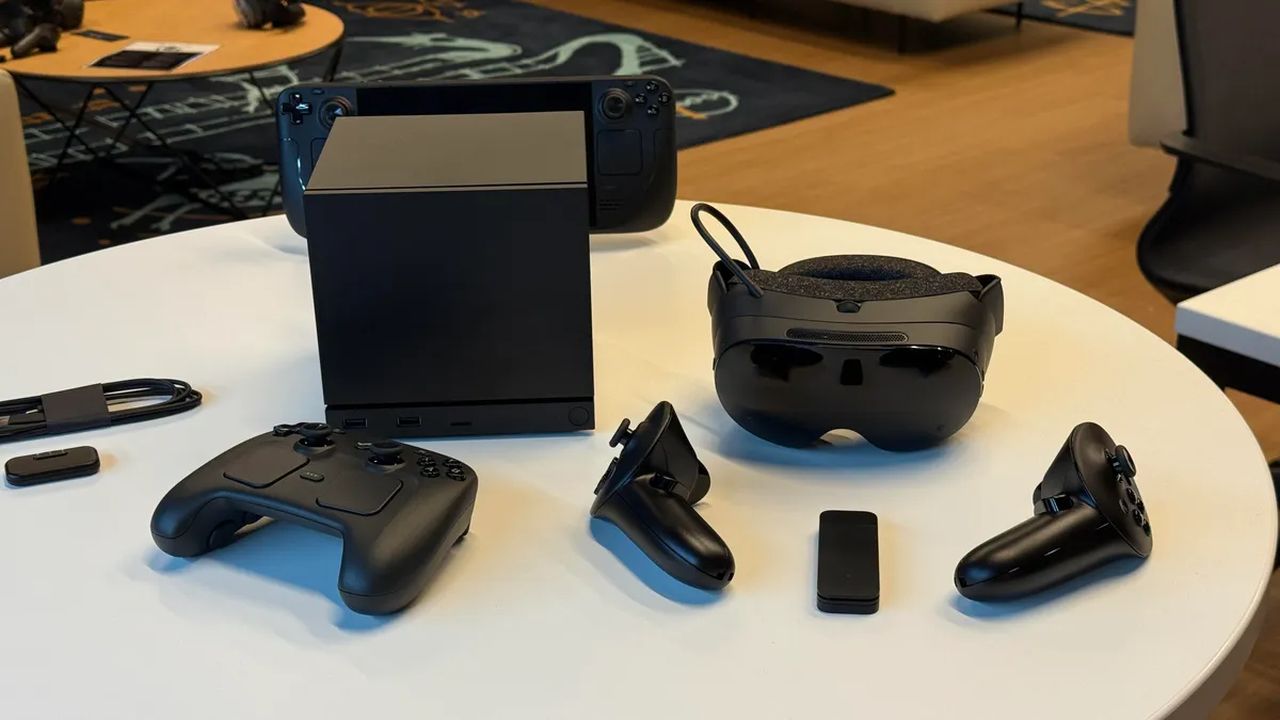
TECH NEWS – Valve doesn’t view the GabeCube the same way it views the Steam Deck, which has been on the market for several years.
Valve shocked consumers when they announced that the base model of the Steam Machine would cost $1,049 (with 512 GB of storage and no Steam Controller), and that the 2 TB version with a Steam Controller could cost as much as $1,428. Consumers had expected to be able to purchase the device at a much lower price. Valve made it clear that these were not the intended prices, stating that suppliers had forced them to take this step due to the current crisis affecting memory and storage components. Pierre-Loup Griffais, an engineer at Valve, told Gamers Nexus that there is no contract. Suppliers provide Valve with a price quote roughly once a month, offering only two options: buy the quoted amount or don’t buy anything. If Valve declines, the suppliers will never do business with them again.
According to Griffais and Yazan Aldehayyat, another Valve engineer, the Steam Machine also saw a forced price increase similar to the one that affected the Steam Deck OLED in May. The handheld PC was originally available for $549, but when it became available again last month, it was priced at $789—a 43.7% increase. This applies to the 512 GB model. The 1 TB model saw an even larger price increase of 46% ($649–$949). Based on these 43–46% increases, the base model of the Steam Machine would have cost approximately $718–734 without the impact of the crisis.
Even so, it would have cost significantly more than the PlayStation 5, which was problematic since the Steam Machine performed worse than Sony’s console in most launch tests. However, it could have appealed to PC gamers looking for a console-like experience who are interested in PC games that might not be released on consoles. While this would have appealed to a niche audience, it’s better than nothing.
Griffais and Aldehayyat told PC Gamer that Valve is treating the Steam Machine quite differently from the Steam Deck in terms of its lifecycle. While Valve does not consider aligning the Steam Machine with the Steam Deck’s roadmap to be necessary, this does not mean that a second generation would be launched immediately. Valve is monitoring how console manufacturers and other tech companies are handling the transition to the next generation in today’s RAM-starved world.
“We’re not thinking about the Steam Machine with quite as long of a timeframe as we are with the Steam Deck. The Steam Deck, by its nature, needs a more fixed performance target so that developers and users can understand, ‘What can I play on this?’ without that changing every year or two. The Steam Machine, on the other hand, is very much in line with gaming PCs. There’s a big gradient: low-end and high-end CPUs and GPUs. The Steam Machine is somewhere on that gradient. So, for a product like that, I think it’s less important to have a fixed performance target for five years. At the same time, we don’t have any immediate plans to change the performance target in a few years. We’re actually really curious to see how things pan out. There are a lot of questions about the new generation of systems, how it will roll out, and how games will adapt,” said Griffais.
Aldehayyat was quick to point out that the next generation of Steam Machine hardware isn’t right around the corner. This partly reflects the current habits of PC gamers: “We’re seeing a natural slowdown in the upgrade cycle for gaming PCs. In some ways, this probably means the Steam Machine will remain a viable product longer than it would have if it had launched 10 years ago. It’s just a matter of when it makes sense to upgrade: the price point, the time, and the available games. For example, if a bunch of new games come out on Steam that require more performance, that would probably make us want to upgrade the Steam Machine faster.”
This seems like a pretty logical approach.
Source: WCCFTech, IGN, PCGamer



![Marvel’s Wolverine Is Getting a Limited-Edition Console, Cover, and DualSense Controller! [VIDEO]](https://thegeek.games/wp-content/uploads/2026/08/wolverine-ps5-bundle-1280x720-1-302x180.jpg)
![Phantom Blade Zero: From Pre-Orders to State of Play [VIDEO]](https://thegeek.games/wp-content/uploads/2026/08/phantom-blade-zero-1280x720-2-302x180.jpg)






![Marvel’s Wolverine Is Getting a Limited-Edition Console, Cover, and DualSense Controller! [VIDEO]](https://thegeek.games/wp-content/uploads/2026/08/wolverine-ps5-bundle-1280x720-1-300x365.jpg)
![Phantom Blade Zero: From Pre-Orders to State of Play [VIDEO]](https://thegeek.games/wp-content/uploads/2026/08/phantom-blade-zero-1280x720-2-300x365.jpg)
Leave a Reply