
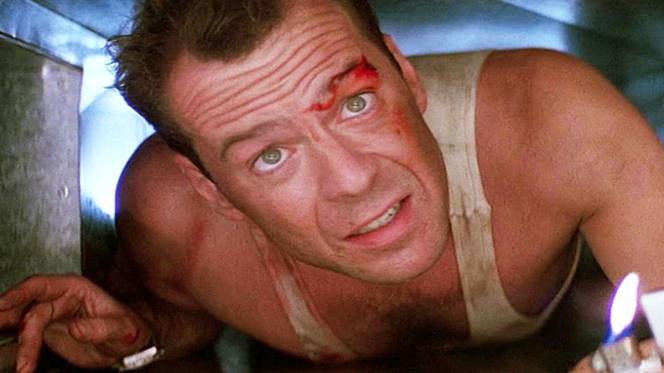
Arnold Schwarzenegger, Sylvester Stallone, Harrison Ford and several other stars rejected the role of John McClane before it went to the comedy actor Bruce Willis.
Die Hard is now almost impossible to imagine without Bruce Willis, but 20th Century Fox first approached much of Hollywood’s action-movie elite. At the time, the future John McClane was known mainly as the star of the comedy series Moonlighting, so the studio hardly regarded him as a safe choice.
Hollywood’s biggest stars kept saying no
Frank Sinatra received the first offer for contractual reasons: Roderick Thorp’s novel Nothing Lasts Forever, on which the film was based, was a sequel to The Detective, whose 1968 adaptation had starred Sinatra. The actor, then around seventy, declined, and Clint Eastwood, Mel Gibson, Burt Reynolds, Richard Gere, Don Johnson, Nick Nolte and Harrison Ford also passed.
The project was briefly reworked as a sequel to Commando for Arnold Schwarzenegger, but he rejected it as well, as did Sylvester Stallone. Producer Larry Gordon later summed up the situation by saying that virtually every available action star had turned the film down.
The comedy star the studio did not trust
Willis initially refused because of his Moonlighting commitments. He became available only when Cybill Shepherd’s pregnancy forced the series into a production hiatus, after which Fox offered him $5 million. That was an extraordinary fee for an actor who had not yet proved himself as a major film lead.
The studio’s uncertainty was reflected in the original theatrical poster, which showed only Nakatomi Plaza and omitted Willis’s face. Marketing executives feared that his comedic image and limited movie credentials would keep audiences away, so they were unwilling to build the campaign around him.
The film’s success changed everything. Willis was added to later posters, while McClane’s vulnerable, recognizably human personality stood in sharp contrast to the seemingly invincible muscle-bound heroes of the era. The quality that had made Willis look like a risky choice ultimately allowed him to redefine the action hero.



![Stranded Deep 2: After Two Years, We Finally Get to See More of It! [VIDEO]](https://thegeek.games/wp-content/uploads/2026/09/Stranded-Deep-2-1280x720-1-302x180.jpg)
![Sony Is Following the Same Path Xbox Took in 2013! [VIDEO]](https://thegeek.games/wp-content/uploads/2026/09/Live-TV-on-PS5-1280x720-exact-302x180.png)





Leave a Reply