
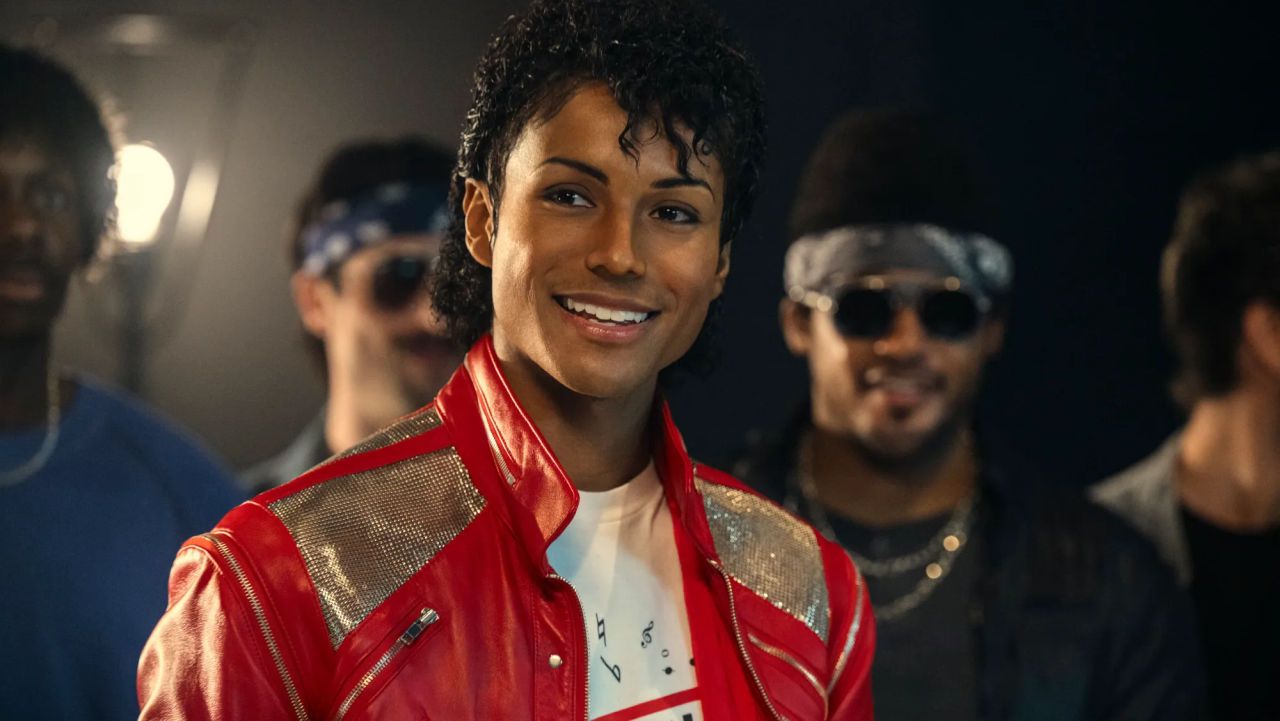
MOVIE REVIEW – Antoine Fuqua’s Michael looks, at first glance, like a grand and elegant prestige music biopic, but under that polished surface it is an unusually cautious and heavily filtered piece of mythmaking. The film does not really want to confront Michael Jackson as a troubling, contradictory, deeply complex human being, but to preserve him as a family-approved icon arranged behind glass. Jaafar Jackson is astonishingly accurate in the role, yet even that cannot make the film bold. It only makes the evasion more expensive and more obvious.
From the start, Michael reveals how narrow its chosen path really is. The story limits itself to the earlier phase of Michael Jackson’s life, running from his childhood in the Jackson 5 to the end of the Victory Tour in 1984, while the overall production carries the unmistakable feeling of family supervision. The result is not an unsparing biographical drama, but a carefully cut, carefully protected, gleamingly safe version of the legend, one more interested in preserving the icon than examining the man.
Fuqua and screenwriter John Logan emphasize Michael’s ascent, his overwhelming cultural power, and the almost supernatural force of his stage presence. The camera gazes at him with constant reverence, while the people around him are framed as if they are witnessing a miracle in real time. The problem is not that Michael admires its central figure. The problem is that admiration is almost all it has to offer. The film does not question, probe, or risk anything. It simply lights the myth from flattering angles.

A Polished Portrait With All the Real Cracks Removed
The film’s biggest weakness is not affection, but deliberate omission. Michael systematically strips away the qualities that made Michael Jackson such a difficult, fascinating, and often unsettling cultural figure. It tries to reduce one of pop culture’s most enigmatic personalities to a gentle, wounded, childlike genius. That is not a serious portrait. It is a branding exercise.
Fuqua’s direction delivers the smoothest, safest, and most sterilized version of this biographical drama, stripping away almost all of the rawness and inner tension that could have made Michael Jackson’s story genuinely compelling. The stranger and more uncomfortable details of Michael Jackson’s life are either absent or reduced to passing signals. The film shows very little interest in understanding him. It only wants to keep the glass case clean.
That is a fundamental failure, because Michael Jackson mattered precisely because he resisted simplification. He was one of the most visible people on the planet and yet remained profoundly unknowable. He projected almost divine star power while often seeming emotionally detached, isolated, fragile, and deeply out of sync with ordinary life. Childhood abuse, fame, body-image anxieties, vast wealth, and a highly curated fantasy world all shaped him. Michael touches some of those things, but rarely with any seriousness.

Trauma Is Treated Like Background Decoration
The film presents Joseph Jackson as abusive and controlling, but it handles that violence with striking caution. The beatings, humiliation, and fear are present, yet they are staged more like unpleasant incidents than life-defining trauma. That is a weak and baffling choice, because if there is one element this story should face directly, it is the brutal family structure that helped shape Michael’s entire emotional reality.
Young Michael escapes into Peter Pan, dreams of animal companions, and lives among Disney imagery, and the film behaves as if this essentially explains him. It reduces his inner life to a longing for endless childhood, surrounded by ice cream, old comedies, Mickey Mouse, and stuffed innocence. None of that is meaningless, but it is nowhere near enough. The real question is what that frozen childhood cost him, and the film would rather not ask.
Where is the real weight of his isolation? Where are the friendships, adult relationships, romantic impulses, loneliness, and the more painful realities of living so far outside normal life? Why does this man seem so disconnected from ordinary humanity, and how does that shape him? Michael has no real answer. It displays the oddness, then leaves it hanging like a decorative trait.

Jaafar Jackson Is Strong, the Screenplay Is Timid
The film’s clearest strength is Jaafar Jackson. This is not mere imitation. His movement, facial control, vocal rhythm, and especially his performance energy are often uncannily precise. In the stage sequences, Michael briefly comes alive and reminds the audience why Michael Jackson was such an extraordinary pop-cultural force. For a few minutes at a time, the movie actually has pulse.
Unfortunately, the script repeatedly drags those moments back into the dead center of formula. Talented child, oppressive father, sudden rise, internal tension, brief suffering, emotional release, onward to triumph. The structure is so familiar that the film often feels assembled from the safest parts bin in the biopic factory. In that sense, Michael lands far too close to sanitized music dramas like Bohemian Rhapsody, where complexity is flattened into clean inspirational beats.
One of the few scenes that genuinely works is the moment when Michael has John Branca fire Joseph as his manager. He does not do it in person, but through a fax, which makes the scene awkward, sad, liberating, and revealing all at once. It is one of the only times the film suggests Michael might actually be making a personal decision on his own behalf. But because Joseph’s domination has been so consistently softened, even this moment lands with less force than it should.
Almost Everything Truly Interesting Has Been Cut Away
The 1984 Pepsi commercial accident, when Michael’s hair caught fire, appears here as the starting point of his painkiller addiction. The film also includes his vitiligo and his attempts to conceal it through makeup and clothing. On paper, these are crucial developments. On screen, they are treated as tragic inconveniences in an otherwise glowing myth. They register, but barely wound.
Janet Jackson’s near-absence is equally revealing. The film gives her almost no real space, as if it is carefully keeping anything complicated at arm’s length. That does not feel accidental. It feels like the movie’s whole method. Anything jagged, uncomfortable, or difficult to control is simply shaved off.
Even Michael’s eccentric private world, his animals, and his emotional attachment to children are framed as harmless quirks rather than material that demands examination. The film points but does not investigate. It signals but does not interpret. Yet that is exactly where a powerful film might have been found: in the contradiction between genius and damage, spectacle and loneliness, innocence and unease. Instead, Michael settles for elegantly packaging the legend and nudging the uncomfortable questions out of frame.
The ending distills that approach into one neat gesture. The film jumps forward to 1988, stages Bad as one more mythic performance, and closes with a reminder that the story continues. Of course it does. The real issue is whether this film has any intention of confronting the more difficult chapters at all. Judging by what is here, the answer is no. Michael is sleek, expensive, and intermittently compelling, but far too obedient to become the searching portrait its subject actually deserved.
-Gergely Herpai “BadSector”-
Michael
Direction - 6.2
Actors - 7.4
Story - 3.3
Visuals/Music/Sounds/ - 7.5
Ambiance - 5.5
6
AVERAGE
Michael is visually polished, musically effective, and anchored by an impressively accurate turn from Jaafar Jackson. But Antoine Fuqua’s film is too cautious, too sanitized, and too protective to become a genuinely probing portrait of Michael Jackson. What remains is not a fearless biopic, but a carefully maintained extension of the legend.


![Harry Potter Fame Did Not Pay the Bills – OnlyFans Saved Jessie Cave [VIDEO]](https://thegeek.games/wp-content/uploads/2026/08/theGeek-Jessie-Cave-OnlyFans-302x180.jpg)



![The Head of Take-Two Is Lying About the Price of Grand Theft Auto VI! [VIDEO]](https://thegeek.games/wp-content/uploads/2026/08/gta-vi-1280x720-1-300x365.jpg)

Leave a Reply