
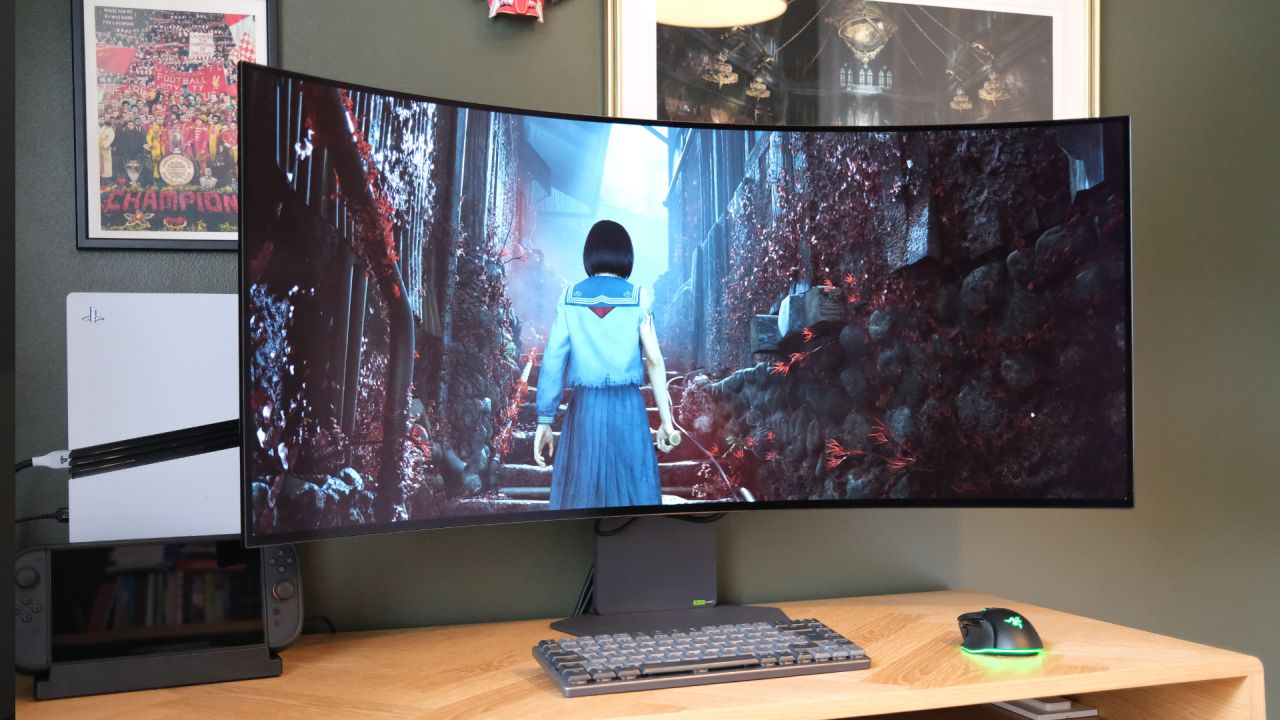
TECH REVIEW – The LG 45GX950A is the kind of monitor where the word “big” stops being marketing fluff and starts becoming a genuine desk-management problem. Its 45-inch, 21:9, 5120 x 2160 OLED panel finally gives this massive format the resolution it always needed. We tested it with local PC gaming, productivity, movies, HDR content, and GeForce NOW Ultimate over fiber internet at the full 5120 x 2160 “5K2K” resolution – and when everything clicks, this screen looks absolutely spectacular.
The core idea behind the LG 45GX950A is straightforward: it is a 45-inch ultrawide OLED gaming monitor with a 5120 x 2160 21:9 resolution, a 165 Hz maximum refresh rate, a 0.03 ms GtG response time, an 800R curve, DisplayHDR True Black 400 certification, and support for NVIDIA G-SYNC Compatible, AMD FreeSync Premium Pro, and VESA AdaptiveSync. In practice, though, it is far more interesting than a spec sheet suggests, because it tries to fix a category that previously always had one foot stuck in compromise.
The biggest weakness of earlier 45-inch OLED ultrawides was resolution. At this size, 3440 x 1440 simply was not enough: acceptable in games, maybe, but rough for text, browsing, editing, and general desktop use. The LG 45GX950A moves to 5120 x 2160, also known as 5K2K, which is a much better match for this 21:9 format. Pixel density rises to roughly 125 PPI, which still does not match the razor-sharp feel of a smaller 4K panel, but it is a massive leap over older 45-inch WQHD OLED ultrawides.
The size cannot be overstated. Coming from a 34-inch ultrawide, this panel almost hits you in the face. It is wider, taller, larger, and it does not merely sit on your desk – it dominates it. That is also exactly what makes it appealing. The combination of a 45-inch diagonal, 21:9 aspect ratio, and 5120 x 2160 resolution creates a field of view that feels almost cinematic in racing games, flight simulators, open-world titles, and story-driven single-player games. This is not a monitor you simply “play on.” It is a monitor you sit inside.

Size, Curve, And Immersion
The 45-inch ultrawide format makes much more sense for gaming than a similarly wide large-format 16:9 display. On a 48-inch 16:9 panel, everything gets bigger: the HUD, menus, map, subtitles, and corner UI elements. The LG 45GX950A, by contrast, does not just enlarge the image; it expands it horizontally. The main gameplay area usually stays centered, while the sides add atmosphere, peripheral information, and presence.
In practice, this works extremely well. In a racing game, you read corners better. In a flight title, the sky and cockpit feel more expansive. In a modern action game, the world wraps around you more naturally. It was especially interesting to push the monitor through GeForce NOW Ultimate: over a stable fiber connection, at the native 5120 x 2160 “5K2K” resolution, with enough bandwidth, games looked stunningly clean, detailed, and fluid. NVIDIA’s recommendation of roughly 65 Mbps for 5K streaming at 120 FPS is easy to satisfy on a proper fiber line, and when the service, the game, and the monitor all line up, cloud gaming stops feeling like a compromise and starts feeling like a luxury setup.
The 800R curve, however, will divide people. For simulators and games built around immersion, it works and makes sense. For general use, text work, image editing, web browsing, or games with a lot of static UI elements, it is less friendly. Your brain can adapt over time, but not everyone will love it. A milder curve around 1800R would have made this monitor more universal, especially for users who want it to be both a gaming display and a daily work screen.

Design, Ports, And Desk Presence
Visually, the LG 45GX950A is a strong piece of hardware. From the front, the massive OLED panel dominates everything. Bezels are slim, there is no distracting chin, and the rear uses a clean gray plastic shell with an RGB light bar around the port and stand area. It does not look cheap or overdesigned. It feels like modern gaming hardware without desperately trying to imitate a spaceship.
The stand is large, but the base is surprisingly practical: a flat metal plate that does not waste too much desk space and can even hold smaller items. Height adjustment, tilt, and swivel are all present, and the maximum height is very welcome for a panel this size. Stability, however, reminds you that this is a 45-inch OLED beast. If your desk is not solid enough, the panel and stand can wobble after a minor bump.
Connectivity is generous. You get DisplayPort 2.1 UHBR13.5, two full-bandwidth HDMI 2.1 inputs, USB-C with DisplayPort Alt Mode and 90 W power delivery, plus two USB-A ports. The full 5120 x 2160 resolution at 165 Hz with 10-bit color is available, but DSC compression is required. That may sound like a compromise on paper, but in real use it is not a meaningful issue: DSC appears visually lossless, and during normal use you will not sit there thinking the image looks compressed.

Resolution, Text Clarity, And Coating
The monitor’s biggest upgrade is resolution. At 5120 x 2160, this size finally becomes viable for work as well. It is not only games that look better; desktop use becomes much more pleasant. Text is cleaner, windows have room to breathe, and browsers, editors, Discord, video windows, timelines, or spreadsheets can all coexist without constant rearranging. This was the major weakness of previous 45-inch OLED ultrawides, and here the panel finally grows into its physical size.
LG’s newer RGWB subpixel layout also helps text rendering. OLED monitors have always had a complicated relationship with Windows font smoothing because of their non-standard subpixel structures. This still does not look as surgically sharp as a smaller 4K monitor, but it is much better than older 3440 x 1440 45-inch OLED panels. It is usable at 100 percent scaling and more comfortable at 125 percent.
The matte coating will also be divisive. A glossy OLED can look punchier, deeper, and wetter, especially in a dark room. A matte WOLED, however, handles ambient light and reflections better, making it more practical in a living room, bright office, or gaming corner where lighting is not perfectly controlled. There is some grain, and black depth can suffer in certain lighting conditions, but overall this coating is usable and less fussy than a mirror-like glossy OLED surface.

OLED, Burn-In, And Everyday Use
OLED’s biggest strength remains the same: per-pixel light control, perfect blacks, enormous contrast, and lightning-fast response. The risk of burn-in, however, has not disappeared. It is not something to panic about while gaming or watching movies, but if someone spends eight to ten hours a day with static windows, spreadsheets, browsers, and fixed UI elements, OLED is still not the most worry-free choice.
The LG 45GX950A includes the basic OLED protection features, such as screen movement, screensaver functions, and pixel cleaning, but customization is not as extensive as it is on some rivals. From a U.S. market perspective, that matters because this is not a casual purchase. The monitor launched as a premium product, and while discounting may vary by retailer, it remains one of the most expensive consumer gaming displays in its class.

Speed, Response Time, And Dual Mode
Response time is exactly what we expect from a modern OLED: almost instant. The 0.03 ms GtG figure looks good in marketing, but the important part is the feel: no LCD smear, no distracting overshoot, and no overdrive juggling where different refresh rates require different settings. Motion is clean, fast, and direct.
The native 165 Hz refresh rate at 5120 x 2160 is strong, even if it is not record-breaking. There are already 240 Hz OLEDs on the market, but at this resolution, even 165 Hz is a serious challenge for current GPUs. If you want modern AAA games at native 5K2K with high settings, you need a very powerful graphics card or intelligent use of upscaling, frame generation, or cloud gaming. This is where GeForce NOW Ultimate becomes interesting, because at 5120 x 2160 and up to the 120 FPS range, it can show what this panel is capable of when the network is fast and stable.
Dual Mode is another key feature. With a dedicated button, the monitor switches to 2560 x 1080 and raises refresh rate to 330 Hz. This should not be described as 5K2K at 330 Hz, because both cannot happen at once: you either get 5120 x 2160 at 165 Hz or 2560 x 1080 at 330 Hz. The switch is quick and the feature works well, especially for competitive shooters. The image becomes softer and resolution clearly drops, but motion clarity and response feel improve noticeably.

Colors, SDR Brightness, And Uniformity
Color performance is strong, though the LG 45GX950A does not beat the best QD-OLED panels. DCI-P3 coverage is excellent, while Rec. 2020 coverage is more limited, so users chasing the widest and most saturated color volume can still find more vivid alternatives. In return, the WOLED character is more natural, less aggressive, and factory settings provide a solid base.
In SDR, full-screen brightness sits around the 250 to 270 nit range, which is fine for a monitor but not spectacular. The big advantage is uniform brightness behavior: on the Windows desktop, while browsing, and while switching between apps, brightness does not jump around in an annoying way. Minimum brightness is also excellent, so the screen remains comfortable in a dark room.
Viewing angles are excellent, as expected from OLED, but uniformity is not perfect. Dark gray fields can show slight vertical banding, especially across large uniform areas. In games, movies, and mixed content this is rarely a problem, but in productivity use, dark-themed applications, or large flat gray panels, it can become visible.

HDR: Where OLED Shows Why We Love It
In HDR, the LG 45GX950A delivers all the classic OLED advantages. Black is truly black, bright objects stand out on a pixel level, and there is no zone transition, no blooming, and no gray glow around stars or subtitles. In darker HDR games and films, it can look gorgeous: lights cut through darkness, while shadow detail remains intact.
Peak brightness in small windows is very strong and can climb above 1000 nits, while full-screen white brightness remains much more modest. That is one of OLED’s basic trade-offs. A night city with neon signs, explosions, or torches looks fantastic. A bright snowy field or sunlit desert scene, however, will not hit as hard as it would on a strong mini-LED display.
The HDR modes include more accurate and more visually aggressive options. The lower peak brightness setting tracks tone mapping more accurately, while the higher setting boosts highlights more strongly in darker scenes. Ideally, LG would add a firmware mode that better combines both strengths: accurate EOTF tracking while allowing the panel to use its full peak brightness potential. The hardware seems capable; the tuning could be more elegant.

Gaming Experience: Local PC And GeForce NOW Ultimate
The monitor truly sells itself in games. The 45-inch, 21:9 OLED panel creates a sense of space that a 32-inch 4K monitor simply cannot match. In modern single-player games, the image feels wider, more cinematic, and more natural. Because of the 5120 x 2160 resolution, it is not just large – it is detailed, which is crucial at this size.
Testing with GeForce NOW Ultimate deserves special mention. Over fiber internet, with stable bandwidth, at 5120 x 2160 resolution, the monitor came surprisingly close to the experience expected from a powerful local PC. The service’s 5K mode effectively means a 5120 x 2160 image, and on this panel, that finally makes sense. Detail is clean, motion is smooth, and HDR-capable content can look stunning. Cloud gaming will not max out every capability of the display in every game and every situation, since the full 165 Hz ceiling still requires a local PC, but around 5K2K at 120 FPS, this already feels like a genuinely premium experience.
For competitive gaming, the 330 Hz Dual Mode gives the monitor a different personality. Resolution drops, and the image becomes softer, but motion and response feel faster. For Counter-Strike 2, Valorant, Call of Duty, or similar fast-paced titles, this is a useful extra. For cinematic, high-resolution games, however, the 5120 x 2160 mode is the reason to fall in love with this display.

Price And Market Position
In the United States, the LG 45GX950A sits firmly in premium territory. It launched as a high-end OLED ultrawide, and even with retailer discounts, it remains an expensive monitor compared with 27-inch, 32-inch, or 34-inch OLED alternatives. Buyers should pay close attention to warranty terms, return policy, and exact model number, because LG sells several 45-inch UltraGear monitors, and not all of them use this 5120 x 2160 5K2K panel.
The price is steep, but so is the category. This is not an ordinary gaming monitor; it is a 45-inch 5K2K OLED ultrawide trying to be a premium gaming display, HDR screen, productivity canvas, and simulator dream panel all at once. If all you want is a fast OLED, there are cheaper options. If you want this size, this resolution, and this type of OLED immersion in one monitor, there are very few true rivals.
Verdict: A Gorgeous Monster, But Not For Everyone
The LG 45GX950A is a huge step forward for 45-inch OLED ultrawides. The higher resolution finally makes sense of the size, text clarity is much better, gaming immersion is tremendous, HDR can be beautiful, and response time is classic OLED: fast, clean, and immediate. This monitor is at its best when you feed it a visually rich game, a movie, or HDR content and let it fill your field of view.
It is not flawless. The 800R curve can be too aggressive, the matte coating will not please everyone, full-screen brightness cannot match strong mini-LED displays, QD-OLED still leads in color volume, and the price is very high. Burn-in also remains part of the OLED conversation. Even so, the LG 45GX950A feels like a serious glimpse of where high-end ultrawide OLED monitors are heading.
If a 34-inch ultrawide now feels too small, a 49-inch super ultrawide feels too wide, and a 32-inch 4K monitor feels too conventional, this may be the sweet spot – just in a huge, curved, expensive, and spectacular form. It is not for everyone, but for the right player, going back to a normal display will be very hard.
-Gergely Herpai “BadSector”-
Pros:
+ Huge and deeply immersive 45-inch 5K2K OLED panel
+ Far better text clarity and pixel density than older 45-inch OLED ultrawides
+ Lightning-fast OLED response times, strong HDR, and useful Dual Mode
Cons:
– 800R curve may be too aggressive for general use
– Very expensive, with warranty and burn-in still worth considering
– Full-screen brightness and color volume do not beat the best alternatives
LG 45GX950A
Design - 9.1
Display - 9.5
For Gamers - 9.6
For Productivity - 8.6
Price/value - 8.2
9
AWESOME
The LG 45GX950A finally gives the 45-inch OLED ultrawide category the resolution it needed. It is huge, spectacular, fast, and often stunning in HDR, while GeForce NOW Ultimate over fiber internet at 5120 x 2160 also shows what premium cloud gaming can become on the right display. The 800R curve, price, and OLED-related risks keep it from being a universal recommendation, but for anyone who wants a large, modern, and wildly immersive gaming monitor, this is one of the most exciting displays on the market.


![DLSS 5’s Neural Rendering Barely Works on a GeForce RTX 3080! [VIDEO]](https://thegeek.games/wp-content/uploads/2026/08/vnews-02-rtx3080-1280x720-1-302x180.png)









Leave a Reply