
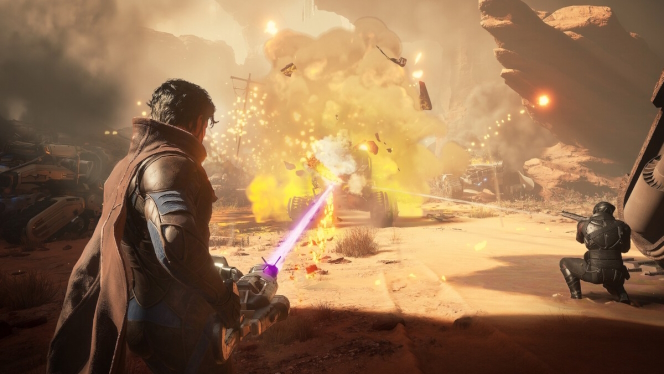
Dune: Awakening has long been discussed as an MMO, but director Joel Bylos now says the game no longer really fits that category. According to him, Funcom’s project is closer to a highly complicated survival game, one built around a large connected world, many players and deep crafting systems rather than the traditional endgame treadmill associated with classic MMOs.
Defining video game genres is often a thankless, almost hopeless task, especially now that more and more games are built from several different design traditions at once. The difference between a strategy game and an RPG can still be useful, but as soon as the argument shifts to hybrids such as whether Deadlock is more of a MOBA or a hero shooter, it becomes obvious how fragile these labels really are. A modern game can be an online world, a survival game, an action game, an RPG-like system and a social experience all at the same time, while none of those labels fully explains what it actually does. Dune: Awakening has run directly into that problem: it has often been described as an MMO, but its own director now wants to place it somewhere else.
Dune: Awakening director Joel Bylos said in an interview with FRVR that, in his current view, the game is not an MMO. That does not mean the title lacks heavily online elements, because Funcom is building a large connected world where many players can meet, move and fight inside the same desert environment. Bylos argues, however, that the genre label is more complicated than that, because the game does not operate according to the familiar structure of classic MMOs and is instead trying to do something that is harder to sell with a single word. “I don’t think it’s an MMO. I’ve worked on multiple MMOs for sure, but I think there was a weird space where we were trying to do slightly more. We have this big, connected world, we have this big deep desert with lots of players being able to go in there. So it was a hard game to describe, and I always find that people kind of have a very set notion of what a genre is. So it’s hard to describe something that does something slightly new”, Bylos said.
The Director Knows What He Means When He Talks About MMOs
Bylos’ statement carries weight because he is not looking at MMOs from the outside. He previously worked on The Secret World, and he was also involved with Conan Exiles, itself a difficult-to-label mixture of survival design, online structure and MMO-like elements. So when he says Dune: Awakening is not an MMO, it is worth treating that not as empty marketing hair-splitting, but as the view of a developer who understands exactly what systems usually make a game function as an MMO. “It’s not an MMO, is my strong feeling right now. It’s definitely not”, he said, grounding his explanation mainly in how the game’s endgame progression is structured.
The difference, according to Bylos, becomes clearest in the late game. Dune: Awakening is not built around the classic MMO treadmill of chasing higher and higher item levels through dungeons, raids or repeatable endgame challenges. In that familiar model, the player keeps climbing an equipment ladder while the entire progression system turns into a constantly moving treadmill. Dune: Awakening, by contrast, puts crafting at the center, meaning that much of its progression, power-building and endgame structure comes through systems more commonly associated with survival games. That means the game can still be large, online, social and multiplayer-driven, but Bylos does not believe that automatically makes it an MMO.
Of course, what developers call their own games does not always settle the argument. Crimson Desert is a useful example: during previews, Pearl Abyss was adamant that the game was not an RPG, while many journalists and players still view it as an action RPG, or at least as a strange hybrid. When a game combines stronghold management, progression systems, an open world and action-heavy combat, genre labels often start arguments rather than clearing anything up. Dune: Awakening brings out the same dilemma from a different angle: its large shared world and many players make the MMO label easy to understand, but its internal systems push its creators toward the language of complex survival design instead.
Dune: Awakening Is More Of A Survival Game, Just A Very Complicated One
The real question is not whether Dune: Awakening is an online game, because it obviously is. The question is whether a large connected world, a shared desert and many players are enough to make it an MMO, or whether its progression, crafting and survival-game logic provide the stronger genre foundation. Bylos’ answer is clear for now: he does not see it as an MMO, but as something newer and harder to describe, a hybrid that only partially fits the usual labels. The issue is that genre terms often lag behind design itself, and by the time players find a comfortable word for a game, developers may already be building the experience from several directions at once.
For now, then, Dune: Awakening is not a classic MMO, but a large-scale online survival game set in the deserts of Arrakis, one that tries to combine social presence, crafting, exploration and the struggle for power. Players may still find it MMO-like once they are sharing the world with many others, but Bylos argues that the essence of the genre is not simply a matter of how many people are present. In the end, the label will probably matter less than the experience itself: whether Dune: Awakening feels like a traditional MMO, a survival game, or an unusual middle ground that keeps the genre argument alive.
Source: PC Gamer













Leave a Reply