
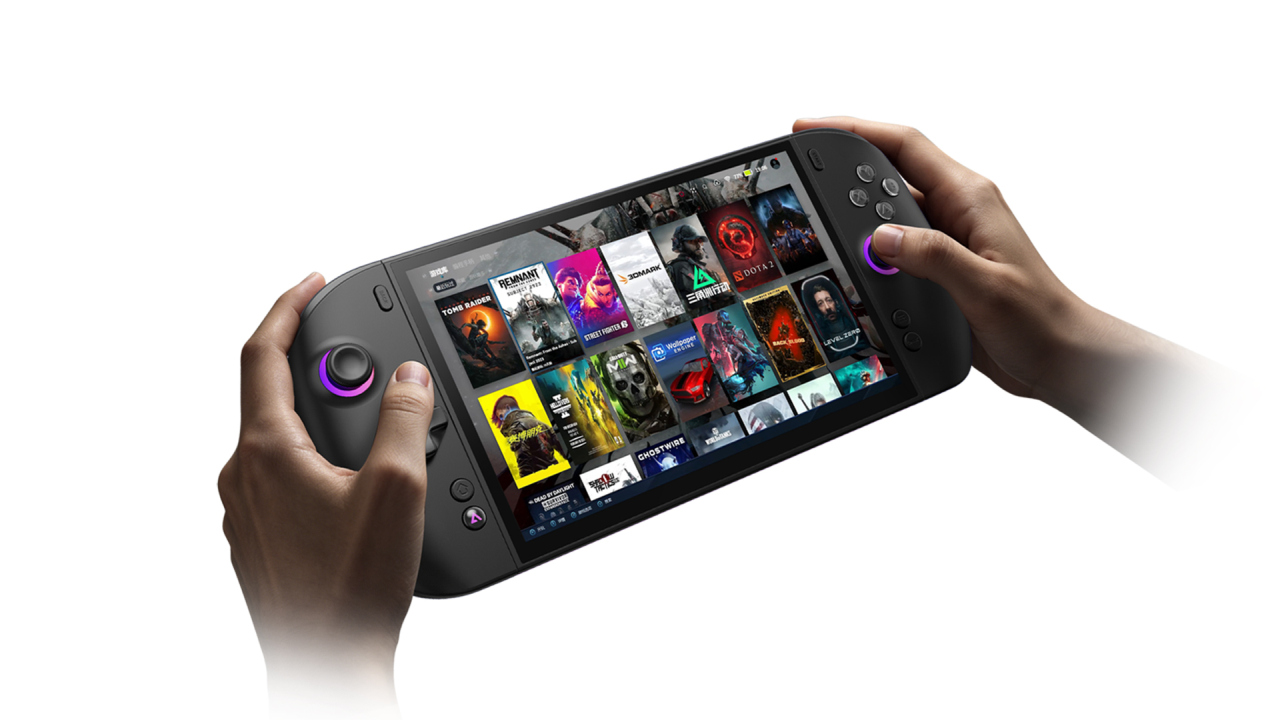
HANDHELD NEWS – The OneXPlayer 3 could become one of the first handheld gaming PCs built around Intel Arc G3 Extreme. With an 8.8-inch OLED display, 144 Hz refresh rate, VRR, HDR, an 85 Wh battery and a 3-in-1 form factor, the device is trying to blur the line between handheld console, mini laptop and portable display.
The handheld gaming PC market has quickly filled up with powerful, expensive and increasingly ambitious devices, but the OneXPlayer 3 arrives with a configuration that wants to be more than just another Steam Deck OLED alternative. The new model is built around Intel Arc G3 Extreme, a chip aimed specifically at next-generation handheld gaming devices. According to Wccftech, the silicon offers up to 14 CPU cores and 12 Xe3 GPU cores, which suggests a much more serious graphics push than what we have usually seen from previous Intel-based portable gaming machines.
The Intel Arc G3 family represents a new direction tied to Panther Lake, and early announcements show that handheld manufacturers are already preparing their next wave of devices around it. Alongside OneXPlayer, companies such as MSI and Acer are also moving toward similar hardware, but the OneXPlayer 3 currently looks like one of the first models actually built around Arc G3 Extreme. This is not being positioned as an entry-level handheld, but as a premium Windows-based gaming and productivity machine that aims to deliver smooth performance in modern titles.

OLED, 144 Hz, and a Display That Is More Than a Footnote
One of the most important parts of the OneXPlayer 3 is its 8.8-inch native landscape OLED display. The panel offers a 144 Hz refresh rate, VRR and HDR support, meaning the machine is not relying only on raw hardware power to sell the portable gaming experience. It is also trying to raise the standard on the display side. That matters in this category, because a powerful chip is not enough if the image tears, the panel feels slow, or the colors and contrast fail to match what modern games demand.
The 8.8-inch size clearly places the device among the larger handhelds. That can improve comfort, readability and even productivity use, but it also makes portability and weight more delicate questions. According to the company’s positioning, the OneXPlayer 3 can be used not only as a gaming handheld, but also as a small laptop and a dedicated display, which means the larger panel is not just a gaming feature. It is one of the pillars of the entire 3-in-1 concept.
The device uses detachable controllers, and the available images and specifications suggest that OneXPlayer is trying to make the control system practical rather than just flashy. The control setup includes a capacitive touchpad described as offering mouse-level precision, while the top triggers use a two-stage design that can switch between micro and linear modes. That could matter not only in games, but also when the machine is used as a small Windows laptop with a keyboard and productivity apps.

3-in-1 Design: Handheld, Mini Laptop, and Display in One Body
The most visible promise of the OneXPlayer 3 is its 3-in-1 design. The device can be used as a traditional handheld, but with detachable controllers, keyboard support and a large OLED panel, it looks closer to a portable mini PC-tablet hybrid. The company is positioning it as both a gaming and productivity device, which is not a completely new idea in this market, but the combination of Arc G3 Extreme and a large OLED display gives the concept more serious foundations.
That kind of design only works if the machine does not become too bulky. In handhelds, performance, battery life, cooling and ergonomics always push against each other: a bigger battery adds weight, a stronger chip needs better cooling, and a larger screen improves the experience while making the device less compact. The OneXPlayer 3 therefore is not really competing with lightweight classic handhelds. It is going after pricier Windows handheld PCs that function more like portable gaming machines.
On the connectivity side, the official Indiegogo page and recent reports mention USB4, USB-A, a microSD card slot, a 3.5 mm headphone jack and mini SSD expansion. That clearly shows the company is not treating this as a closed console, but as a Windows system that can connect to peripherals, external storage, docks and accessories. For this type of device, that is essential. If it is being sold as a laptop and productivity tool as well, it cannot simply be a large screen with controllers attached.

Arc G3 Extreme Is the Real Question
In performance terms, Intel Arc G3 Extreme is the key novelty. Wccftech suggests that the OneXPlayer 3 may target Arc B390-level gaming performance, with the potential for 60+ FPS gameplay in modern titles. That sounds good, but handhelds always raise the same real question: at what power draw, with what temperatures, at what noise level and for how long can that performance be sustained? Raw specifications can be misleading in a portable device, because sustained performance is at least as important as peak numbers.
For Intel, Arc G3 could be especially important because AMD-based solutions have dominated much of the handheld PC conversation so far. The Steam Deck, ROG Ally, Legion Go and several other Windows handhelds have relied on AMD hardware, while previous Intel attempts received mixed reactions. If Arc G3 Extreme proves efficient, stable and well optimized for games, the OneXPlayer 3 could be more than another expensive handheld. It could become an important demonstration of Intel’s renewed handheld ambitions.
The device includes an 85 Wh battery, which is a strong figure in this category and may be necessary to feed both the large OLED display and the high-end hardware. The promotional images also refer to a swappable battery design, which is an interesting direction, but there is still not enough concrete information about real battery life, power profiles or charging behavior. This will be decisive. A handheld can be powerful, but if it drains too quickly under serious gaming loads, or if it only behaves well at reduced performance, the experience changes completely.

The Price Is Still Missing, and That May Be the Painful Part
The OneXPlayer 3 Indiegogo campaign is scheduled for June, but pricing has not yet been disclosed. That is not a small detail. It is one of the most important parts of the entire story. High-end Windows handhelds can become very expensive very quickly, especially when an OLED display, a powerful Intel chip, a large battery, detachable controllers, keyboard support and productivity modes are all involved. Based on where the competition has been moving, this is unlikely to be a cheap machine.
For now, the OneXPlayer 3 is more of a promise than a final offer. On paper, it could become a very strong handheld PC, with its OLED display, 144 Hz VRR, 3-in-1 design and Arc G3 Extreme all making sense together. The real question is how performance, cooling, battery life, software stability and price come together. If the machine is too expensive, it may remain a niche product. If Intel’s new chip really delivers the promised level of performance, however, the OneXPlayer 3 could become one of the most interesting Windows handhelds of 2026.
Source: Wccftech, Indiegogo, Notebookcheck, VideoCardz






![The System Requirements for Fable Are In! [VIDEO]](https://thegeek.games/wp-content/uploads/2026/08/vnews-05-fable-1280x720-1-302x180.png)







Leave a Reply