
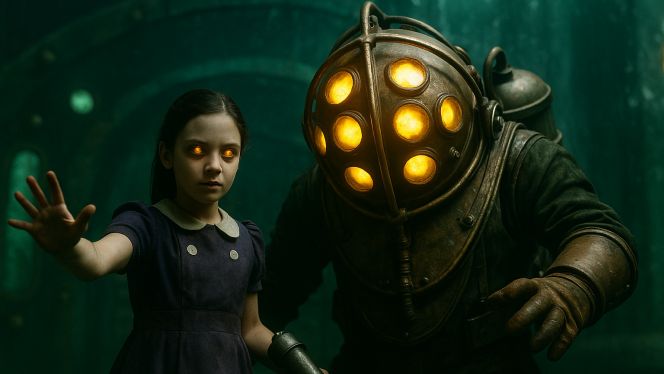
According to one developer who worked on BioShock and BioShock 2, 2K Marin had been building a cooperative open-world project that was already pointing toward Destiny years before Bungie’s shooter arrived.
It has been a long time since we last had a new BioShock game. Fourteen years have passed since BioShock Infinite, slightly less if its two DLCs are included, and without Irrational Games or 2K Marin, the franchise now rests in Cloud Chamber’s hands. In a parallel universe, however, one of those defunct studios could have had a much larger future: 2K Marin, the team that followed Ken Levine’s studio with BioShock 2, nearly moved from that sequel into a project that is now easy to describe as Destiny before Destiny.
David Lindsey Pittman, a programmer who worked on both the first BioShock and its sequel, has now spoken openly about that canceled game. In a BlueSky thread, he described the internally named Project Richmond as, quite literally, an attempt to “make Destiny before Destiny existed” while still preserving the distinctive identity of the BioShock saga. That did not mean the project was officially a BioShock entry, but it would have carried a lot of the series’ DNA: a firearm or melee weapon in the right hand, strange almost magical abilities in the left, all placed inside a cooperative open-world structure.
2K Marin’s Canceled Game Would Have Taken BioShock Energy Into an Apocalyptic Time Loop
According to Pittman’s description, the game would have been a cooperative open-world looter-shooter set in a tundra, inside an apocalyptic scenario bound together by a time loop. The exact geographical inspiration is not entirely clear, but North America, Asia, or Northern Europe all seem possible reference points, while the visual identity would have mixed late-1960s and early-1970s suburban imagery with brightly colored geometric buildings and social-experiment themes. The player would begin in what seemed like a normal suburban environment, only for the sky to break open as futuristic rangers arrived to rescue them. From there, the multiplayer adventure would begin, in a project Pittman later described as his personal “Everest” at the studio.
The project reached the prototype stage alongside three other internal concepts, eventually becoming known inside the studio as The Experiment. Pittman said he wanted to make the game so badly that he stayed at 2K Marin longer than he probably should have, simply because he hoped it might eventually be greenlit. That never happened. When 2K Marin closed in 2013, the project disappeared with it, turning into one of those fascinating what-if stories the games industry leaves behind.
The idea did not come from nowhere, though. 2K Marin had already experimented with multiplayer through BioShock 2, which included a PvP mode alongside its campaign, even if that component never became the most memorable part of the series. Project Richmond would have been a far more ambitious step: not just an additional mode, but a full cooperative world that blended BioShock’s weapon-and-power logic with a looter-shooter structure that would become hugely influential a few years later. The irony is that by the time Bungie actually launched Destiny in 2014, 2K Marin was no longer around to show what its stranger, more experimental answer to that direction might have looked like.
Source: 3DJuegos







![Monster Hunter Wilds: Ascendance’s Daily Boosted Action Overviews Have Begun [VIDEO]](https://thegeek.games/wp-content/uploads/2026/09/bca47e7d475d4cc4-302x180.jpg)
![Lost Museum: Echoes of the Chromageists: Adventures in the Lost Museum [VIDEO]](https://thegeek.games/wp-content/uploads/2026/09/1c2bd0af3f56a59c-1-302x180.jpg)


Leave a Reply