
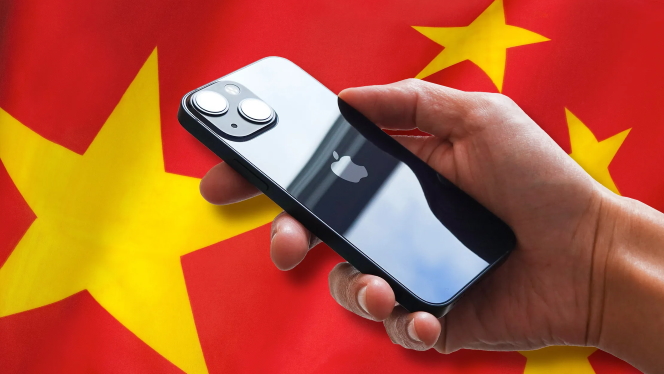
TECH NEWS: According to Bank of America, the Cupertino giant’s main goal may be to strengthen its bargaining position instead.
It never made much sense for Apple to source DRAM from CXMT solely for products sold in China. The memory’s technical specifications are clearly weaker, and it appears better suited to cheaper devices that would not achieve massive sales volume even in the Chinese market.
Nevertheless, a major American bank has offered a simpler explanation for why Apple may be willing to risk the displeasure of the Trump administration. The answer is probably not technological advantage, but negotiating leverage.
The Financial Times previously reported that Apple lobbied the Trump administration for permission to buy DRAM from CXMT. The company remains on a Pentagon blacklist because of its alleged links to the Chinese People’s Liberation Army.
Bloomberg editor Mark Gurman wrote last week that Apple is working with the Trump administration to minimize Washington’s reaction if it ultimately uses CXMT and YMTC chips in products sold in China.
That has never appeared particularly sensible from an economic perspective. Much of CXMT’s capacity is already tied up in long-term agreements, its enormous AI-focused DDR capacity is unusable for Apple, and its limited LPDDR capacity is priced roughly in line with Samsung, SK Hynix, and Micron.
Furthermore, CXMT DRAM could only be used in products sold in China.
BofA on Apple $AAPL and CXMT:
“We do not expect Apple to meaningfully adopt CXMT’s DRAM. Three reasons: (1) US’s restriction on China semis, (2) DRAM quality to meet Apple’s specs (10Gbps+ speed, 1.1V power consumption, ECC function), and (3) DRAM IPs owned by major Korean/US… https://t.co/L8dfTeBkxN
– P Equity Research 📰 (@pequityresearch) July 5, 2026
Bank of America’s analysis argues that Apple could not meaningfully deploy CXMT DRAM because of its technical shortcomings. Apple’s requirements call for LPDDR5X chips with speeds well above 10 Gbps, 1.1V power consumption, and ECC functionality.
CXMT’s chips reach only up to 10.667 Gbps, while higher parasitic capacitance and current leakage also hold them back. According to the analysis, these issues stem from CXMT’s older manufacturing process node.
There is also litigation risk. Samsung, SK Hynix, and Micron hold substantial DRAM-related intellectual property, so they could attempt to draw Apple into patent-infringement cases.
Bank of America therefore believes Apple could only use CXMT DRAM in lower-end products such as the iPhone 18e, and even there not in meaningful quantities. Sales volumes for cheaper iPhones in China are limited in the first place.
CXMT could still be useful to Apple. The Cupertino company may use the Chinese supplier as a bargaining chip when negotiating contract prices for the second half of the year or for 2027 with Samsung, SK Hynix, and Micron.
Actual purchase volumes from CXMT will probably remain modest. Apple nevertheless appears willing to burn political capital in Washington so it can approach price negotiations with the big three DRAM makers from a stronger position.
Source: WCCFTech












Leave a Reply