
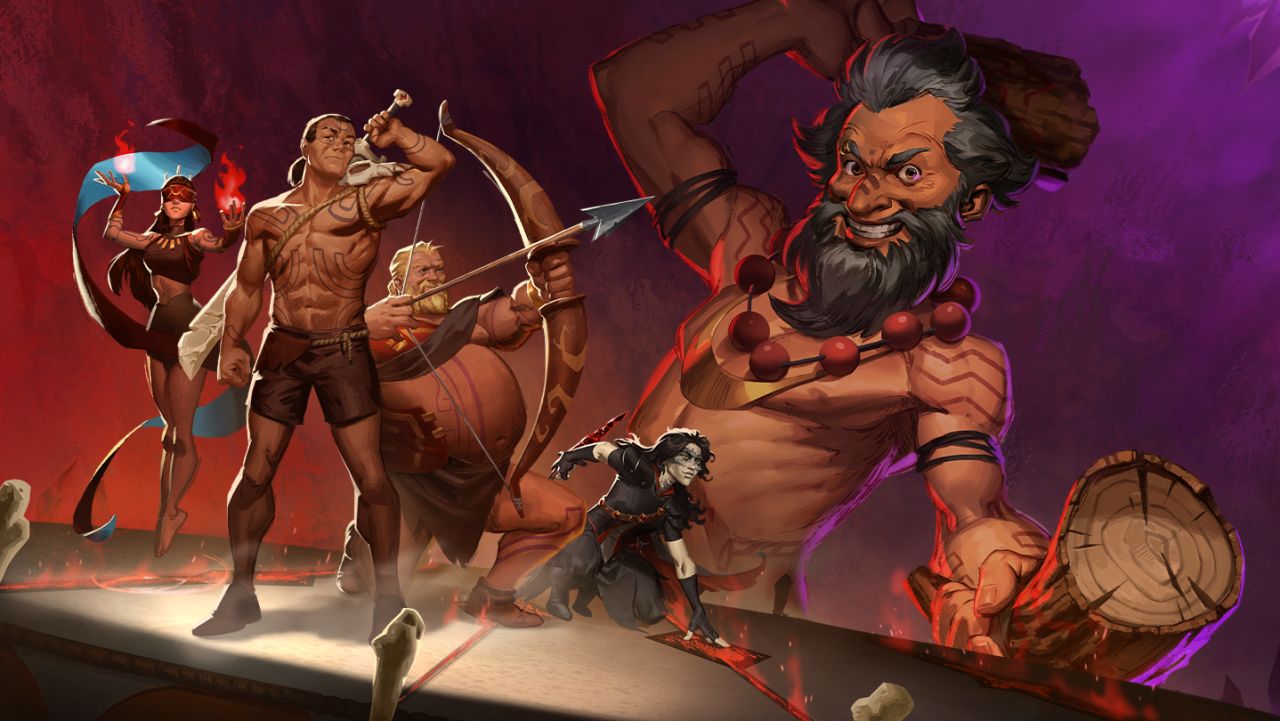
REVIEW – Wardrum is a turn-based tactical roguelite where choosing the correct formation is only half the job, because attacks and abilities must also be performed in rhythm. Mopeful Games and Team17 appear to have thrown three separate genres into the same drum, yet tactics, roguelite progression, and rhythm gameplay find a surprisingly natural shared beat. Not every system works perfectly, and the difficulty occasionally kicks down the door without warning, but the result is still a fresh and entertaining adventure.
I have played enough roguelites over the past few years that I can almost predict from the main menu when permanent upgrades will appear, when the next character will unlock, and after which defeat the game will wisely explain that death is actually progress. The genre nevertheless remains dangerously addictive: short runs, gradual improvement, and the promise of one more attempt can easily consume another evening. Wardrum, however, found something capable of disrupting that familiar routine. Here, deciding where a warrior should move and whom they should attack is not enough, because the command must then be executed in time with the music.
The story takes place in a dark fantasy world infected by a destructive force of off-beat magic. Settlements have fallen, monsters and corrupted sorcery dominate the land, and we must lead a five-member warband toward the source of the disaster. The plot does not overcomplicate its purpose, serving primarily as a framework for successive expeditions while new regions, enemies, and characters gradually expand the setting.
The leader is not a silent knight or enormous barbarian, but Yelder Strongwrist, a hairy, energetic, and distinctly unhinged little drummer. His constant performance is more than decoration: depending on the active rhythm, he provides a strengthening aura to nearby allies and restores a small amount of health every turn. That healing appears insignificant at first. Once the difficulty rises sharply, however, a few recovered points can decide an entire battle.

The Drummer Is Not Marching Behind the Battle This Time
Combat uses a turn-based tactical system, but every member of the party can act during the same player phase. A unit may move, attack, and usually reposition before control passes to the enemy. Using an item does not automatically end a turn, and the entire team shares the inventory, allowing far more flexible healing and emergency management. The real distinguishing feature begins only after an attack has been selected.
During the Rhythm Phase, the camera moves closer, the game briefly demonstrates the required input pattern, and we must repeat it in time with the beat. On keyboard, combinations can involve the left and right mouse buttons, WASD, the spacebar, and Q, E, or F. That sounds like a lot because it is a lot. A controller assigns the actions to XYAB, triggers, and bumpers, producing a clearer layout that made the rhythm mechanics considerably more comfortable for me.
More accurate execution increases damage and improves the chance of landing critical hits. Stronger abilities naturally use more complicated patterns, so safe basic attacks can carry the party for a while, but dangerous enemies eventually force us to learn the more demanding sequences. Ranged units can receive hold prompts, while certain stances provide overwatch or direct counters during enemy turns. Some skills use Choice Keys to alter their effect, and others demand simultaneous button presses.
Rhythm is not simply a minigame attached to attacks, because status effects interfere with it directly. Confusion randomises the displayed buttons, while Bleed and Poison can introduce additional inputs that reduce damage or shorten the effect. Blind is especially unpleasant: the commands remain visible, but the timing cursor disappears, forcing us to rely on instinct. These situations prove that Wardrum treats its musical concept as a foundation rather than decoration.

The Battlefield Joins the Performance
The tactical maps are not passive backgrounds either. Day and night cycles introduce modifiers that may help or hinder the party, while packs of wild predators occasionally enter the conflict. They initially seem like another threat, but careful positioning can convince them to attack our opponents instead. Bushes, rubble, and spike nests provide bonuses or hazards, while breakable, pushable, and volatile tiles create further possibilities. A well-timed shove can occasionally achieve more than the most elaborate rhythm sequence.
Each warrior can equip two Trinkets, providing passive bonuses such as stronger terrain effects, healing every turn, or other role-defining improvements. The game helpfully warns us when equipment remains unused despite an open slot. Levelling improves statistics and frequently offers a choice between two new abilities, allowing the same unit to develop in different directions.
On the world map, we travel between nodes containing battles, random events, treasure chests, and special locations. Rhythm Stones can be used to forge Rhythm Chains: red, green, and yellow stones provide different properties, while we choose an attack’s range, type, cooldown, and other characteristics. It is one of the game’s most interesting systems because it allows genuinely customised abilities. It is also one of the least intuitive, and forging naturally requires another rhythm challenge.
Most roguelite progression occurs between attempts at the Shrine of Growth. Rhythm Essence unlocks characters, abilities, and permanent upgrades, while the Shrine of Mending can resurrect fallen allies or remove curses. D’jembe sends the party back through time after defeat, although both Rhythm Essence and Cadence are needed to improve the chances of the next expedition. The journey crosses six distinct biomes, gradually raising the stakes with new enemies, hazards, and environmental conditions.
Death is initially permanent within a run. When a warrior loses all health, they fall and may only return if the party later finds a suitable Oasis. Shrine of Growth upgrades eventually allow characters to suffer injuries instead of dying, but every loss carries serious consequences until then. The surviving party at least receives a temporary attack bonus after losing a companion. Yelder is a special case: if he falls, his irritable ghost can continue wandering the battlefield, still refusing to stop drumming even after death.

The Rhythm Is Stronger Than the Difficulty Curve
Wardrum combines two-dimensional character models with three-dimensional environments. The camera moves closer during clashes and presents hits dynamically enough to stop the rhythm sequences from feeling like detached button prompts. The dark fantasy landscapes, unusual monsters, and different biomes remain visually distinct. The Crimson Desert is particularly memorable, where giant flying insects, suicidal soldiers, and blood mages announce that the gentler opening region was merely a warm-up.
Music naturally has a central role, but the most impressive audio element is not necessarily a melody. It is the percussion itself. The drumbeat drives every encounter forward, while the percussive effects accompanying successful inputs give each strike additional weight. Music and mechanics function as parts of the same system rather than separate layers, helping longer progression stretches retain their energy.
The difficulty does not rise with equal elegance. Early encounters can be extremely easy before the game quickly introduces enemies capable of removing a fragile unit with one powerful attack. Empra, for example, spends her own health to cast magic and can be defeated before her considerable damage becomes useful. Roguelites are expected to be harsh, but Wardrum sometimes punishes the player through abrupt power spikes rather than tactical mistakes.
The number of systems can also become exhausting. Rhythm patterns, stances, status effects, terrain tiles, Trinkets, forging, time-of-day changes, metaprogression, and several resources all demand attention at once. Waypoint Mode is supposed to help avoid traps and enemies, but it is easy to activate accidentally and can create more inconvenience than it removes.
The greatest obstacle remains the complexity of certain attacks. A single ability may require three or four distinct inputs in quick succession, in the correct order and exact rhythm, while we also monitor the tactical state of the field and any active debuffs. It is thrilling when everything works, but tiring when every strong attack from every party member requires the same concentration during a long encounter. The easier rhythm setting helps with timing, although it cannot completely solve the underlying clutter.
The Drum Calls Us Back After Every Defeat
Despite its flaws, Wardrum is difficult to leave behind. The combination of tactics and rhythm is not a one-off gimmick, but a genuine mechanical foundation that influences attacks, negative conditions, and even ability forging. Party building, branching character development, and environmental tactics provide enough choice to ensure that the next expedition does not unfold exactly like the previous one.
It demands patience. Conquering all six biomes, overcoming increasingly dangerous enemies, and collecting the necessary improvements involves considerable repetition, while difficulty spikes can abruptly stop a promising run. Players expecting a quick victory or a relaxed rhythm game may soon experience pain in both their hands and pride. Anyone willing to accept that tactical decisions must not only be planned but also performed to the beat will find an inventive, substantial, and pleasantly unusual roguelite.
Wardrum is not perfect, and several systems would have benefited from simplification or more consistent balance. Even so, genre combinations whose seemingly distant components support each other this naturally are rare. Battles are divided not only into turns, but into beats. Miss the rhythm and death will probably follow, but at least the next run may begin with better timing.
-Gergely Herpai „BadSector”-
Developer: Mopeful Games
Publisher: Team17
Genre: turn-based tactical rhythm roguelite
Release date: May 7, 2026 (PC, Steam)
Pros:
+ Tactical and rhythm mechanics connect inventively throughout almost every system.
+ A wide selection of warriors, development paths, and customisable abilities.
+ Distinctive visuals, excellent percussion, and energetic battles.
Cons:
– The difficulty rises too abruptly.
– Too many overlapping systems occasionally make the experience feel cluttered.
– More complex attacks demand too many inputs for a single action.
Wardrum
Gameplay - 8.2
Graphics - 8.3
Story - 7.2
Music/audio - 8.9
Ambience - 8.4
8.2
EXCELLENT
Wardrum is a fresh and substantial roguelite that does not merely decorate turn-based tactics with rhythm gameplay, but genuinely builds its combat systems around the beat. Abrupt difficulty spikes, crowded mechanics, and overly complicated input patterns hold it back, yet party building, environmental tactics, and its forceful percussion easily encourage another attempt. It is neither quick nor easy, but players who find its rhythm may hear the drum for a very long time.

![The JRPG Made by Final Fantasy and Dragon Ball Creators Got an unofficial PC port! [VIDEO]](https://thegeek.games/wp-content/uploads/2026/08/vnews-blue-dragon-reblue-302x180.jpg)
![Stranger Than Heaven: A Dozen Minutes from the Gamescom Demo [VIDEO]](https://thegeek.games/wp-content/uploads/2026/08/vnews-stranger-than-heaven-302x180.jpg)



![The Wolf Among Us Remastered: Bigby Goes Noir! [VIDEO]](https://thegeek.games/wp-content/uploads/2026/08/theGeek-08-wolf-among-us-remastered-1280x720-1-302x180.jpg)
![Alien Deathstorm: A Look at the Reactor Mission [VIDEO]](https://thegeek.games/wp-content/uploads/2026/08/theGeek-06-alien-deathstorm-1280x720-1-302x180.jpg)

![Shadow of the Road: You Can Now Try Out This Japanese Adventure [VIDEO]](https://thegeek.games/wp-content/uploads/2026/08/theGeek-05-shadow-of-the-road-1280x720-1-302x180.jpg)
![Etre: A Metroidvania with a sci-fi twist [VIDEO]](https://thegeek.games/wp-content/uploads/2026/08/theGeek-04-etre-1280x720-1-302x180.jpg)


![The JRPG Made by Final Fantasy and Dragon Ball Creators Got an unofficial PC port! [VIDEO]](https://thegeek.games/wp-content/uploads/2026/08/vnews-blue-dragon-reblue-300x365.jpg)
![Several Thefts Have Occurred on the Gamescom Exhibition Grounds! [VIDEO]](https://thegeek.games/wp-content/uploads/2024/08/theGeek-gamescom-2024-300x365.jpg)