
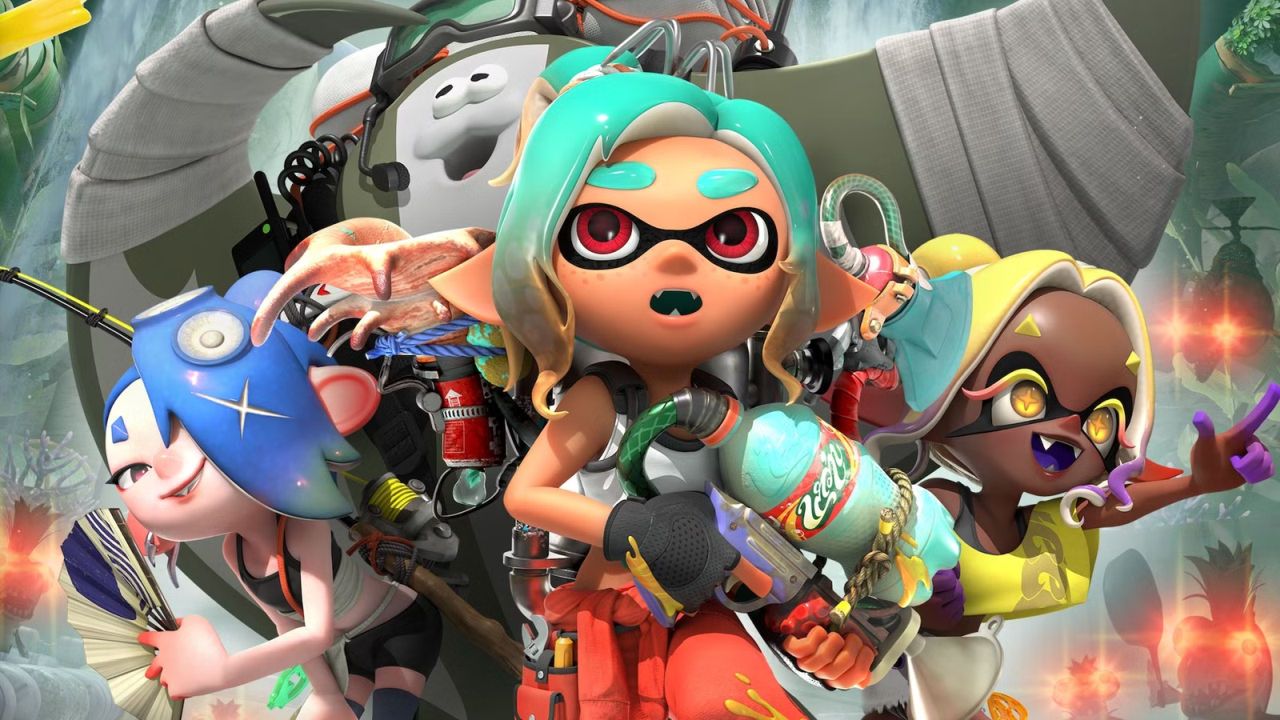
REVIEW – Nintendo has left its ink-soaked urban arenas behind and promoted one of Splatoon’s best side activities into a full game. Splatoon Raiders takes the horde battles of Salmon Run to the Spirhalite Islands, surrounding them with looter-shooter progression, upgradeable equipment, and short replayable missions. The result is spectacular, fast, and dangerously easy to consume, even though a few boxes of the series’ familiar urban madness appear to have been left on the dock.
Splatoon has always been a peculiar creature. It looks like a Saturday morning cartoon dropped into a vat of neon paint, but beneath that surface sits a precise and relentlessly quick shooter where covering the floor can matter as much as hitting an opponent. After three main entries, Nintendo has avoided producing another straightforward competitive sequel. Instead, it has taken Salmon Run, removed the “side mode” label, and handed it the keys to its own building.
Splatoon Raiders is primarily a single-player adventure, although up to three additional players can join online or through local wireless. Its structure follows the familiar loop of Destiny, Borderlands, and other looter shooters: prepare at the base, select a compact mission, bring the loot home, upgrade, and return because the next weapon may fire pink ink three percent faster. That sounds more sarcastic than it feels while playing. The loop works.
Nintendo has also resisted the urge to hide an endless live-service game inside the ink tank. There are no daily chores demanding attention, no paid battle pass, and no suggestion that missing a weekend will forever cost us the legendary purple sponge sword. Raiders respects the player’s time while understanding exactly how to tempt us into one more mission.

We Left the City Behind, but the Pipes Came Along
A strange storm forces Deep Cut and the mechanic travelling with them to make an emergency landing on the mysterious Spirhalite Islands. After a month of improvised construction, the crew completes a ramshackle hideout ship, and Shiver, Frye, and Big Man decide that being stranded is no reason to ignore the archipelago’s rumoured treasures. We control a customisable mechanic responsible for completing raids, improving equipment, and preventing the Salmonids from permanently occupying the neighbourhood.
The new setting is initially exciting, but it soon becomes clear what was lost during the journey. There is no crowded plaza, no player messages displayed on walls, no fashionable squid kids, and no loud shops piled on top of each other. The islands have their own personality, assembled from plumbing, industrial wreckage, and unusual vegetation, yet they are noticeably lonelier. Silence is an especially visible guest in a Splatoon game.
The hideout ship is at least an excellent operational hub. Weapons can be tested, equipment modified, facilities upgraded, and new missions selected without unnecessary travel. Menus respond quickly, movement between unlocked stations is almost instant, and the game rarely makes us swim through the same corridor for the hundredth time merely to replace a module.
One member of Deep Cut accompanies each raid inside a powerful Exploration Bot that helps in both combat and treasure hunting. We still see less of the trio than we should. Much of their communication comes through text-only radio messages, while longer conversations at the base are reserved for specific story moments. They remain charming, but the game rarely allows them to fill the screen.

Salmon Run Finally Gets Prime Time
The Spirhalite Islands are explored through a gradually uncovered two-dimensional map. Beneath the fog lie new missions, treasure sites, materials required for upgrades, and increasingly demanding challenges. Most activities can be completed within a few minutes, making the game ideal for short handheld sessions, although those carefully measured portions can easily assemble themselves into an entire evening.
The simplest arenas ask us to collect a required amount of Power Eggs before the timer expires while Salmonids attack from every direction. Other missions involve hunting elite enemies, drilling crystals in larger exploration spaces, or solving platforming and puzzle sequences with predetermined equipment. These more controlled stages occasionally recall the musical levels of Rayman Legends, not because they copy them directly, but because movement and environment are forced into a similarly precise shared rhythm.
Mission design regularly changes which weapon or play style is most effective. A short-range ink weapon can destroy crowds inside narrow corridors, but an arena filled with distant targets quickly demonstrates that enthusiasm is not an adequate substitute for range. As a result, we experiment with equipment that might have remained permanently untouched in the competitive games.
The familiar arsenal returns with rarity levels and random properties. Better versions offer stronger base statistics or passive bonuses, although the weapon affixes found during the campaign are often conservative. A little additional damage, faster firing, or the occasional status effect is useful, but it is not always the kind of reward that convinces someone to repeat the same stage at three in the morning.
The three selectable ink tanks and their mechanical Gadgets provide the real depth. One setup favours speed and mobility, another durability, and the third tactical tools, while later upgrades allow traits from these roles to overlap. Turrets, explosive devices, and various support tools can be included in a loadout, and the correct module combination can substantially change how a mission is approached.
The game deliberately encourages experimentation. Some improvements require us to use a particular item for a meaningful amount of time, while certain stages contain different rewards depending on the equipment carried into them. Raiders refuses to let us find one comfortable weapon and press the same button for twenty hours. At the very least, it makes a polite and persistent effort to prevent it.

The Switch 2 Can Handle It; We May Struggle
Combat still relies on the familiar relationship between ink and movement. In humanoid form we fire paint, while squid form allows us to dive into our own colour, move rapidly, restore ammunition, and recover health. The system remains fresh after a decade because attacking, travelling, and transforming the battlefield all depend on the same resource. Anyone attempting to stand still and shoot soon discovers the limited life expectancy of a dry squid.
Splatoon Raiders demonstrates the power of the Switch 2 when an arena fills with dozens of Salmonids, damage numbers, projectiles, explosions, and several competing colours of ink. At such moments the screen can resemble an attack by modern art rather than a readable battlefield, yet performance remains convincing even during the most crowded sequences. Whether docked or handheld, the game feels quick, stable, and immediately responsive.
Enemy quantity alone would not produce good combat. Elite Salmonids and bosses use recognisable patterns, protected points, and particular weaknesses, forcing us to manage priorities, ink reserves, and Gadget cooldowns instead of holding the trigger without thought. Selecting the wrong target can allow one specialist enemy to flood the arena with smaller creatures in seconds.
The best encounters create carefully organised chaos. We can see how little time remains and how many eggs are still required, while an armoured monster blocks the exit and something behind us has once again exploded. At those moments, Raiders does not resemble a leisurely search for loot. It feels as though Salmon Run has finally received the hardware and budget it had been waiting for.
Several boss encounters are impressively staged, and the final opponent is best approached with as little prior information as possible. More large-scale battles would have been welcome, because the existing ones demonstrate how naturally the game can shift from crowd control into a focused mechanical test. The opening half of the campaign waits too long before revealing this side of itself.
Aiming may remain divisive. Gyroscope controls are exceptionally precise, handheld and television modes receive separate options, and sensitivity can be adjusted in considerable detail. Long-term Splatoon players may no longer understand why anyone struggles with them. Traditional right-stick aiming still feels awkward on the vertical axis, however, and the absence of a Switch 2 mouse mode is a missed opportunity after other games have shown how naturally the Joy-Con 2 can serve that purpose.
A Splatoon That Occasionally Forgets How Strange It Is
The greatest weakness of Splatoon Raiders is not its gameplay. Shooting is excellent, missions load quickly, experimenting with equipment is enjoyable, and harder challenges genuinely demand considered builds. Three difficulty levels alter enemy strength without reducing rewards, allowing players to adjust the journey according to their patience and blood pressure.
The problem is that part of the series’ identity was lost during the crossing. The crowded locations, aggressive music, peculiar supporting characters, and fashionably pointless details of the main games gave their world a density that the islands rarely reproduce. The stages are well designed, but the space between them feels less alive. Music could occupy the foreground more often, and Deep Cut deserves more scenes in which its members are not attempting to express their personalities from the side of a radio window.
This is partly a deliberate exchange. Raiders is less interested in presenting itself as a cultural phenomenon and more concerned with becoming a clearly organised, approachable action game. It performs that task extremely well, but occasionally feels too normal for a series where one of the pop stars is a giant manta ray, shops are managed by talking sea creatures, and fashion carries more strategic importance than ammunition.
The main campaign can take approximately fifteen to twenty hours, while advanced mission variants, higher-level equipment, and the endgame can extend that considerably. Harder versions of completed stages offer altered enemy arrangements and exclusive rewards, while cooperative play provides further life for the systems. The full game works well alone, but the largest arenas become even more spectacular and unpredictable when shared with other players.
Splatoon Raiders is not the most daring or memorable entry in the series, but it is an excellent game. Nintendo has found a way to transform the foundations of Salmon Run into a substantial and sustainable PvE adventure without damaging the qualities that make its ink combat enjoyable. More urban madness, additional character scenes, and bolder loot effects could have elevated it further, but when the missing eggs are collected during the final seconds while buried beneath Salmonids, it becomes difficult to think about what is absent. Too much is moving across the screen.
-Gergely Herpai „BadSector”-
Developer: Nintendo
Publisher: Nintendo
Genre: single-player-focused PvE action game, looter shooter
Release date: July 23, 2026 (Nintendo Switch 2)
Pros:
+ Salmon Run’s foundations produce fast, spectacular combat that remains entertaining over time.
+ Varied missions, a large arsenal, and a flexible Gadget system.
+ Stable performance, rapid loading, and a substantial endgame.
Cons:
– The islands lack the urban energy and concentrated personality of the main entries.
– Random weapon properties could have been considerably bolder.
– Too few major bosses, and no Joy-Con 2 mouse mode.
Splatoon Raiders
Gameplay - 8.9
Graphics - 9.1
Story - 7.7
Music/audio - 8.7
Ambience - 8.5
8.6
EXCELLENT
Splatoon Raiders transforms the concept of Salmon Run into an excellent, fast, and surprisingly substantial looter shooter that can absorb hours in both solo and cooperative play. Its varied missions, equipment building, and the masses of enemies handled effortlessly by the Switch 2 compensate for the restrained story and the less densely populated world. This may not be the strangest Splatoon, but once it gathers momentum, it pours so many Salmonids and so much ink onto the screen that the missing urban chaos temporarily becomes impossible to remember.




![The Wolf Among Us Remastered: Bigby Goes Noir! [VIDEO]](https://thegeek.games/wp-content/uploads/2026/08/theGeek-08-wolf-among-us-remastered-1280x720-1-302x180.jpg)

![Greak 2: Alliance of the Storms: A Hand-Drawn Metroidvania Set in Synoraz [VIDEO]](https://thegeek.games/wp-content/uploads/2026/08/theGeek-02-greak-2-1280x720-1-302x180.jpg)
![Graveyard Keeper II: TinyBuild Joins the September Rush [VIDEO]](https://thegeek.games/wp-content/uploads/2026/08/theGeek-01-graveyard-keeper-ii-1280x720-1-302x180.jpg)

![Warhammer 40K: Boltgun II: Heading Back in Time This Fall [VIDEO]](https://thegeek.games/wp-content/uploads/2023/06/thegeek-Warhammer-40000-Boltgun-2-302x180.jpg)



Leave a Reply