
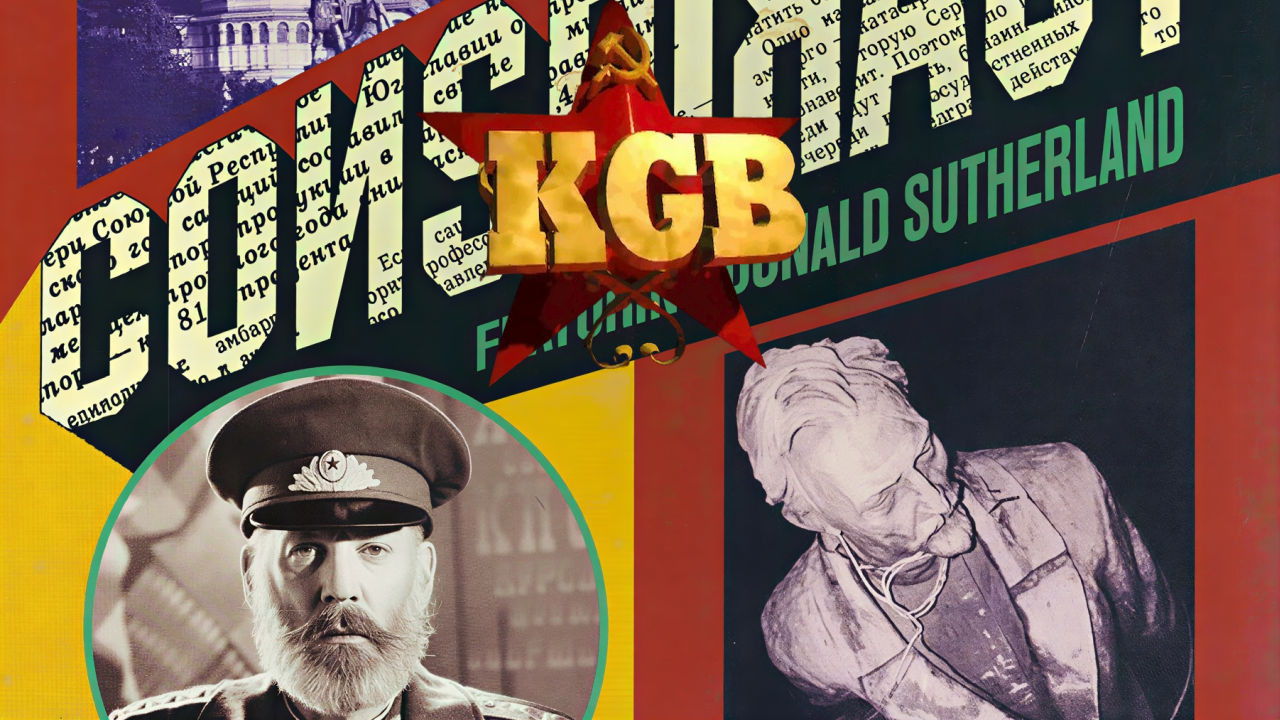
RETRO – In 1992, when most video games were still either running from reality or coating their conflicts in flashy heroic varnish, the French studio Cryo came out with something whose title alone promised nothing good. KGB was released for DOS and Amiga, published by Virgin, and from the very first moment it was clear this would not be a breezy, romantic spy yarn. It came from the same studio that had already shown with Dune just how powerful an atmosphere it could create, only here the mystique of the desert was replaced by the muggy, nicotine-soaked, paranoia-drenched world of a collapsing Soviet Union.
The protagonist is Captain Maksim Mikhailovich Rukov, a young officer transferred from the GRU to Department P, the unit that is supposedly tasked with uncovering corruption inside the KGB. The story opens with a murder: a former agent turned private detective is killed, and Rukov almost immediately finds himself in the middle of a conspiracy driven by dogmatic, reactionary apparatchiks who despise perestroika.
It quickly becomes clear that this is not simply about money or internal power struggles, but about people trying to seize back control. In its opening hours, KGB already speaks about politics as if it were a rotting body: still intact on the outside, but long since overrun within by dark, swarming parasites.

Where Power Does Not Seduce, but Suffocates
KGB‘s greatest coup is that it completely turns its back on the gloss of James Bond-style spy fiction. There is no charm here, no breezy action, no flirtatious humor, and nothing whatsoever to make the player feel safe. Cryo’s game may technically be an adventure title, but it feels far more like a suffocating bureaucratic nightmare than a classic thriller. Its semi-first-person perspective, dialogue system, timing, and object use all exist to keep you under constant pressure. Anyone familiar with Dune will recognize parts of the interface, but where that game still had a sense of exotic scope, everything here feels cramped, cold, and distrustful. The people you meet are not trying to help you – they are trying to confuse you, size you up, or lure you deeper into the trap.
One of the most oppressive things about the game is the way it handles time. The clock keeps moving relentlessly forward no matter whether you are still hesitating over a question, trying to decide whom you can trust, or weighing which location to visit first. A single bad question, a missed meeting, or a decision made at the wrong moment can be fatal on the spot, but its real cruelty lies in the fact that sometimes you only realize much later just how badly you screwed up. KGB does not explain itself, does not guide you, and could not care less whether you feel comfortable inside it. What it wants to convey instead is what it might feel like to investigate inside a system where every word is suspect, every sentence has a price, and where a truth spoken at the wrong moment can be more dangerous than a carefully constructed lie.

Donald Sutherland and the System’s Intercepted Whispers
It is no coincidence that contemporary reviews compared the game to John le Carré. KGB is not great because of its spectacle, but because of its density. Everyone knows something they are not saying. Every conversation carries a second layer of meaning, and often a third as well. The game builds its characters and situations in a way that constantly suggests that, in this system, loyalty is only a temporary disguise, while ideology is little more than makeup smeared over the face of raw power. The music reinforces that feeling too. Stéphane Picq’s ominous electronic themes do not dominate the scenes so much as slowly seep beneath them, like some piece of intercepted background noise.
Then came the CD version, Conspiracy, which tried to make the experience even more cinematic through live-action video inserts. One of the most interesting details of that release is that Rukov’s late father was played by Donald Sutherland. Yes, the legendary actor made his one and only appearance in a video game here, as a kind of otherworldly adviser who accompanies the story through filmed sequences. It is both a strange period curio and a terrific move on Cryo’s part. The sentence alone has an absurd punch to it: Donald Sutherland plays a dead Soviet father figure in the CD version of KGB. And somehow, for this game, even that fits perfectly.

The Real Filth of the Coup: Not a New Leader, but a New Face
The finale is the point where KGB leaves the realm of fun retro curiosity behind and starts to feel chillingly relevant. The story’s ultimate solution is not merely an assassination attempt against Gorbachev. The conspirators’ plan is far nastier and far more devious than that: they want to kidnap Gorbachev and replace him with Protopopov, a lookalike surgically altered into Gorbachev’s image and prepared to resign in public, clearing the way for the hardliners. In plain terms, this is not about openly seizing power, but about staging legitimacy. They do not want a new leader. They want an artificially manufactured face, a biological prop, an emptied-out puppet body.
This is the point where you see not only the logic of the late Soviet system, but also that eternal political reflex whereby power protects appearances first. Vovlov even goes so far as to try to make Rukov kill the miserable double himself, as if the machinery’s final crime had to be pinned on the most defenseless figure available. The right path is to refuse him. But by then the game has already made its point: to the system, a human being is not a person, but a replaceable surface. Conviction does not matter – what matters is whose face can still be turned toward the camera.
And this is where KGB collides with the uglier undertones of the present. If we apply the game’s logic to Hungarian politics, we can quite explicitly play with the idea that Orbán was replaced by a Russian puppet double. Not because there is any evidence for such a thing, but because KGB‘s final twist makes that exact mechanism feel chillingly plausible: the same face remains in the shop window, but behind it a different will, a different center, a different power is already at work. According to Bloomberg’s transcript, Orbán’s relationship with Putin goes back to their 2009 meeting in St. Petersburg, and in a later phone conversation Orbán was already invoking the mouse and the lion to signal that he was ready to be of service in any way he could. Seen from here, KGB is no longer merely a Soviet coup thriller, but a chilling political template: the leader does not necessarily have to be removed, as long as the same face is now looking back at us from the shop window of power in someone else’s service.
That may be why the game still hits so hard today. It is not easy to love – it is stubborn, punishing, often openly hostile, and deeply uncomfortable by modern standards. But that is exactly what makes it more than simple nostalgia. KGB is not just an old adventure game, but a cold, dossier-scented, intelligent political nightmare whose logic echoes in real life far too often. And when a game more than thirty years old can so accurately sense how power manufactures itself a new face, a new story, and a new servant, it becomes hard not to conclude that Cryo saw something very ugly long before most others did.
The game can be played online here: PlayClassic.
-Gergely Herpai “BadSector”-
Forrás: Wikipedia, GameFAQs, Bloomberg, theGeek











Leave a Reply