
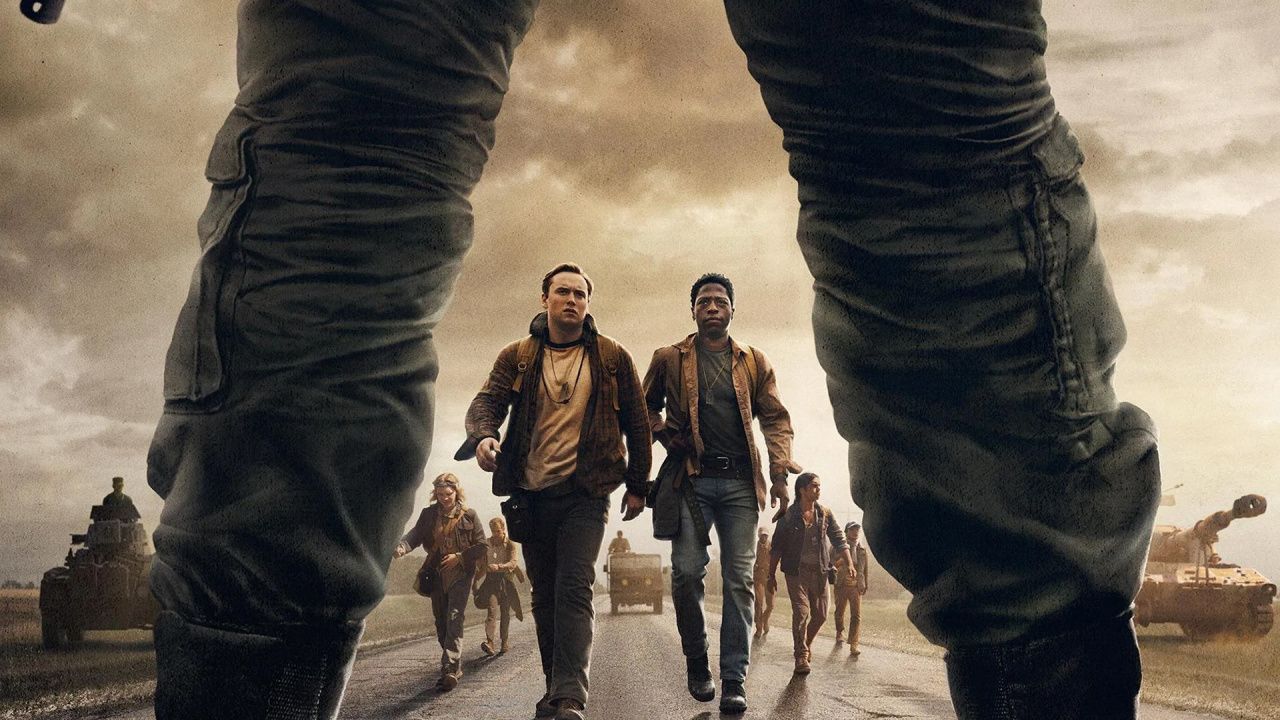
MOVIE REVIEW – Director Francis Lawrence and screenwriter JT Mollner deliver a searingly uncompromising take on one of Stephen King’s most brutal novels. Lionsgate’s latest isn’t just a dystopian nightmare—it’s a razor-sharp allegory about the fragility of youth, the illusion of survival, and the sustaining power of human connection. Few King adaptations have managed to capture the spirit of the source material with such precision and devastating force. This is a film that breaks you apart even as it lifts you up, and it stands as one of 2025’s strongest contenders for best picture.
King was only nineteen when the Vietnam War draft lottery was sweeping thousands of American teenagers into combat. The question was never if you’d be called, but when. Out of that climate came The Long Walk, the story of boys selected by lottery to participate in a lethal endurance march: no finish line, no reprieve, only one survivor. Published later under his Richard Bachman pseudonym, the book wasn’t conceived as political, yet the constant drumbeat of war and dead youth inevitably seeped into every line.
Over the decades, filmmakers like George A. Romero, frequent King collaborator Frank Darabont, and Norwegian horror stylist André Øvredal circled the property. None of their versions materialized—a twist for which we can now be thankful. The iteration that finally reached the screen, written by Strange Darling’s JT Mollner and directed by Francis Lawrence of The Hunger Games fame, is a staggering triumph. This is a King adaptation destined to be counted among the greats, a relentless emotional gut punch and arguably one of the cinematic high points of the year.

The American Dream Turned on Its Head
Where King’s novel occasionally lingers on the masses watching the event unfold, the film keeps us locked on the road with the boys. There’s no vision of a better tomorrow—only the chilling decree of Az Őrnagy (Mark Hamill), flanked by silent armed guards, who promises wealth beyond measure and one limitless wish for the final boy still standing. The rules are simple: three miles per hour, and don’t stop. The movie lays bare the cruel inversion of the cherished myth that “anyone can make it if they just try”—most won’t, no matter how hard they push. Farm kids, city kids, athletes, dreamers: none of it matters once the march begins. Death is the great equalizer.
The violence is unblinking and relentless. Each fall feels like a punch to the gut. Locals stare, transfixed, as the death parade trudges past, while postcard landscapes warp into sun-scorched purgatories. The breeze in tall grass no longer soothes when punctuated by rifle fire. Even police and veterans line up to salute—not to question the slaughter, but to legitimize it. Beneath blistered soles, despair simmers, yet defiance and the reckless fire of youth drive them onward, flowers cracking through concrete. The empty platitudes of “thoughts and prayers” are answered here with a raised middle finger from the young.

Bonds Forged in the Shadow of Death
Unlike the book, which emphasized spectatorship, the film pares down the audience and focuses inward, on the connections between the boys themselves. Cooper Hoffman and David Jonsson form the emotional core as Raymond Garraty and Peter McVries. Roman Griffin Davis, far removed from the child star we knew in Jojo Nyuszi, gives a startlingly mature performance as Thomas Curley. Jordan Gonzalez (Pretty Little Liars: Original Sin), one of today’s most promising transgender actors, is seamlessly folded into the group—his fate all the more devastating because his belonging is never in question.
Joshua Odjick, Garrett Wareing, and Charlie Plummer shoulder perhaps the hardest work, embodying Collie Parker, Stebbins, and Barkovitch—the march’s least sympathetic figures—without reducing them to caricatures. As façades crumble, what emerges is raw vulnerability. The book’s “eight musketeers” are reduced to four, with Tut Nyuot’s Arthur Baker and Ben Wang’s Hank Olson joining Garraty and McVries. Wang injects sharp comic relief, while Baker radiates a warmth that feels like the last ember of humanity. Their camaraderie echoes foxhole bonds born in wartime, yet the futility of their struggle conjures an American Nyugaton a helyzet változatlan.
We grow attached to them as if we’ve known them all along—making their gradual unraveling feel like a personal loss.
King’s Most Intimate Themes on Screen
Stephen King is celebrated for horror, but less often for the precision with which he captures the inner lives of boys. From the fragile brotherhood of the Losers’ Club in Az, to the aching nostalgia of A test (adapted into the film Állj mellém!), King’s stories repeatedly probe fears, loyalties, and the hunger for connection in worlds that deny young men the vocabulary for emotion. The Long Walk may be the purest example of how these bonds can carry the weight of a love story. Hoffman and Jonsson embody that truth with an unshakable chemistry, every glance and line vibrating with urgency and despair.
Mollner’s script recalls Darabont’s approach to A köd: faithful to King while daring to improve on structure. Four hundred pages are distilled into a taut two hours without losing the essence. By centering the Garraty/McVries relationship—whether read as friendship, romance, or something ineffable born of trauma—the film makes their bond the beating heart of the story. Each shared step is electric, a reminder that time is borrowed, and our hope as viewers is that they keep walking—not only to live, but to postpone the moment we must say goodbye.
-Gergely Herpai “BadSector”-
The Long Walk
Direction - 8.6
Actors - 8.8
Story - 9.2
Visuals/Music/Sounds - 8.6
Ambience - 9.2
8.9
EXCELLENT
Francis Lawrence’s The Long Walk is a harrowing and deeply moving adaptation that secures its place among the best Stephen King films ever made. Powered by remarkable performances and a story that reflects the brutal mirror of our world, it devastates and lingers long after the credits roll.







Leave a Reply