
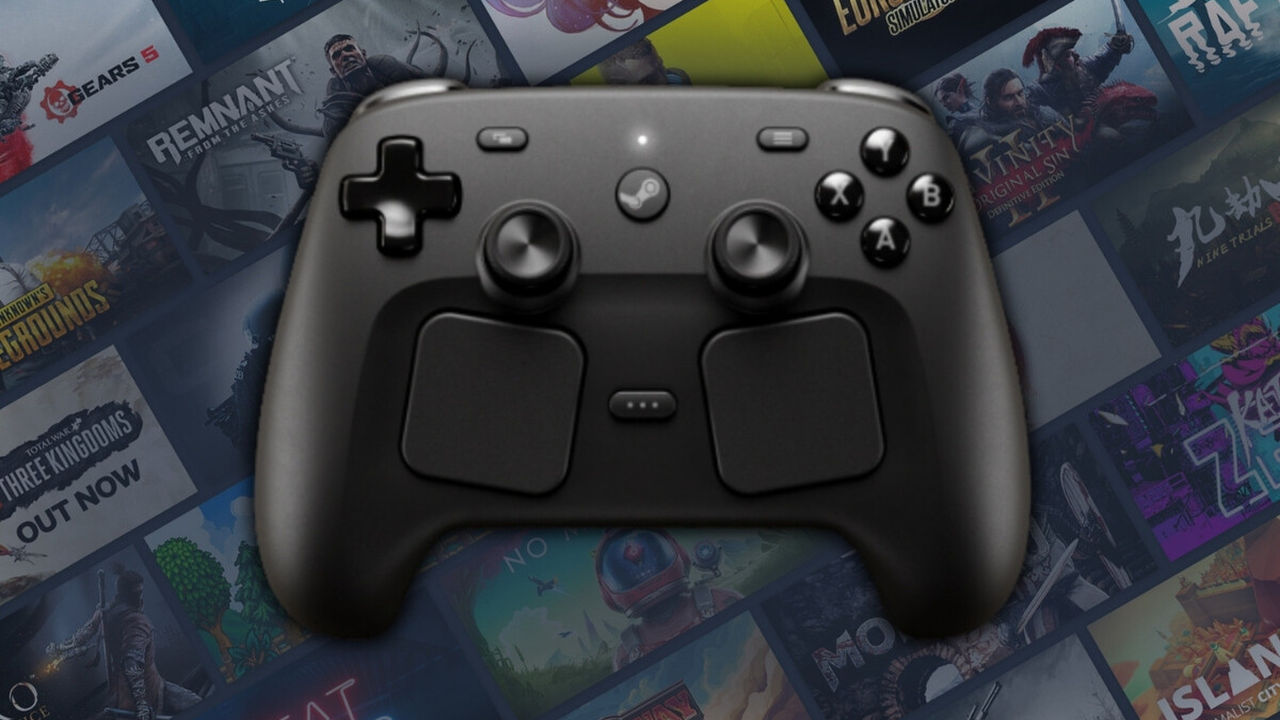
TECH NEWS – While debate over Valve’s new hardware continues, a wildly unusual community project has drawn attention for a completely different reason. Ray Foss has created a webcam-based system that uses the Steam Controller’s vibration to guide it towards its magnetic charging dock. It is not an official feature, and it is probably not the gentlest way to charge the device, but the ingenuity behind it is difficult to deny.
In recent days, almost every conversation about Valve has revolved around the Steam Machine. The American company’s new hardware still does not have a release date, but the possibility that its most basic model could cost more than €1,000 without even including the Steam Controller has already triggered substantial debate. That has led many people to wonder what the next generation of consoles might look like, but this time the story is not about bad news connected to Valve’s new machine. Instead, it is about the fact that the Steam Controller may now be able to make its own way to its charger without its owner needing to move it.
It is a little like the Rick and Morty scene in which Rick builds a robot purely to butter his toast. There is now a system that effectively lets you tell your controller to go and charge itself.
That kind of strange idea fits Valve hardware perfectly, since the company’s devices have traditionally left plenty of room for users to freely experiment with what they can do. In this case, the vibration system is the key. Ray Foss demonstrated on X, formerly Twitter, that a Steam Controller can use its own vibrations to slide towards its charging dock while another system guides it in the right direction. He also created a website for the project, which asks users to place the magnetically attaching charging base on a table and position a webcam above the surface. Once the controller is switched on and connected to a PC, users only need to mark the top and bottom points of the dock on the website.
After those reference points are set, the system enters continuous tracking mode and uses the camera’s visual data to monitor the controller. The software analyses the pixels captured by the webcam, identifies the Steam Controller’s position in real time, and calculates its orientation, movement, and relationship to the charging base. The purpose is simple: once the device is no longer being used, it should return to the dock by itself, attach magnetically, and begin charging.
The “Magic” Is Hidden in the Steam Controller’s Vibration System
But how can a controller actually move? The answer lies in the Steam Controller’s vibration system. Unlike more traditional peripherals, Valve’s controller and the PS5 DualSense use linear haptic actuators, or LRAs, to generate vibration. They consist of two small moving masses suspended on springs that move linearly back and forth through the action of a moving coil, in a way that is broadly similar to a speaker cone. Valve placed the two LRAs beneath the controller’s trackpads, while the DualSense uses them beneath its grips.
Ray Foss’s modification increases the revolutions per minute of the vibration system, and on a smooth surface the Steam Controller can no longer maintain enough grip, causing it to gradually move across the table. That is exactly what allows the camera-based system to guide it towards the charger, but it is also the project’s greatest risk: prolonged use could damage the controller’s chassis or even the table surface, while the constant vibration could place additional wear on the haptic mechanism itself. It should therefore be used carefully, even if it is undeniably one of the most entertaining community Steam Controller experiments seen so far.
Source: 3DJuegos







![Monster Hunter Wilds: Ascendance’s Daily Boosted Action Overviews Have Begun [VIDEO]](https://thegeek.games/wp-content/uploads/2026/09/bca47e7d475d4cc4-302x180.jpg)




Leave a Reply