
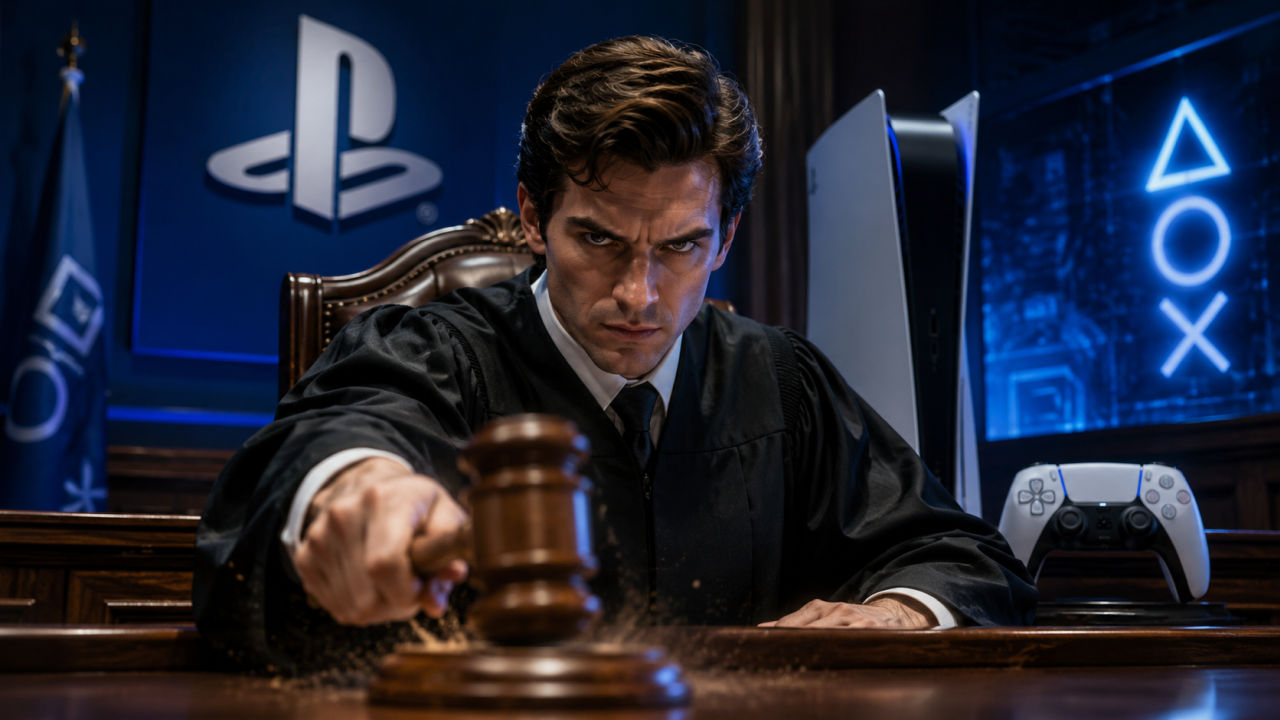
PlayStation’s disc-free future could affect far more than collectors and traditional game retailers. Sony’s decision raises competition-law and consumer-rights questions that may eventually reach the courts, because the real issue is not whether discs can disappear, but what choices remain for players after they do.
The disappearance of physical games would mean far more than empty shelves in game stores. A disc does not grant unlimited legal ownership over every part of a game, but it can still be resold, lent to someone else, or passed on, and it is much harder to imagine a company taking a purchased disc away from its owner. Digital purchases work very differently: Ubisoft is not going to arrive at anyone’s home to confiscate an old Assassin’s Creed II disc, but the company has already removed the first The Crew from players’ digital libraries.
That creates two major questions. The first is whether Sony could gain such a strong position by phasing out physical media that retailers are effectively pushed out of PlayStation game sales, leaving the company with more freedom to set prices. The second is whether a law or competition authority could ever force PlayStation to continue offering games on disc if the digital shift clearly reduces competition and weakens consumer rights.
Sony Could Be Walking a Legal Tightrope
To examine those questions, legal experts from the Jugando a Derecho podcast, which studies current events in gaming through a legal lens, were asked for their view. They stressed that it is still too early to say whether Sony’s announcement alone changes the company’s legal position, because much will depend on how PlayStation handles the transition. “I believe they already have a class-action lawsuit in the United States over not allowing certain retailers to sell their games digitally with download codes, but it all depends on how this issue develops in the European Union,” they explained, adding that Sony’s own choices and the way it phases out physical editions could be decisive.
More serious problems could emerge if Sony tried to turn the PlayStation Store into the only meaningful place to buy digital games on its hardware. In that scenario, the experts believe there could be arguments about abuse of market power, distortion of competition, and consumer legal action. They also warn, however, that nothing is guaranteed in cases like these: major gaming-industry acquisitions have shown before that decisions widely expected to be blocked can still receive approval in the end.
That may be why Sony’s plan to let publishers continue selling digital codes in physical retail boxes after 2028 could matter so much. From a player’s perspective, it is an unattractive compromise, because the box would no longer contain a disc, only a download code tied to an account. Legally, though, there may be an important difference between leaving consumers with a worse alternative and leaving them with no alternative at all.
“It could reduce the likelihood of coordinated action by third parties or major physical and second-hand game sellers attempting to argue that there is a dominant position or anti-competitive conduct through which Sony imposes conditions on the market or expels them from it. We would have to see how this ends before competition authorities or the courts. Sony would almost certainly argue that physical sales still exist, that no one is being expelled from the market, only that the box no longer contains a disc, and that this is not entirely new in physical retail.”
The code-in-a-box model could still weaken the very right that has most clearly separated physical games from digital licences. If the code has to be redeemed through a user account, the ability to resell the game later effectively disappears, even if the product still looks like a traditional retail release at first glance. The legal experts describe this as taking away a player’s rights through the back door, particularly because Spain’s physical market, including second-hand games, is estimated to account for 54 percent of the market, far above the 20 percent figure cited by Sony.
The debate also reaches well beyond discs. Dynamic pricing, revoked licences and difficult refund policies have created a growing political demand for stronger regulation of the video game market. The Stop Killing Games movement has gained noticeable political weight in the European Parliament in recent months, while French politicians and Spanish members of parliament have also spoken out following Sony’s decision. For PlayStation, the end of physical games may therefore become more than the start of a new business model, because the final consequences could be determined not by Sony, but by courts and regulators.
Source: 3DJuegos



![Code Vein II: Mask of Idris: Update and DLC Coming Soon, All at Once [VIDEO]](https://thegeek.games/wp-content/uploads/2026/02/theGeek-Code-Vein-II-302x180.jpg)
![The Second Story DLC for Borderlands 4 Launches in Three Weeks [VIDEO]](https://thegeek.games/wp-content/uploads/2025/09/theGeek-Borderlands-4-302x180.jpg)
![God Save Birmingham Is Getting Co-op Mode [VIDEO]](https://thegeek.games/wp-content/uploads/2025/04/theGeek-God-Save-Birmingham-302x180.jpg)


![Miyazaki Says The Duskbloods’ Story Can Stand Alongside FromSoftware’s Earlier Games [VIDEO]](https://thegeek.games/wp-content/uploads/2026/08/theGeek-The-Duskbloods-story-1280x720-q80-302x180.jpg)



![Code Vein II: Mask of Idris: Update and DLC Coming Soon, All at Once [VIDEO]](https://thegeek.games/wp-content/uploads/2026/02/theGeek-Code-Vein-II-300x365.jpg)
![The Second Story DLC for Borderlands 4 Launches in Three Weeks [VIDEO]](https://thegeek.games/wp-content/uploads/2025/09/theGeek-Borderlands-4-300x365.jpg)
Leave a Reply