
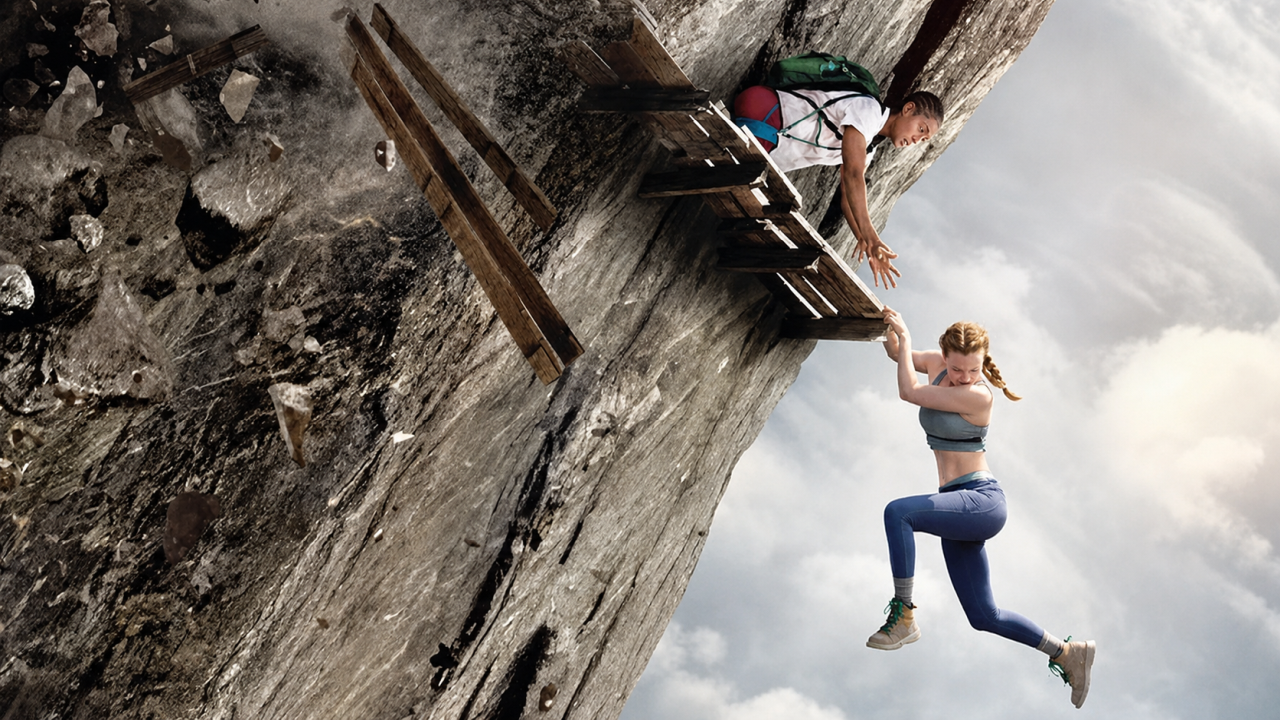
MOVIE REVIEW – 2022’s Fall turned one almost primitively simple idea into an effective survival thriller: two women climb somewhere no sane person would go without a drone, and naturally discover that getting back down is considerably more complicated. Four years later, Fall 2: Deadpoint realizes there are still a few thousand feet left in the formula, replacing the rusty TV tower with a Thai cliff face, increasing the drop and once again sending common sense on an extended vacation. Peter and Michael Spierig’s sequel works whenever it refuses to pretend it is anything more than roughly ninety-seven minutes of sweaty-palmed B-movie tension involving two women, several rotten planks, and an alarming amount of empty air beneath them. Whenever it tries to construct serious drama, character depth, and bigger twists around that precipice, however, it becomes painfully clear that the screenplay has a much weaker grip than its protagonists.
The sequel first has to solve the problem that the original Fall needed another installment about as badly as a successfully removed appendix. Scott Mann and Jonathan Frank therefore begin with Shiloh’s death and introduce her sister Jax, who still has no idea how to process the loss. Then Shiloh’s old friend Luce appears, along with the dead woman’s “Fuck-It List,” a scrapbook packed with dangerous places she wanted to conquer. Under normal circumstances this might lead to shared memories, several beers, and perhaps a therapy appointment; here it leads to plane tickets to Thailand so two amateurs can tackle Mount Kwan’s closed and notoriously dangerous route.
At least the movie seems vaguely aware that this decision is impossible to defend with normal human logic. Everyone tells them it is a terrible idea: it is the rainy season, the path has been closed, smugglers use the area, and neither woman is an experienced climber. Luce essentially responds to the entire universe that this is precisely why they should go. Anyone still surprised when something eventually goes wrong probably experienced the iceberg in Titanic as a major third-act revelation.

Grief therapy, now without guard rails
Fortunately, Jax is slightly more than a designated future victim. Harriet Slater convincingly plays someone who spent much of her life in the shadow of a braver, more reckless sister and now finds herself simultaneously mourning Shiloh and trying to understand what drove her toward one suicidal adventure after another. The climb is therefore theoretically more than a physical challenge; it is Jax’s attempt to connect with the way her sister experienced life. That is a perfectly serviceable foundation, except Mann and Frank explain it so bluntly that “FACE YOUR FEARS” might as well be painted across the mountain in twenty-foot letters.
Arsema Thomas’ Luce occupies the opposite side of that dynamic: instinctive, adventurous, and charismatic enough that, for a few minutes at least, you can almost understand why anyone might follow her up a rusty ladder over an abyss. The chemistry between the two actresses is among the movie’s stronger elements, especially once the climb removes the luxury of discussing old resentments and personal motives under civilized conditions. The larger problem is that the characters frequently behave less like people and more like functions required by the next plot twist. Whenever the screenplay needs somebody to do something stupid, rest assured that somebody soon will.

At least the mountain knows exactly what it is doing
The Spierig Brothers become much more confident filmmakers once solid ground disappears. The best sequences in Fall 2: Deadpoint require very little narrative trickery: a foot on a rotten plank, a loosening bolt, a few stones vanishing into the distance, and Andrew Strahorn’s camera knowing exactly when to look down. The POV shots are particularly effective because they do not merely show the height; they seem determined to relocate it directly into the viewer’s knees. Anyone with genuine acrophobia can probably save money on a 4DX ticket, because their autonomic nervous system will provide the special effects for free.
There are moments when it is obvious that Slater and Thomas are not genuinely clinging to the side of a Thai mountain thousands of feet in the air, and several digital backgrounds are unlikely to trouble this year’s visual-effects awards. The film nevertheless cuts intelligently between enormous wides and tiny physical details, allowing the sensation of danger to survive most cracks in the illusion. The sound design also does heavy lifting: creaking wood, groaning metal, wind, and falling debris often create more suspense than the dialogue. Some of the ADR, unfortunately, sounds so artificial that certain lines might have been recorded not on another mountain but inside a wardrobe on another continent.

The screenplay is hanging on too, just not very well
The biggest problem is that Fall 2: Deadpoint remembers its predecessor far too accurately. Once again there is loss, trauma, an ill-advised climb, isolation, dwindling options, improvised survival, and naturally several twists designed to make the audience sit back and say, “Well, I didn’t see that coming.” Sometimes we genuinely do not see them coming, although not necessarily because they were cleverly prepared, but because no reasonable person would arrive at the decisions required to make them happen. The sequel thankfully avoids repeating the original film’s cheapest dramatic trick, but it still regularly confuses invention with absurdity.
The final act also decides that thousands of feet of empty space are apparently no longer sufficiently threatening, so it introduces a more human form of danger. The intention is understandable on paper: sequel law apparently dictates that everything must become bigger, louder, and slightly more insane. Unfortunately, you cannot negotiate with a crumbling cliff or a rotten plank, whereas human villains give the audience valuable time to think about whether what they are watching makes any sense. That is not necessarily a service this screenplay should be offering.

Harriet Slater hangs onto the movie with both hands
Slater, at least, is considerably better than what the screenplay occasionally asks of her. Jax’s fear feels genuine, and she thankfully does not graduate from that familiar Hollywood survival school where an accountant becomes an elite commando in twenty minutes. Her panic, uncertainty, and gradual realization that nobody else can solve the situation for her give the character a functional arc. Thomas’ more energetic presence provides a useful counterweight, while Tom Brittney does exactly what the story requires during his more limited screen time.
This is still a very long way from deep character study. Most of the players are assembled from recognizable genre components: the frightened sister, the reckless friend, the more experienced guide, buried guilt, and secrets from the past. That alone is hardly fatal in a movie like this; ever since Jaws, we have known that a thriller does not have to become a Bergman seminar to work. It is simply that whenever Fall 2 is not literally hanging over the abyss, we are repeatedly reminded how little exists underneath it.

The vertigo works, the movie only partially does
Fall 2: Deadpoint ultimately achieves most of its effect through the same simple cinematic scam that powered its predecessor: from the absolute safety of a theater seat, we watch people make decisions that would probably get the rest of us placed under legal guardianship before reaching the foot of the mountain. The 97-to-98-minute runtime helps, the Spierigs do not linger excessively on individual situations, and whenever the movie focuses exclusively on producing unpleasant physical reactions, it is remarkably effective. Palms sweat, stomachs tighten, and occasionally you instinctively pull your feet backward even though, reassuringly, the theater floor remains exactly where it was.
That does not automatically mean a good movie has been built around the stunt. Fall 2: Deadpoint competently performs the one task most people will presumably buy a ticket for, while remaining flat as a story, sketchy as character drama, and impressively committed to testing our faith in humanity’s evolutionary success whenever another twist arrives. If you want ninety-seven minutes of feeling sick because somebody else is looking into an abyss, you will receive exactly what you ordered. If you also want strong characters, intelligent writing, or substantial thematic depth, it is probably better not to look down, but not in that direction either.
-Gergely Herpai „BadSector”-
Fall 2: Deadpoint
Direction - 5.8
Actors - 6.2
Story - 4.4
Visuals/Music/Sounds - 6.9
Ambience - 5.8
5.8
AVERAGE
Fall 2: Deadpoint genuinely works whenever it asks nothing more of us than to look down and feel terrible. The Spierig Brothers effectively exploit height, unreliable footholds, and physical vulnerability, while Harriet Slater and Arsema Thomas are convincing enough to carry the weaker material. The screenplay remains the real problem: the characters are thin, their decisions are frequently ridiculous, and the later twists raise eyebrows more reliably than pulses. As a B-movie it gets the job done; just do not expect much beyond ninety-seven minutes of making you deeply appreciate the existence of solid ground.










Leave a Reply