
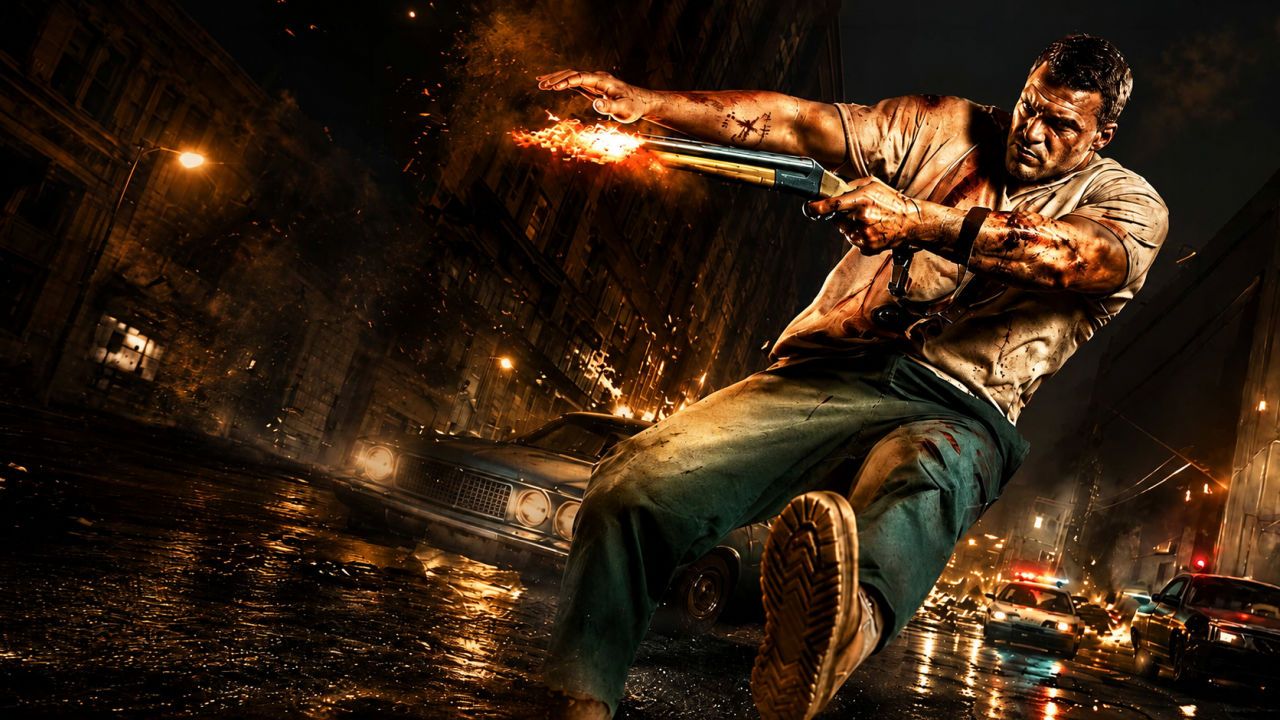
MOVIE REVIEW – In Potsy Ponciroli’s 1970s crime thriller, Alan Ritchson plays a wrongly imprisoned Detroit autoworker who returns years later to settle the score with the gangster who destroyed his life. Motor City tells this familiar revenge story with only a handful of spoken lines, leaving the narrative to Ritchson’s physical performance, carefully choreographed violence, 1970s songs, and neon-lit Detroit locations. The formal experiment is bold and occasionally highly effective, but even Ritchson’s fists cannot completely overcome the thin characters and predictable screenplay.
A mutilated corpse falls from the roof of a Detroit building and crushes a parked car, David Bowie begins to play, and Alan Ritchson is soon running through the night with a gun in his hands. Potsy Ponciroli wastes no time on a lengthy introduction. The opening minutes of Motor City establish the direction of the next 103 minutes: violence, period songs, slow motion, freeze frames, and an almost entirely dialogue-free story.
After Old Henry, the director once again attempts to reorganise a classic genre according to his own rules. This time, he combines 1970s American crime pictures, revenge thrillers, and exploitation movies into an extended and bloody musical montage. Chad St. John’s screenplay is built on the simplest possible foundations: an innocent man, a corrupt cop, a ruthless drug lord, a romantic triangle, and a revenge campaign in which everyone involved will eventually have to pay.
John Miller is an autoworker who falls in love with diner waitress Sophia. She was previously involved with gangster Reynolds, who responds by planting cocaine in John’s car and using a corrupt detective to arrange his arrest. Miller loses his freedom, Sophia, and the future they had planned together. When he leaves prison years later, he is not looking for an explanation. He is looking for Reynolds.
Ponciroli does not tell the story in chronological order. The present-day revenge campaign is interrupted by memories of the romance, the arrest, and John’s years behind bars. The structure initially withholds information effectively, although it offers few real surprises. By the time the film reveals exactly what happened, the audience has already assembled most of the story.

Five Lines Have to Tell Us Everything
The central directorial idea behind Motor City is that only a handful of lines are spoken throughout the entire running time. The characters communicate through looks, gestures, movement, editing, and songs, while much of the emotional and narrative information is delivered through John’s memories. The approach initially feels genuinely fresh. Ponciroli trusts his images and avoids interrupting scenes with explanations the audience has already understood.
The lack of dialogue does not make the film quiet. Engines, gunshots, punches, broken bones, and period songs dominate the soundtrack almost continuously. Fleetwood Mac, Bill Withers, Donna Summer, the Moody Blues, and David Bowie occupy the space usually reserved for conversation, with their lyrics frequently expressing what the characters never say aloud.
The method works best while the story remains in motion. An escape, a fight, or a carefully prepared attack has little need for lengthy conversation. During the slower and more emotional material, the absence becomes harder to ignore. When two characters stare at each other while another famous song performs the emotional work for them, the concept begins to feel less like freedom and more like a self-imposed restriction.

Alan Ritchson Handles the Silence Better Than the Supporting Cast
John Miller is a role well suited to Alan Ritchson. The character is not complicated, but the actor’s physical presence fills the screen even when he stands perfectly still. He brings the human battering ram familiar from Reacher, only this time the dry one-liners have disappeared as well. John communicates pain with a lowered head, a tightened jaw, and blows powerful enough to send somebody over a railing.
Ritchson is also convincing during the quieter moments. Humiliation and the weight of the lost years remain visible beneath the anger, while a few carefully timed expressions add more to the character than Chad St. John’s script provides. John remains a basic revenge hero, but there is at least a sense that the bodybuilder exterior belongs to someone who genuinely mourns the life taken from him.
Shailene Woodley receives considerably less help as Sophia. For much of the film, she moves through the story as an unreadable femme fatale in sunglasses, enormous fur coats, and appropriately excessive hair, while the screenplay treats her true loyalty as a mystery. By the time the answer arrives, much of the interest in her character has disappeared. Woodley occasionally suggests Sophia’s fear and uncertainty, but the writing rarely allows her to become a complete person.
Ben Foster embraces every possible excess as Reynolds. Thick gold chains, open shirts, malicious smiles, and an unforgettable wig accompany him throughout the film. Foster clearly enjoys playing the comic-book gangster, although the character lacks the dangerous unpredictability of the actor’s stronger performances. Reynolds appears louder than everyone around him despite speaking very little.
Pablo Schreiber fares better as corrupt detective Savick because the role primarily requires physical menace. His black leather coat immediately reveals which side he represents, but Schreiber gives genuine weight to the later confrontations. Ben McKenzie receives too little screen time as the more respectable Kent, while Lionel Boyce’s Youngblood and Amar Chadha-Patel’s Singh at least provide some companionship during Miller’s otherwise solitary campaign.

The Music and 1970s Detroit Give the Film Its Strength
The appearance of Motor City is easily its greatest success. Cinematographer John Matysiak and production designer Mayne Berke create a Detroit defined by rusting industrial sites, smoky clubs, filthy alleys, enormous cars, cheap motel rooms, and flickering neon. The city resembles an exaggerated cinematic memory of the decade rather than an exact historical reconstruction, but that appearance suits this revenge story.
Ponciroli relies heavily on slow motion, freeze frames, and carefully composed violence. Miller sometimes flies over a car bonnet as though arranged across a comic-book splash page, while gunshots and knife wounds become visual events in their own right. The direction crosses into indulgence more than once, yet several individual images remain more memorable than the plot developments surrounding them.
The period songs are never simple decoration. They give scenes rhythm, irony, and emotional meaning, while the film entrusts them with much of the characters’ inner lives. When the right track begins at precisely the right moment, Motor City</i achieves exactly what it intends: a simple story told as an elaborate and extremely violent music video.
The momentum weakens whenever the 1970s selections retreat and Steve Jablonsky’s synthesiser score takes over. His work is tense and functional but considerably less distinctive than the curated songs. Jack White’s Archbishop Harold Holmes provides the end credits with one final burst of energy, although the strongest scenes have already passed.

The Stairwell and Elevator Fights Are the Film’s High Point
The first half of Motor City spends a surprising amount of time preparing a story whose important developments are easy to predict. Flashbacks, romantic montages, and Reynolds’ provocations repeatedly communicate the same emotional information. At this stage, the near-total absence of dialogue feels less like a fearless cinematic decision and more like a rule Ponciroli follows even when a brief conversation might improve the scene.
Once Miller and his allies finally attack Reynolds’ organisation, the film comes alive. The blows carry weight, the knives move uncomfortably close to flesh, and the choreography remains clear despite the rapid editing. Ponciroli makes effective use of Ritchson and Schreiber’s size, presenting the fighters as heavy bodies crashing into each other rather than effortless acrobats.
The stairwell struggle between Singh and Savick is raw and exhausting, while the elevator knife fight that follows is the film’s finest sequence. Two enormous men attempt to kill each other inside a confined space, with every movement reducing the air and the possibility of escape. During these minutes, the dialogue-free concept works perfectly because speaking would serve no purpose.
The action arrives with such force that the eventual confrontation between Miller and Reynolds cannot reach the same level. An unnecessary time jump, unconvincing old-age makeup, and an ending determined to become emotional slow down the movie precisely when it should be moving at full speed. The revenge is completed, but the catharsis is much weaker than the fights leading towards it.
The Directorial Concept Is Better Than the Screenplay
Potsy Ponciroli’s undertaking deserves recognition. Telling a feature-length story almost entirely through images, music, sound effects, and physical performance requires considerable discipline. Several scenes in Motor City prove that the approach can work, while the technical crew does everything possible to make the audience feel the engines, broken bones, and unease of the city after dark.
The form cannot disguise the simplicity of the story. John, Sophia, and Reynolds are constructed from familiar revenge-movie archetypes, and the absence of conversation makes those foundations even more visible. The film attempts to combine Walter Hill’s toughness, Michael Mann’s urban melancholy, John Woo’s operatic violence, and the excess of old exploitation cinema, but never matches the power of any of those influences.
Alan Ritchson carries the film through muscle, expression, and suppressed rage, while the action provides the brutal entertainment expected by genre fans. Motor City is more interesting as a formal experiment than as a complete crime drama, but it possesses its own rhythm, visual identity, and nerve. With a stronger screenplay, Ponciroli’s concept could have travelled much further.
-Gergely Herpai “BadSector”-
Motor City
Direction - 7.2
Actors - 6.8
Story - 5.5
Visuals/Music/Sounds/ - 8.2
Hangulat - 7.3
7
GOOD
Motor City is a bold, nearly dialogue-free revenge thriller built around Alan Ritchson’s physical presence, brutal action, and a superb selection of 1970s songs. Potsy Ponciroli’s stylised direction and neon-lit Detroit setting conceal the conventional story, thin characters, and weak conclusion for much of the running time. The experiment is only partially successful, but the film’s best fights genuinely require no explanation.













Leave a Reply