
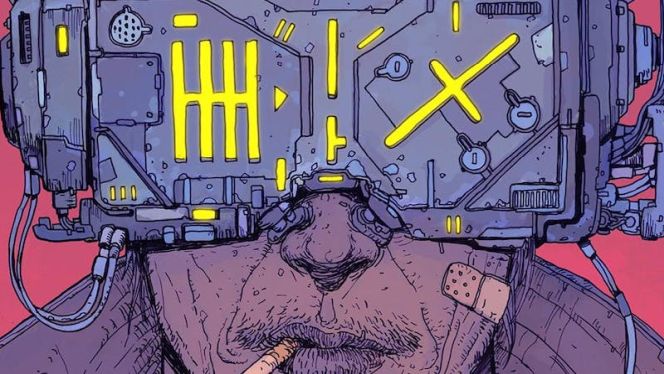
SERIES PREVIEW – William Gibson’s novel has haunted the shadow of modern science fiction for more than forty years, yet Hollywood has always circled around it rather than truly adapting it. Now Apple TV+ is taking on the impossible: Neuromancer is coming as a series, and if it works, the original cyberpunk cornerstone may finally claim the screen space that its imitators occupied long ago.
There are novels that change the world. There are novels that change fiction. And there is only one novel that has done both: Gibson’s 1984 work. Faced with that kind of legacy, it is not surprising that no one really dared to bring it to the screen for four decades. Now Apple TV+ is stepping into the field: the ten-episode adaptation is being developed by Graham Roland and JD Dillard, with Roland serving as showrunner and Dillard directing the pilot. According to current information, the premiere is expected toward the end of 2026, and anyone who has read the book understands perfectly why Hollywood has dodged this material for forty years like someone walking through a minefield.

Cyberspace Was Invented On A Typewriter From The 1930s
In 1981, William Gibson was sitting in a Vancouver apartment, working on a manual Hermes 2000 typewriter. It was a Swiss machine from the 1930s, given to him by his wife’s journalist stepfather. The thing was heavy, clumsy, without a screen, without a hard drive and without anything remotely futuristic about it. Gibson first used the word “cyberspace” in a short story published in Omni in 1982, then refined it while writing Neuromancer. It is worth stopping for a moment at that image: the founding father of cyberspace wrote the foundational text of the digital future on a machine where not even Ctrl-Z could save him from a bad sentence.
Ace Books published Neuromancer directly as a paperback in July 1984, with little promotion and probably no real sense that something in science fiction was about to shift for good. The story of Case, the burned-out hacker, and Molly Millions, the street samurai with mirror eyes, first spread through fanzines, specialized fan circles and word of mouth before the world fully understood what had landed in its hands. The following year, the novel achieved something no debut novel has repeated since: it won the Hugo, the Nebula and the Philip K. Dick Award in the same year. That is the triple crown of Anglo-Saxon science fiction, and Gibson’s first novel claimed a historical position with its first strike.
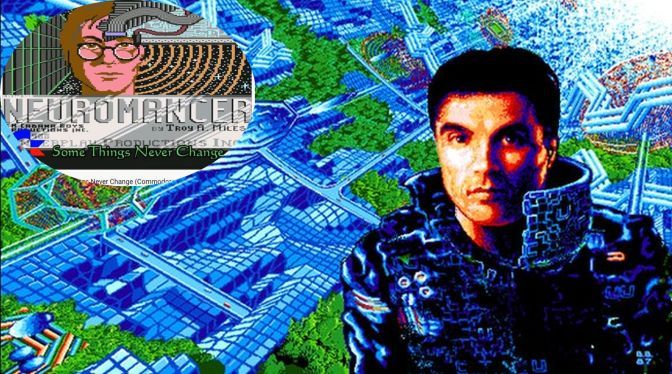
Forty-One Years Of Hollywood Circling The Original
What happened next remains one of the strangest cases in recent pop culture history. The foundational cyberpunk novel became an almost inexhaustible source of concepts, images and atmosphere. AKIRA read it closely. Blade Runner owes it a great deal. Ghost in the Shell is practically a manga-shaped homage to it. The Matrix turned the basic structure of jacking in into a universal pop myth. Cyberpunk 2077 and Edgerunners built Night City on the outlines of Gibson’s Sprawl, while Altered Carbon borrowed the noir-corporate hybrid with little subtlety. The list is long, and the conclusion is obvious enough: an entire industry spent forty years copying Neuromancer while avoiding a direct adaptation of Neuromancer itself.
The question is obvious: why? The technical explanations are understandable. The novel is atmospheric, fragmented and packed with jargon invented by Gibson to name a digital world that nobody had seen in 1984. Its best scenes often take place inside characters’ heads, in drug-distorted hallucinations or in the abstract network of cyberspace. These are hard to film without falling into the cheap visual tricks of the nineties or accidentally looking like a Matrix clone. Several directors came close to the material over the decades, including Vincenzo Natali, Joseph Kahn and Tim Miller, but all of them eventually stepped away from it.
It is also undeniable that the foundational works of a genre often reach worthy adaptations later than the works that feed on them. Stoker’s Dracula waited decades for a truly worthy screen version while Nosferatu triumphed in 1922, and Tolkien’s Middle-earth was considered unfilmable for forty years. The film industry now has tools that did not exist in 1984, so the question may no longer be whether Neuromancer is unadaptable. It may be whether the industry felt more comfortable with substitutes, however good they were, than with the original.
Apple TV+ May Be The First Place Where This Really Has A Chance
Apple TV+ has built a serious science-fiction catalog in only a few years, and few streaming platforms can currently rival it. Foundation, long considered unadaptable, has lasted three seasons and has tried to bring Asimov’s massive world to the screen. Silo proved that tense, audience-building, serious science fiction can work, while Severance showed that viewers can be grateful when a series twists their brains into knots. Murderbot, For All Mankind and Dark Matter strengthen that picture even further. Apple TV+ no longer has to prove to shareholders that it can produce adult science fiction, and that may give it the room to take on a risk as large as Neuromancer.
The series has a strong creative setup and cast behind it. Graham Roland, who comes from the worlds of Jack Ryan and Lost, is serving as showrunner. JD Dillard is directing the pilot, and he is exactly the kind of established but still rising filmmaker that Apple TV+ seems willing to trust with this sort of undertaking. His first feature, Sleight, followed by Sweetheart and Devotion, showed a filmmaker with a voice of his own, while he has also worked around larger franchises, including Star Wars. The cast includes Callum Turner as Case, Briana Middleton as Molly, with Mark Strong, Clémence Poésy, Peter Sarsgaard and Emma Laird also among the names attached.
The most important element may still be that Gibson himself is part of the creative team. Not merely as a consultant, and not as a courtesy credit, but as an executive producer. At the same time, he has spoken with surprising honesty on his own social media about how the process works. He said he does not have veto power: the showrunner and the director do, because the adaptation is their creation, not his. A novel is a solitary creation, while an adaptation is fundamentally collaborative, so first of all it is not going to “be the book.” That kind of openness, in an industry addicted to promotional fog, is encouraging in itself.

The Shadow Of The Peripheral Still Hangs Over The Whole Project
Some fans are still understandably nervous. In 2022, Prime Video premiered The Peripheral, an adaptation of another Gibson novel, produced by the Westworld team and starring Chloë Grace Moretz. The series was ambitious, visually bold, narratively dense and aimed at the kind of attentive audience that might have been enough to sustain it in another era. It was not a failure in the simple sense of the word. Prime Video still canceled it after a single season, leaving the story on a cliffhanger that will now never be resolved. That is a shame, because it really was a strong series, but there is no point fooling ourselves: it was a financial decision, one where the retention curve did not show what the platform wanted to see.
The consequence of that cancellation is that Neuromancer arrives with both moderate expectations and very little room for error. If the series works, it could open the way for Gibson’s full Sprawl saga, meaning Neuromancer, Count Zero and Mona Lisa Overdrive could finally find an audiovisual home. If it stumbles, streaming platforms may spend another decade avoiding an author whose adaptations have so far accumulated more disappointments than successes. Apple TV+ is in a particularly interesting position here: it already has the science-fiction prestige, but with Neuromancer it is not merely adding another series to its catalog. It is trying to pay off a debt owed by an entire genre.

Neuromancer’s Future Has Already Arrived, And That Is The Biggest Problem
There is an uncomfortable idea here: the most accurate predictions about the future are often not written by those already living inside it, but by those who observe it from the outside with enough distance. Gibson did not write Neuromancer because there was a modem on his desk. He could write it precisely because there was not. He could imagine cyberspace without being weighed down by reality’s burdens, speeds, flaws and banalities. The paradox of science-fiction writing is that too close a contact with technology can sometimes damage the imagination. That does not mean Gibson wrote blindly. He knew the technology; he simply did not yet know the practical limits of its applications.
In my view, that is what the Apple TV+ series must understand if it wants to avoid crashing hard. The replicants in Do Androids Dream of Electric Sheep?, the basis for Blade Runner, are fascinating not because Philip K. Dick accurately foresaw what artificial intelligence would be, but because in 1968 he did not know what the process of making them would look like. Adapting Gibson in 2026 does not mean copying Chiba City with drones, neon lights and blockbuster post-production. It means recreating the outsider’s perspective that saw the future before living inside it. That is the hardest task, because from the point of view of the time when Neuromancer was written, the future has long since arrived.
If Dillard and Roland get this cyber-future right, as many of Gibson’s heirs have done in their own ways, Neuromancer could become the definitive cyberpunk adaptation and the moment when the genre finally gives something back to the man it owes so much. If they fail, it will be another expensive attempt that few people will remember in five years. The stakes are not small: a historical debt can slowly lose its meaning because the world it presents no longer looks like a coming nightmare, but like the prehistory of our own reality. Gibson has said for decades that the future is already here, just not evenly distributed. Neuromancer can only be properly adapted in 2026 from the perspective from which it was written, not from the one in which we already live.
-Herpai Gergely „BadSector”-
Source: 3DJuegos







Leave a Reply